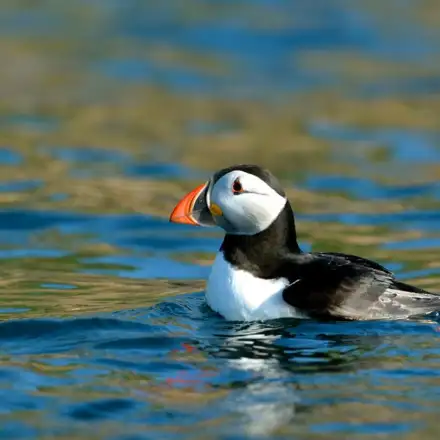
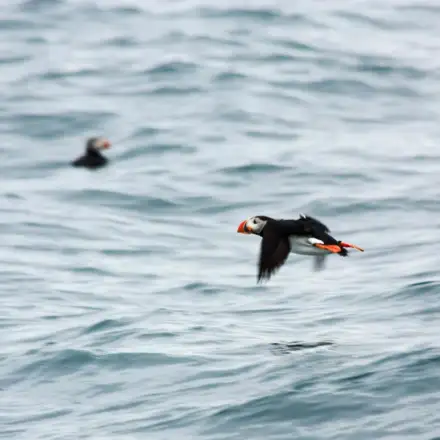
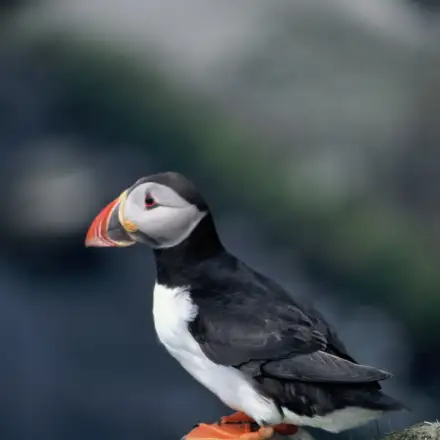
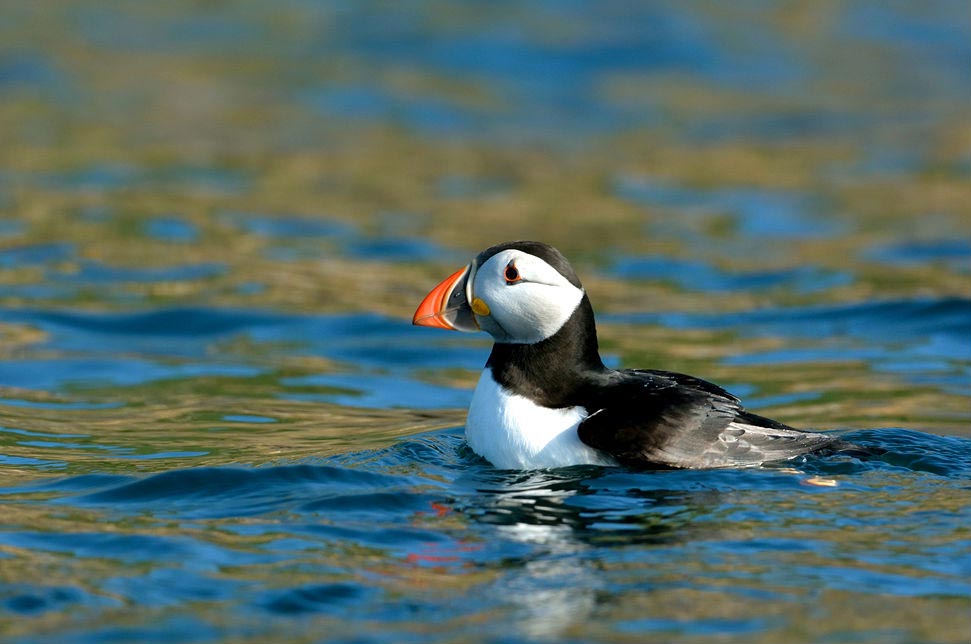
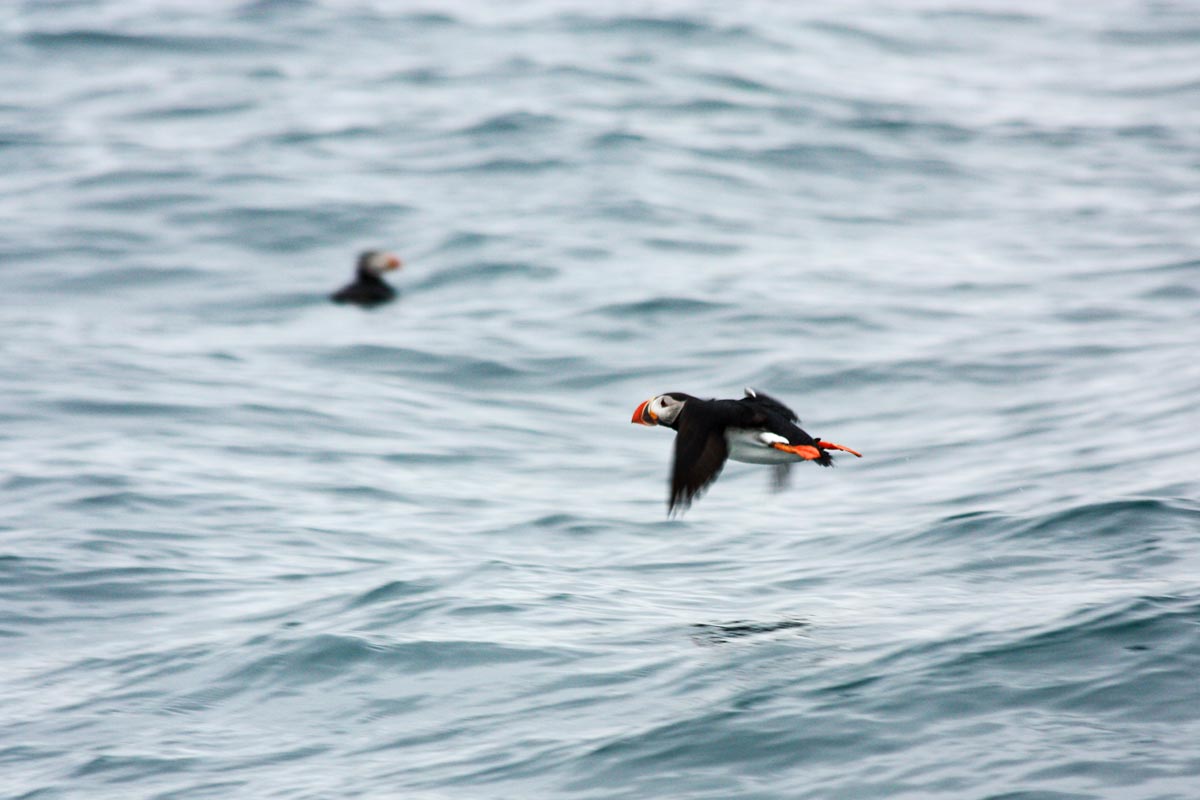
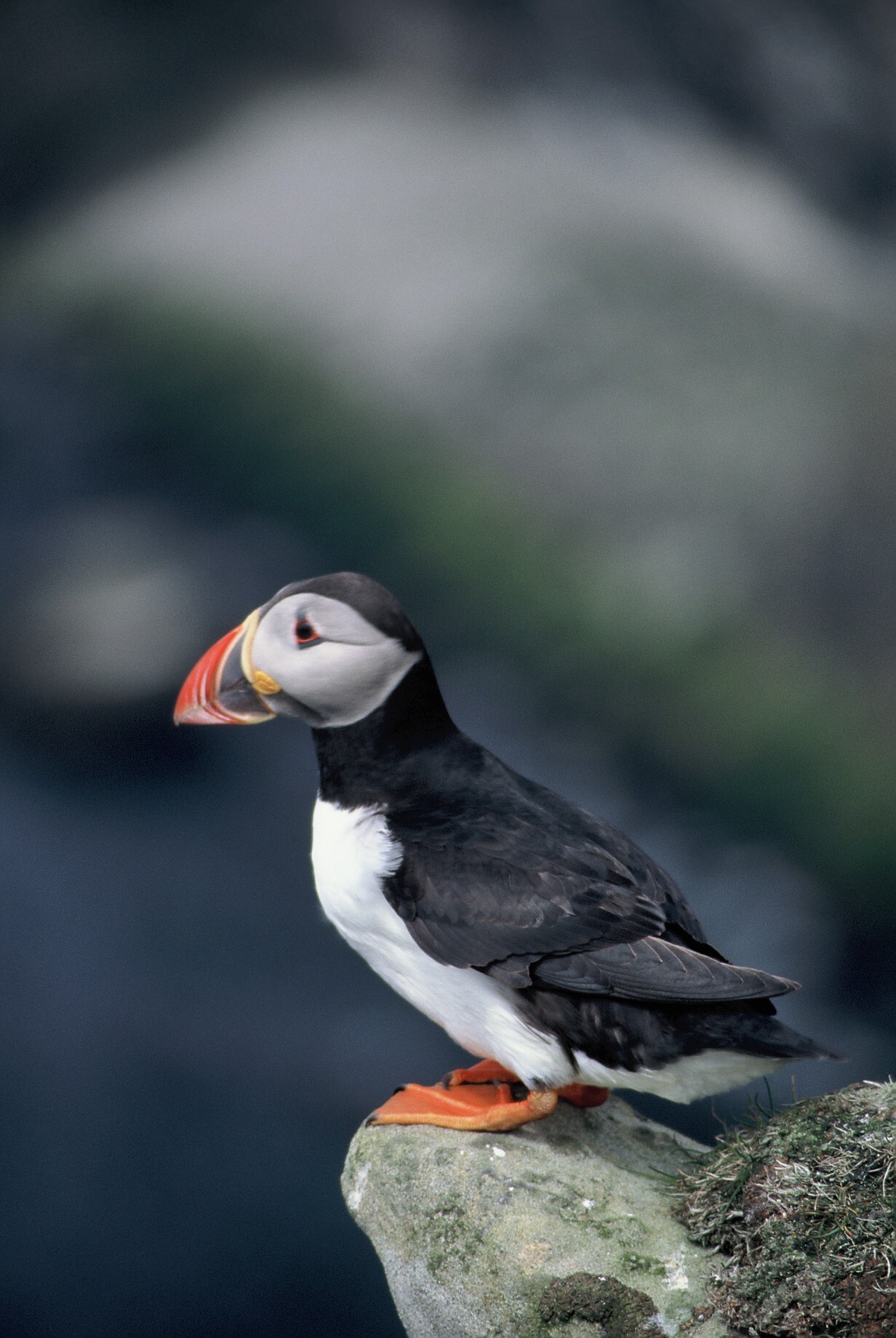
Atlantic Puffin
Scientific name: Fratercula arctica
Family alcidae
Phenology
- Mainland
- Wintering and passage migrant
- Madeira
- Wintering and passage migrant
- Azores
- Wintering and passage migrant
Conservation status
Learn more- Mainland
- Madeira
- Azores
- IUCN Global
Data
Maps
Distribution | Breeding
Scale
Minimum value:
Maximum value:
Scale
Minimum value:
Maximum value:
Scale
Minimum value:
Maximum value:
Scale
Minimum value:>
Maximum value:<
Scale
Minimum value:
Maximum value:
Scale
Minimum value:>
Maximum value:>
Distribution based on seabird tracking data (locations/hexagone).
Colony(ies) of origin:
Device:
Data period / number of individuals:
Data period / number of individuals:
Distribution of seabird breeding colonies or sites (number of breeding pairs).
Distribution based on marine censuses (probability of occurrence).
Observed density based on marine censuses (birds/ km2).
Confirmed occurence during marines censuses.
Abundance of waders derived from Project Arenaria coastal surveys (birds/square).
Passage rates derived from RAM coastal surveys (birds/hour).
No data available for the selected period.
Presentation
Distribution, movements and phenology
The Atlantic Puffin is a species found mainly in the North Atlantic, which, outside the breeding season, disperses to pelagic environments (Guilford et al. 2011). The Moroccan coast and the western Mediterranean represent the southern limit of its range (Billerman et al. 2026). In Portugal, it occurs as a winter visitor and a passage migrant, being present mainly between October and early April (Catry et al. 2010a). Based on data from 129 birds fitted with GLS devices between 2008 and 2023 in various colonies across northern Europe, there was extensive use of the Portuguese EEZ, with records throughout all months of the year. Most sightings were concentrated in the Mainland sub-area, particularly in the areas furthest from the coast in the centre and north of the region. Significant concentrations of the species were also recorded north-east of Madeira and north-west of the Azores, with these areas likely marking the southern limit of the species’ distribution during the wintering period (Fayet et al. 2017).
Abundance and population trends
The global population has been estimated at 12 to 14 million mature individuals, with 70% to 95% of this population concentrated in Europe (BirdLife International 2025). Iceland and Norway, which host around 80% of the European population, have recorded sharp declines since the early 2000s, with frequent breeding failures and iconic colonies in collapse. As the species has a predominantly oceanic distribution during the wintering period, there are no recent or historical estimates of the number of birds occurring in Portugal; however, based on the data used for the environmental status assessment, it is estimated that there are thousands of birds, at least on the Mainland. A pattern corroborated by stranding events involving several thousand birds that have occurred recently in the country (Oliveira et al. 2023c).
Despite some variation in abundance figures for the continental shelf, this population has not achieved Good Environmental Status for the respective indicator. In the case of Madeira and the Azores, there is no information regarding population trends, thus preventing an assessment of their environmental status.
Ecology and habitat
It nests on grassy coastal slopes, cliffs and rocky slopes, digging its nests into the ground. During the winter, it has a wide distribution and is found in distinctly pelagic habitats; its distribution may depend on oceanic productivity and the movements of schools of small pelagic fish (Harris et al. 2010). During the wintering period, its diet includes small fish, crustaceans and cephalopods (Falk et al. 1992), although there is no information regarding its diet in Portugal.
Threats and conservation
The species is highly vulnerable to climate change, particularly to rising sea surface temperatures, which affect the availability, distribution and quality of prey, leading to frequent breeding failures (Durant et al. 2003; Sandvik et al. 2005). Extreme weather events also cause mass mortalities (Costa et al. 2026). These impacts are exacerbated by overfishing, invasive predators in colonies, human disturbance, marine pollution (including oil spills and plastics) and, potentially, by the expansion of offshore infrastructure (BirdLife International 2025). Monitoring of stranding events, measures to minimise bycatch in fishing nets, and oil spill prevention and response plans are potentially important for the conservation of the species in Portugal.
- Autores
Kurt K. Burnham, Tânia Nascimento
- Owners/sources of tracking data
Burnham et al. 2021, Fayet et al. 2017, Fayet & Guilford 2014, Hansen & Thorarinsson 2014a, Hansen & Thorarinsson 2014b, Hansen & Thorarinsson 2014c, Jessopp 2013, Jessopp 2021
Sandvik H, Erikstad KE, Barrett RT & Yoccoz NG (2005). The effect of climate on adult survival in five species of North Atlantic seabirds. Journal of Animal Ecology 74(5): 817-831. Bibliography:
Oliveira N, Varanda IC, Harris MP, Almeida A, Alonso H, Bouça A, Ferreira M, Georg M, Lopes J, Sequeira M, Hilário F & Andrade J (2023c). Caracterização do arrojamento massivo de papagaio-do-mar no inverno de 2022-23 em Portugal Continental. Sociedade Portuguesa para o Estudo das Aves, Lisboa (unpublished report). Bibliography:
Harris MP, Daunt F, Newell M, Phillips RA & Wanless S (2010). Wintering areas of adult Atlantic puffins Fratercula arctica from a North Sea colony as revealed by geolocation technology. Marine Biology 157(4): 827-836. Bibliography:
Guilford T, Freeman R, Boyle D, Dean B, Kirk H, Phillips R & Perrins C (2011). A Dispersive Migration in the Atlantic Puffin and its Implications for Migratory Navigation. PLoS ONE 6(7): e21336 Bibliography:
Fayet AL, Freeman R, Anker-Nilssen T, Diamond A, Erikstad KE, Fifield D, Fitzsimmons MG, Hansen ES, Harris MP, Jessopp M, Kouwenberg AL, Kress S, Mowat S, Perrins CM, Petersen A, Petersen IK, Reiertsen TK, Robertson GJ, Shannon P, Sigurðsson IA, Shoji A, Wanless S & Guilford T (2017). Ocean-wide drivers of migration strategies and their influence on population breeding performance in a declining seabird. Current Biology 27: 3871-3878.e3. Bibliography:
Falk K, Jensen JK & Kampp K (1992). Winter diet of Atlantic Puffins (Fratercula arctica) in the northeast Atlantic. Colonial Waterbirds 15: 230–235. Bibliography:
Durant J, Anker-Nilssen T & Stenseth NC (2003). Trophic interactions under climate fluctuations: the Atlantic puffin as an example. Proceedings of the Royal Society of London Series B 270: 1461-1466. Bibliography:
Costa RA, Tavares AS, Hilário FV, Vaqueiro J, Ferreira M, Sá S, Monteiro SS, Torres-Pereira A & Eira C (2026). Atlantic Puffin Fratercula arctica mortality along the Portuguese west coast in early 2023. Marine Ornithology 54(2): 21–28. Bibliography:
BirdLife International (2025). IUCN Red List for birds. Downloaded from https://datazone.birdlife.org on 30.11.2025. Bibliography:
Billerman SM, Keeney BL, Kirwan GM, Medrano F, Sly ND & Smith MG (eds.) (2026). Birds of the World. Cornell Laboratory of Ornithology, Ithaca, NY, USA. Bibliography:
Catry P, Costa H, Elias G & Matias R (2010a). Aves de Portugal, Ornitologia do Território Continental. Assírio e Alvim, Lisboa Data:
Fayet AL, Freeman R, Anker-Nilssen T, Diamond A, Erikstad KE, Fifield D, Fitzsimmons MG, Hansen ES, Harris MP, Jessopp M, Kouwenberg AL, Kress S, Mowat S, Perrins CM, Petersen A, Petersen IK, Reiertsen TK, Robertson GJ, Shannon P, Sigurðsson IA, Shoji A, Wanless S & Guilford T (2017). Ocean-wide drivers of migration strategies and their influence on population breeding performance in a declining seabird. Current Biology 27(24): 3871-3878. Data:
Jessopp M (2021). Dataset 1926: Atlantic Puffin, Fratercula arctica, Geolocator (GLS), Skellig Michael, Kerry, Ireland, 2010–2021. BirdLife International Seabird Tracking Database. Downloaded from https://data.seabirdtracking.org/dataset/1926/ on 30.11.2025. Data:
Jessopp M (2013). Dataset 1048: Atlantic Puffin, Fratercula arctica, Geolocator (GLS), Skellig Michael, Kerry, Ireland, 2010–2013. BirdLife International Seabird Tracking Database. Downloaded from https://data.seabirdtracking.org/dataset/1048/ on 30.11.2025. Data:
Hansen ES & Thorarinsson TL (2014c). Dataset 1072: Atlantic Puffin, Fratercula arctica, Geolocator (GLS), Papey, Iceland, Iceland, 2013–2014. BirdLife International Seabird Tracking Database. Downloaded from https://data.seabirdtracking.org/dataset/1072/ on 30.11.2025. Data:
Hansen ES & Thorarinsson TL (2014b). Dataset 1074: Atlantic Puffin, Fratercula arctica, Geolocator (GLS), Heimaey, Iceland, Iceland, 2013–2014. BirdLife International Seabird Tracking Database. Downloaded from https://data.seabirdtracking.org/dataset/1074/ on 30.11.2025. Data:
Hansen ES & Thorarinsson TL (2014a). Dataset 1073: Atlantic Puffin, Fratercula arctica, Geolocator (GLS), Grimsey, Iceland, Iceland, 2013–2014. BirdLife International Seabird Tracking Database. Downloaded from https://data.seabirdtracking.org/dataset/1073/ on 30.11.2025. Data:
Fayet A & Guilford T (2014). Dataset 1124: Atlantic Puffin, Fratercula arctica, Geolocator (GLS), Skomer, Wales, United Kingdom, 2007–2014. BirdLife International Seabird Tracking Database. Downloaded from https://data.seabirdtracking.org/dataset/1124/ on 30.11.2025. Data:
Burnham KK, Burnham JL, Johnson JA & Huffman A (2021). Data from: Migratory movements of Atlantic puffins Fratercula arctica naumanni from High Arctic Greenland. Movebank Data Repository. Downloaded from https://www.doi.org/10.5441/001/1.nr8qv005. Glossary:
Individuals capable of breeding, used as a reference in population estimates. Glossary:
A group of marine arthropods that are important in the marine food chain. Glossary:
A group of marine molluscs that includes squids, cuttlefish and octopuses. Glossary:
Persistent changes in global or regional climate patterns, influenced by natural and anthropogenic factors. Glossary:
A species or parameter that reflects the state of an ecosystem or environmental changes. Glossary:
A concept defined under the Marine Strategy Framework Directive (MSFD), referring to the condition of the elements of the marine environment, including birds. It aims to assess whether ecosystems are healthy, balanced and capable of supporting ecological functions and human uses in a sustainable manner. The ultimate goal is for the components and ecosystems to achieve Good Environmental Status. Glossary:
Refers to the unintentional capture of marine species during fishing. Animals may become entangled in hooks or fishing nets. It is usually associated with commercial fishing, but can also occur in recreational fishing. Bycatch is one of the main threats to seabirds at sea. Glossary:
Under the United Nations Convention on the Law of the Sea, coastal states are entitled to declare an EEZ comprising maritime area beyond their territorial waters. The national EEZ is delimited by an imaginary line situated 200 nautical miles from the coast, separating national waters from international or shared waters. Within its EEZ, each state has rights such as the exploitation of marine resources, the conduct of scientific research and the regulation of fishing by foreign vessels. Glossary:
A form of fishing in which fish stocks (or populations) are exploited to levels that are biologically and ecologically unsustainable. Overfishing of certain key species, such as sharks, can lead to the collapse of marine ecosystems. Glossary:
Quantity of organic matter produced per unit of time (usually one year). Primary productivity refers to the quantity of organic matter produced by primary producers: algae in aquatic or marine environments, or plants in terrestrial environments. Glossary:
The portion of the seabed that begins at the coastline and slopes gently downwards to the continental slope (where the slope is much steeper). On average, the continental shelf extends to a depth of 200 metres. Glossary:
The area or environment where organisms that do not depend on the seafloor normally live. It is the typical ecological environment of open ocean waters. The pelagic ecosystem does not include only the open sea; it also comprises the waters covering the continental shelf. The pelagic zone begins below the influence of tides and extends into the open ocean, at depths ranging from a few tens of metres to approximately 6,000 metres, and is divided into different layers. Glossary:
A period generally corresponding to the winter months, which may include part of autumn. Glossary:
A small device attached to birds to study their large-scale movements (usually migration), which works by recording light intensity (from which the duration of night and the local midday time are estimated, and consequently the latitude and longitude on each day). Glossary:
A dead or moribund animal that is brought ashore by the action of winds and ocean currents.