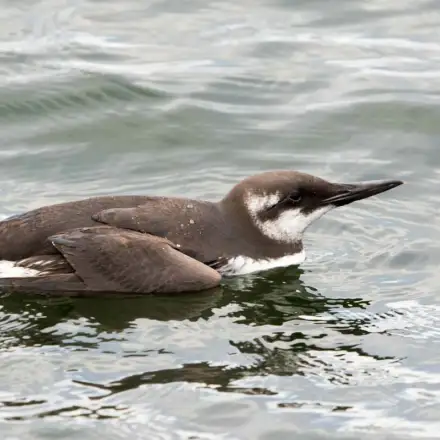
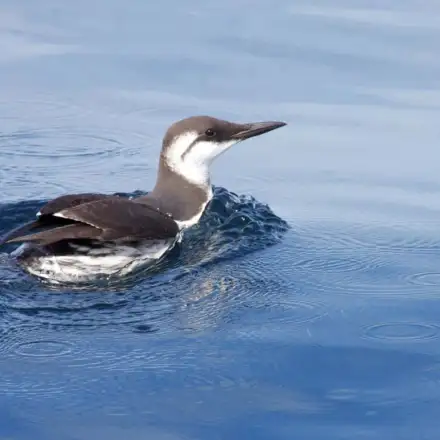
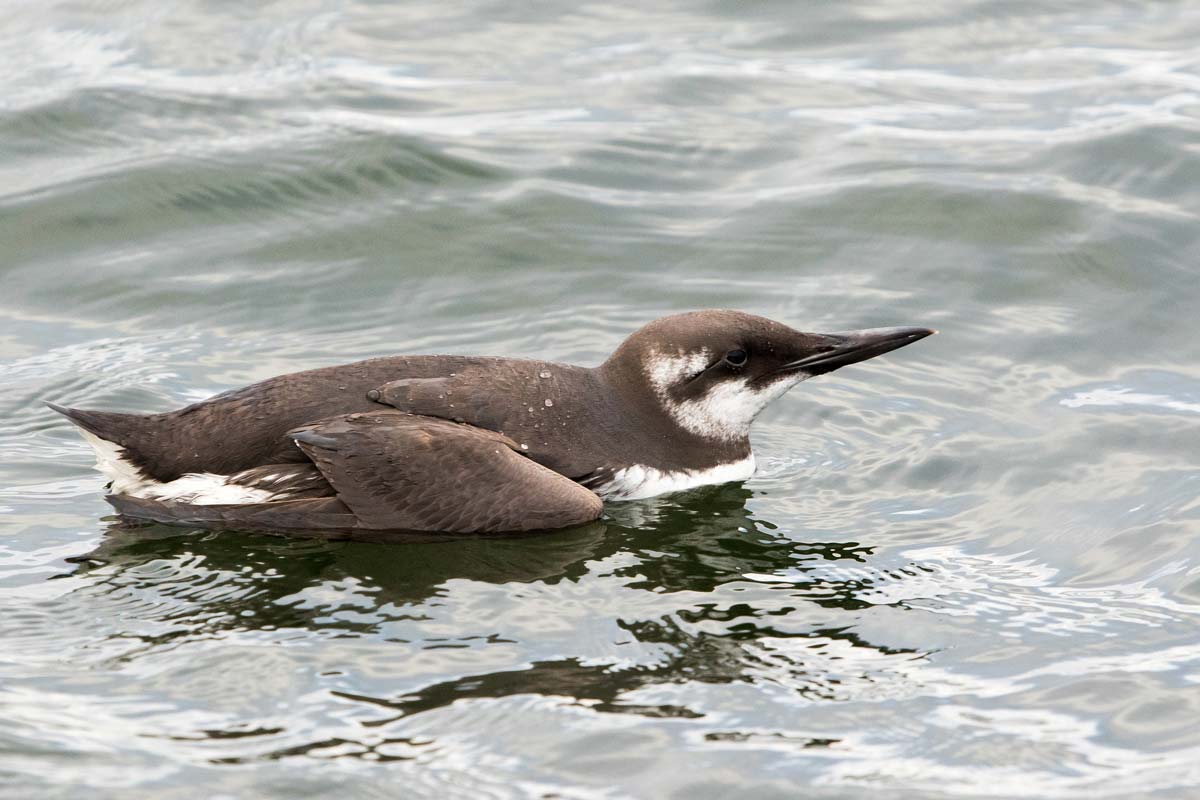
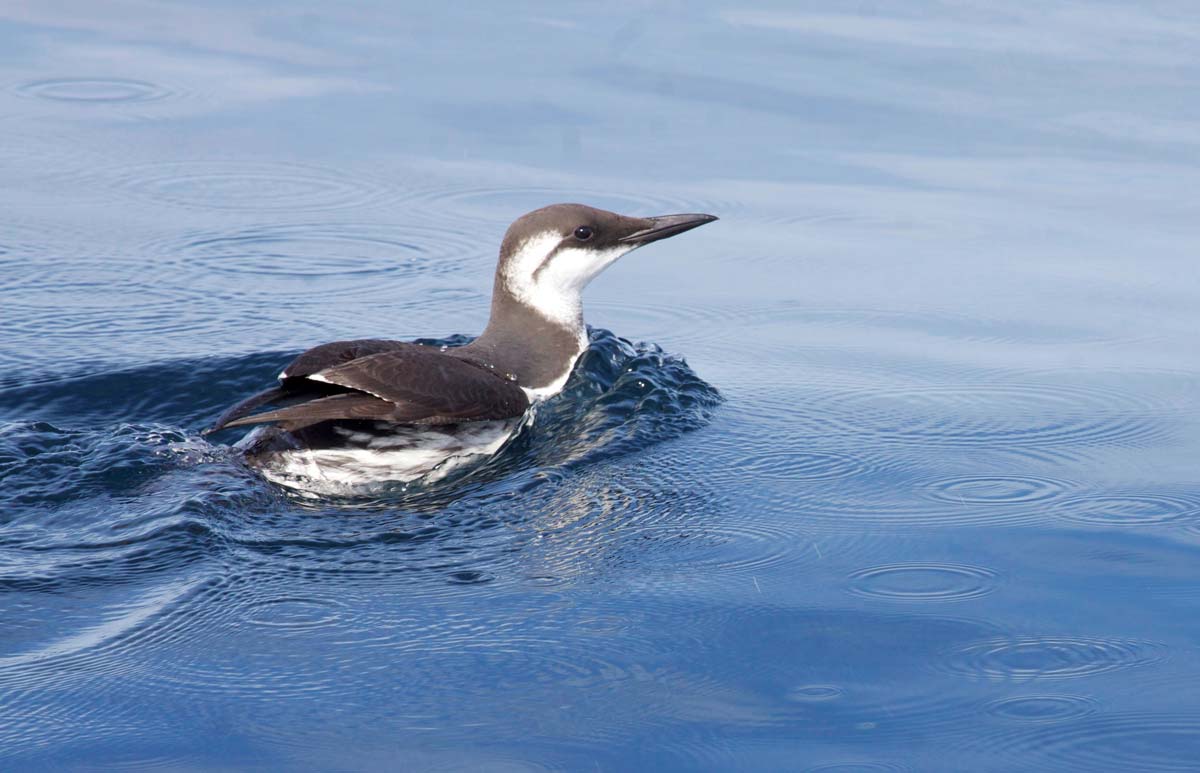
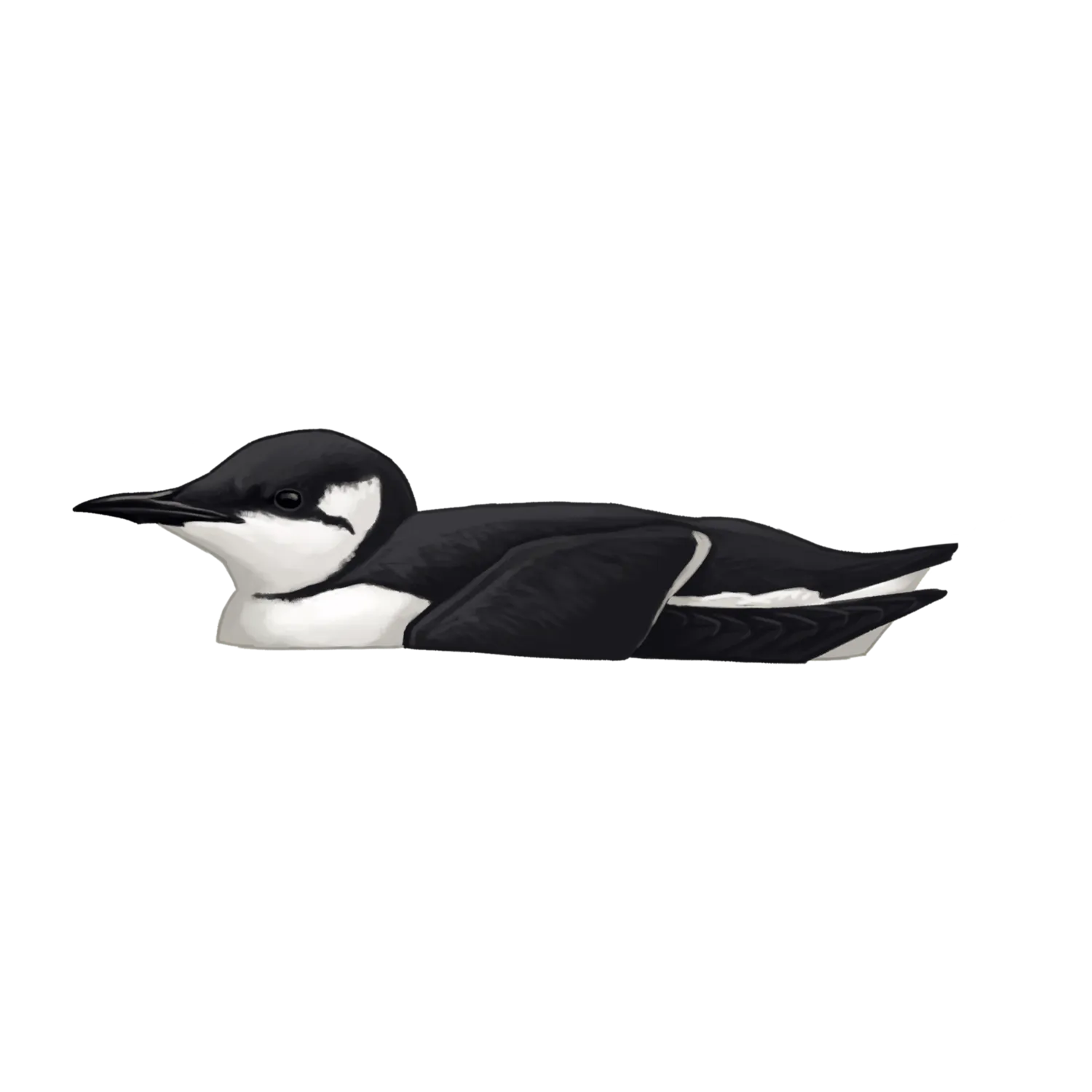
Common Murre
Scientific name: Uria aalge
Family alcidae
Phenology
- Mainland
- Summer breeder and wintering
- Madeira
- Vagrant
- Azores
- Vagrant
Conservation status
Learn more- Mainland
- Breeding population Wintering population
- Madeira
- Azores
- IUCN Global
Data
Maps
Distribution | Breeding
Scale
Minimum value:
Maximum value:
Scale
Minimum value:
Maximum value:
Scale
Minimum value:
Maximum value:
Scale
Minimum value:>
Maximum value:<
Scale
Minimum value:
Maximum value:
Scale
Minimum value:>
Maximum value:>
Distribution based on seabird tracking data (locations/hexagone).
Colony(ies) of origin:
Device:
Data period / number of individuals:
Data period / number of individuals:
Distribution of seabird breeding colonies or sites (number of breeding pairs).
Distribution based on marine censuses (probability of occurrence).
Observed density based on marine censuses (birds/ km2).
Confirmed occurence during marines censuses.
Abundance of waders derived from Project Arenaria coastal surveys (birds/square).
Passage rates derived from RAM coastal surveys (birds/hour).
No data available for the selected period.
Presentation
Distribution, movements and phenology
The Common Murre has a circumpolar distribution, occurring in the North Atlantic and the North Pacific (Billerman et al. 2026).
In Mainland Portugal, the species once bred and was common in the Berlengas archipelago, but now occurs only as a wintering species, mostly originating from British and Irish colonies (Teixeira 1983; Silva & Canto e Castro 1992). Its presence is most regular between November and early spring, although the region marks the southern limit of its wintering range. It has a predominantly coastal distribution and may occasionally be observed near beaches, headlands and sheltered areas. In Mainland Portugal, it is more common in the central and northern regions, although it may occur along the entire coast (Meirinho et al. 2014). The species was not recorded in past marine censuses conducted in the Azores and Madeira. Available data on individual tracking of the species are very limited. The five birds fitted with GLS in 2013 and 2014, originating from colonies in Iceland, indicate use of the Portuguese EEZ between April and October, with some locations in the Azores sub-area and occasional records along the coast of Madeira and Mainland Portugal.
Abundance and population trends
The global population is on an upward trend and has been estimated at over 18,000,000 birds, with the European population ranging between 2,350,000 and 3,060,000 mature individuals (BirdLife International 2025).
The Portuguese colonies of this species corresponded to the southern limit of its breeding range, having previously had a wider distribution as a breeding bird. However, the population suffered a sharp decline, becoming progressively restricted to a single colony in the Berlengas archipelago, which in 1939 was estimated to comprise around 6,000 pairs (Lockley 1952). This population fell dramatically to 320 adults in 1977 and 70 pairs in 1981 (Teixeira 1983), with the last record of breeding occurring in 2002 (Lecoq 2003). There is no up-to-date information on the abundance or population trends of the wintering population in the Portuguese EEZ, and it has not been possible to assess its environmental status.
Ecology and habitat
The species’ distribution is restricted to shallow areas of the continental shelf, and it is rarely observed from land in Portugal. During storms, however, individuals may be sighted taking refuge in harbours or within tidal inlets. It feeds mainly in shallow waters (between 50 and 100 m). It seeks out productive areas such as rocky or sandy bottoms, thermal fronts, schools of prey and areas with strong currents (BirdLife International 2025). In the Iberian Peninsula, its diet may include sardines, anchovies and sand eels (Martínez-Abraín et al. 2023).
Threats and conservation
The sharp decline of the Common Murre in the Iberian Peninsula occurred in the second half of the 20th century, as a result of the introduction of synthetic gillnets and high mortality from bycatch (Munilla et al. 2007), whilst a reduction in the stocks of its main prey cannot be ruled out (Martínez-Abraín et al. 2023). Overfishing may have direct impacts on European populations of the species by compromising food availability (BirdLife International 2025). The Common Murre is also particularly vulnerable to oil spills, which cause very high mortality rates (Munilla et al. 2011), as well as to climate change, due to its sensitivity to variations in sea surface temperature (BirdLife International 2025). The priority conservation measure includes minimising bycatch.
- Autor
Tânia Nascimento
- Owners/sources of tracking data
Teixeira AM (1983). Seabirds breeding at the Berlengas, forty-two years after Lockley’s visit. Ibis 125: 417-420. Bibliography:
Silva MA & Canto e Castro MF (1992). Recuperação de anilhas entre 1989 e 1991. Airo 3 (3): 90-120. Bibliography:
Munilla I, Díez C & Velando A (2007). Are edge bird populations doomed to extinction? A retrospective analysis of the common guillemot collapse in Iberia. Biological Conservation 137: 359-371. Bibliography:
Munilla I, Arcos JM, Oro D, Álvarez D, Leyenda PM & Velando A (2011). Mass mortality of seabirds in the aftermath of the Prestige oil spill. Ecosphere 2(7): 1-14. Bibliography:
Meirinho A, Barros N, Oliveira N, Catry P, Lecoq M, Paiva V, Geraldes P, Granadeiro JP, Ramírez I & Andrade J (2014). Atlas das Aves Marinhas de Portugal. Sociedade Portuguesa para o Estudo das Aves. Bibliography:
Martínez-Abraín A, Tomillo PS, Mouriño J, Rodríguez-Silvar J & Bermejo A (2023). Predator-prey collapses at the edge of predator distribution: the case of clupeids and common guillemots (Uria aalge) in NW Iberia. Scientia Marina 87(1): e053-e053. Bibliography:
Lockley RM (1952). Notes on the birds of the islands of the Berlengas (Portugal), the Desertas and Baixo (Madeira) and the Salvages. Ibis 94(1): 144-157. Bibliography:
Lecoq M (2003). Censo das Populações de Aves Marinhas Nidificantes no Arquipélago da Berlenga em 2002: Calonectris diomedea, Phalacrocorax aristotelis e Uria aalge. Relatório II (Final): Censo da População em 2002. SPEA, Lisboa. Bibliography:
BirdLife International (2025). IUCN Red List for birds. Downloaded from https://datazone.birdlife.org on 30.11.2025. Bibliography:
Billerman SM, Keeney BL, Kirwan GM, Medrano F, Sly ND & Smith MG (eds.) (2026). Birds of the World. Cornell Laboratory of Ornithology, Ithaca, NY, USA. Data:
Thorarinsson TL & Kolbeinsson Y (2014c). Dataset 1071: Common Murre, Uria aalge, Geolocator (GLS), Latrabjarg, Iceland, Iceland, 2013–2014. BirdLife International Seabird Tracking Database. Downloaded from https://data.seabirdtracking.org/dataset/1071/ on 30.11.2025. Glossary:
A rocky, steep and prominent geographical area that projects into the sea, often forming a cape. Glossary:
The southernmost extent of a species’ range. Glossary:
Individuals capable of breeding, used as a reference in population estimates. Glossary:
Persistent changes in global or regional climate patterns, influenced by natural and anthropogenic factors. Glossary:
Standardised bird counts carried out at sea to estimate abundance and distribution. Glossary:
Monitoring the movements of individuals using tracking devices. Glossary:
The direction of change in the size of a population over time (increase, decline or stability). Glossary:
A concept defined under the Marine Strategy Framework Directive (MSFD), referring to the condition of the elements of the marine environment, including birds. It aims to assess whether ecosystems are healthy, balanced and capable of supporting ecological functions and human uses in a sustainable manner. The ultimate goal is for the components and ecosystems to achieve Good Environmental Status. Glossary:
Refers to the unintentional capture of marine species during fishing. Animals may become entangled in hooks or fishing nets. It is usually associated with commercial fishing, but can also occur in recreational fishing. Bycatch is one of the main threats to seabirds at sea. Glossary:
A term used in fisheries science referring to a population unit of fish (or shellfish) that is commercially exploited, belonging to the same species, within a given geographical area, and harvested by a specific fishery. Glossary:
Under the United Nations Convention on the Law of the Sea, coastal states are entitled to declare an EEZ comprising maritime area beyond their territorial waters. The national EEZ is delimited by an imaginary line situated 200 nautical miles from the coast, separating national waters from international or shared waters. Within its EEZ, each state has rights such as the exploitation of marine resources, the conduct of scientific research and the regulation of fishing by foreign vessels. Glossary:
A form of fishing in which fish stocks (or populations) are exploited to levels that are biologically and ecologically unsustainable. Overfishing of certain key species, such as sharks, can lead to the collapse of marine ecosystems. Glossary:
A static net, often nearly invisible and with variable mesh size, used to catch a wide variety of fish. It is set in the sea at varying depths and later retrieved. It is a non-selective fishing gear that frequently catches seabirds, marine mammals and reptiles. Glossary:
The portion of the seabed that begins at the coastline and slopes gently downwards to the continental slope (where the slope is much steeper). On average, the continental shelf extends to a depth of 200 metres. Glossary:
A period generally corresponding to the winter months, which may include part of autumn. Glossary:
A small device attached to birds to study their large-scale movements (usually migration), which works by recording light intensity (from which the duration of night and the local midday time are estimated, and consequently the latitude and longitude on each day). Glossary:
A generic common name given to various species of bony fish of the genus Ammodytes. Glossary:
A small bony fish of the family Engraulidae, whose scientific name is Engraulis encrasicolus, also known as the European anchovy.