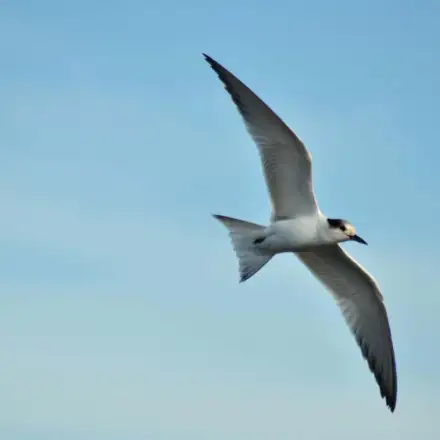
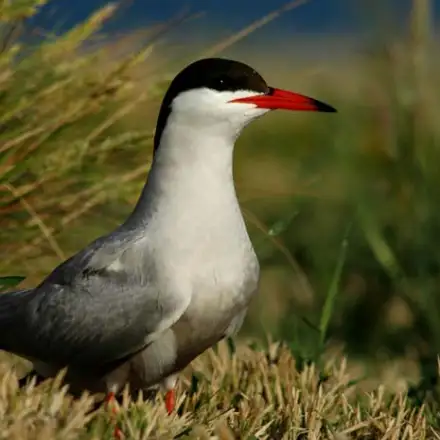
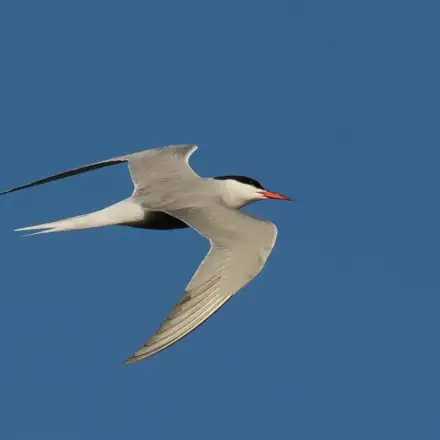
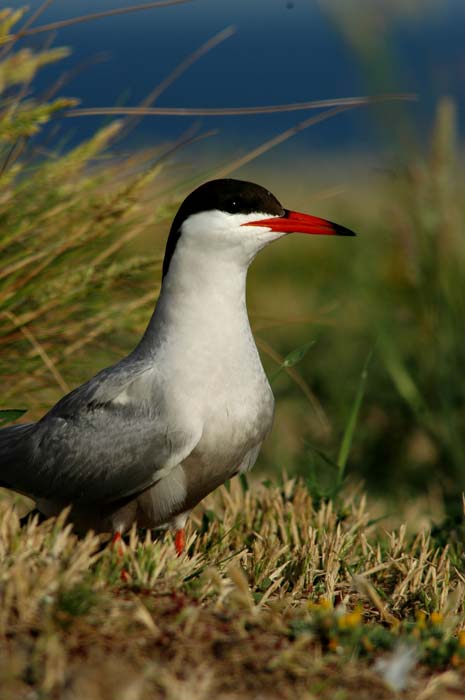
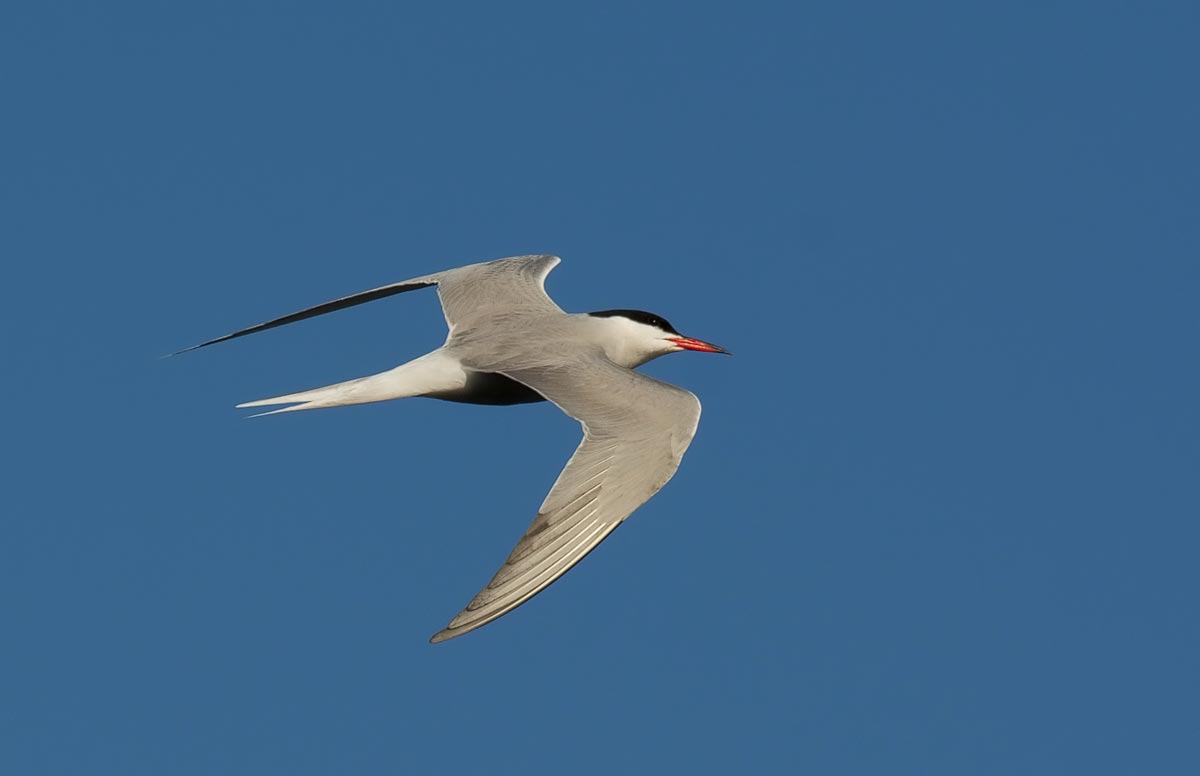
Common Tern
Scientific name: Sterna hirundo
Family laridae
Phenology
- Mainland
- Summer breeder and passage migrant
- Madeira
- Summer breeder and passage migrant
- Azores
- Summer breeder
Conservation status
Learn more- Mainland
- Madeira
- Azores
- IUCN Global

Data
Maps
Distribution | Breeding
Scale
Minimum value:
Maximum value:
Scale
Minimum value:
Maximum value:
Scale
Minimum value:
Maximum value:
Scale
Minimum value:>
Maximum value:<
Scale
Minimum value:
Maximum value:
Scale
Minimum value:>
Maximum value:>
Distribution based on seabird tracking data (locations/hexagone).
Colony(ies) of origin:
Device:
Data period / number of individuals:
Data period / number of individuals:
Distribution of seabird breeding colonies or sites (number of breeding pairs).
Distribution based on marine censuses (probability of occurrence).
Observed density based on marine censuses (birds/ km2).
Confirmed occurence during marines censuses.
Abundance of waders derived from Project Arenaria coastal surveys (birds/square).
Passage rates derived from RAM coastal surveys (birds/hour).
No data available for the selected period.
Presentation
Distribution, movements and phenology
The Common Tern has a circumpolar distribution, breeding across most of Europe, Asia and North America. It winters along the coasts of South America, Africa, the Arabian Peninsula, India, Southeast Asia and Australia (Billerman et al. 2026).
In Portugal, it breeds between April and August in the Azores and Madeira. It also breeds, albeit rarely, on the Mainland, where it is more commonly seen as a passage migrant (Equipa Atlas 2022). Pre-breeding migration takes place in April and post-breeding migration from August to October, involving mainly birds from the British Isles, the North Sea and Scandinavia (Catry et al. 2010a). The Azorean populations winter mainly in South America (Neves et al. 2002; Neves et al. 2015), whilst populations from central and northern Europe prefer the African coast (Billerman et al. 2026).
Data from 10 birds fitted with GLS in 2009 and 2012 in the Azores, Germany and Sweden show that the birds used Mainland and Madeiran waters mainly during pre- and post-breeding migrations. In the Azores, however, occurrences were concentrated during the breeding season in the area surrounding the breeding colony, located in the central group of the archipelago.
Abundance and population trends
The global population has been estimated at between 1,600,000 and 3,600,000 individuals, of which 316,000 to 605,000 pairs breed in Europe, with an unknown trend (BirdLife International 2025).
The Azores are home to the largest breeding population in Portugal. It breeds on all the islands and has a population of 2,419 to 3,411 pairs, with considerable annual fluctuations. In the Madeira region, estimates do not exceed 1,000 pairs. On the Mainland, it nests sporadically and in small numbers (Equipa Atlas 2022). In this region, the migratory population is more significant, with a total of 700 birds recorded during the post-breeding migration in 2015, observed from Cape Carvoeiro (Elmberg et al. 2020).
The assessment of environmental status shows that the Azorean population has achieved Good Environmental Status for the abundance indicator. Regarding the situation on the Mainland and in Madeira, the existing abundance data do not allow for an assessment of the status of these populations.
Ecology and habitat
The Common Tern feeds mainly on small mesopelagic fish (Granadeiro et al. 2002), preferably in calm waters and relatively sheltered bays (Monticelli et al. 2006). On Mainland Portugal, nesting sites are found in estuaries, salt pans and fish farms (Elias & Leitão 1992), whilst in the Azores and Madeira, colonies are generally located on coastal cliffs and islets (Equipa Atlas 2022).
Threats and conservation
The main threats include human disturbance in the areas surrounding the colonies (Monteiro et al. 1996a) and predation, both by native species such as starlings (Neves et al. 2011b) and by introduced mammals (Amaral et al. 2010). The eradication of introduced mammals is a key conservation priority to ensure the viability of breeding populations (Bried et al. 2009b; Amaral et al. 2010).
- Autores
Tânia Nascimento, Sissel Sjöberg
- Owners/sources of tracking data
Alerstam et al. 2025, Gonzalez-Solis & Becker 2011, Neves et al. 2015
Neves VC, Panagiotakopoulos S & Ratcliffe N (2011b). Predation on roseate tern eggs by European starlings in the Azores. Arquipelago - Life and Marine Sciences 28: 15-23. Bibliography:
Neves VC, Nava CP, Cormons M, Bremer E, Castresana G, Lima P, Junior SMA, Phillips RA, Magalhães MC & Santos RS (2015). Migration routes and non-breeding areas of Common Terns (Sterna hirundo) from the Azores. Emu 115: 158–167. Bibliography:
Neves VC, Bremer RE & Hays H (2002). Recovery in Punta Rasa, Argentina of Common Terns banded in the Azores Archipelago, North Atlantic. Waterbirds 25: 459–461. Bibliography:
Monticelli D, Ramos JA & Pereira J (2006). Habitat use and foraging success of roseate and common terns in flocks in the Azores. Ardeola 53(2): 293-306. Bibliography:
Monteiro LR, Ramos JA, Furness RW (1996a). Past and present status and conservation of the seabirds breeding in the Azores Archipelago. Biological Conservation 78: 319–328. Bibliography:
Granadeiro JP, Monteiro LR , Silva MC & Furness RW (2002). Diet of common terns in the Azores, Northeast Atlantic. Waterbirds 25: 149-155. Bibliography:
Equipa Atlas (2022). III Atlas das Aves Nidificantes de Portugal (2016-2021). SPEA, ICNF, LabOr/UÉ, IFCN. Portugal. Bibliography:
Elmberg J, Hirschfeld E, Cardoso H & Hessel R (2020). Seabird migration at Cabo Carvoeiro (Peniche, Portugal) in autumn 2015. Marine Ornithology 48: 231-244. Bibliography:
Elias G & Leitão D (1992). A nidificação da Andorinha-do-mar-comum Sterna hirundo em Portugal Continental. Airo 3 (3): 86-88. Bibliography:
Bried J, Magalhães M & Neves V (2009b). Aspectos da Ornitologia Marinha nos Açores. Boletim do Núcleo Cultural da Horta 18: 61-83. Bibliography:
BirdLife International (2025). IUCN Red List for birds. Downloaded from https://datazone.birdlife.org on 30.11.2025. Bibliography:
Billerman SM, Keeney BL, Kirwan GM, Medrano F, Sly ND & Smith MG (eds.) (2026). Birds of the World. Cornell Laboratory of Ornithology, Ithaca, NY, USA. Bibliography:
Amaral JJS, Almeida S, Sequeira M & Neves VC (2010). Black rat Rattus rattus eradication by trapping allows recovery of breeding roseate tern Sterna dougallii and common tern S. hirundo populations on Feno Islet, the Azores, Portugal. Conservation Evidence 7: 16-20. Bibliography:
Catry P, Costa H, Elias G & Matias R (2010a). Aves de Portugal, Ornitologia do Território Continental. Assírio e Alvim, Lisboa Data:
Neves V, Nava C, Cormons M, Bremen E, Castresana G, Lima P, Junior S, Phillips R, Magalhaes M & Santos RS (2015). Migration routes and non-breeding areas of Common Terns (Sterna hirundo) from the Azores. Emu 115:158–67. Data:
Gonzalez-Solis J & Becker PH (2011). Dataset 985: Common Tern, Sterna hirundo, Geolocator (GLS), Lake Bant, Wilhelmshaven, Germany, 2009–2011. BirdLife International Seabird Tracking Database. Downloaded from https://data.seabirdtracking.org/dataset/985/ on 30.11.2025. Data:
Alerstam T, Bäckman J, Grönroos J, Olofsson P, Strandberg R & Sjöberg S (2025). Migration of black terns Chlidonias niger and common terns Sterna hirundo between south Sweden and the Atlantic coast of Africa. Journal of Avian Biology 2025: e03348. Glossary:
Complete removal of an invasive species from a specific area. Glossary:
A species or parameter that reflects the state of an ecosystem or environmental changes. Glossary:
The direction of change in the size of a population over time (increase, decline or stability). Glossary:
A concept defined under the Marine Strategy Framework Directive (MSFD), referring to the condition of the elements of the marine environment, including birds. It aims to assess whether ecosystems are healthy, balanced and capable of supporting ecological functions and human uses in a sustainable manner. The ultimate goal is for the components and ecosystems to achieve Good Environmental Status. Glossary:
Referring to the period preceding breeding. Glossary:
Referring to the period following breeding. Glossary:
A marine organism living in the water column generally between 200 and 1,000 metres in depth. Glossary:
A small device attached to birds to study their large-scale movements (usually migration), which works by recording light intensity (from which the duration of night and the local midday time are estimated, and consequently the latitude and longitude on each day). Glossary:
A term generally applied to a species introduced deliberately or accidentally into a specific location or region outside its original range. Depending on its adaptation to the new environment, an introduced species may or may not become naturalised and proliferate.