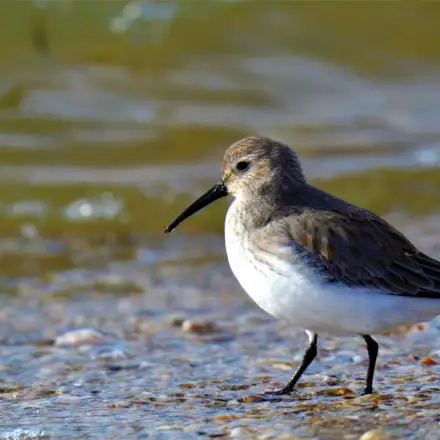
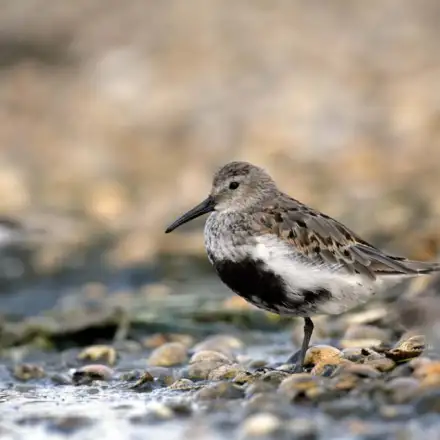
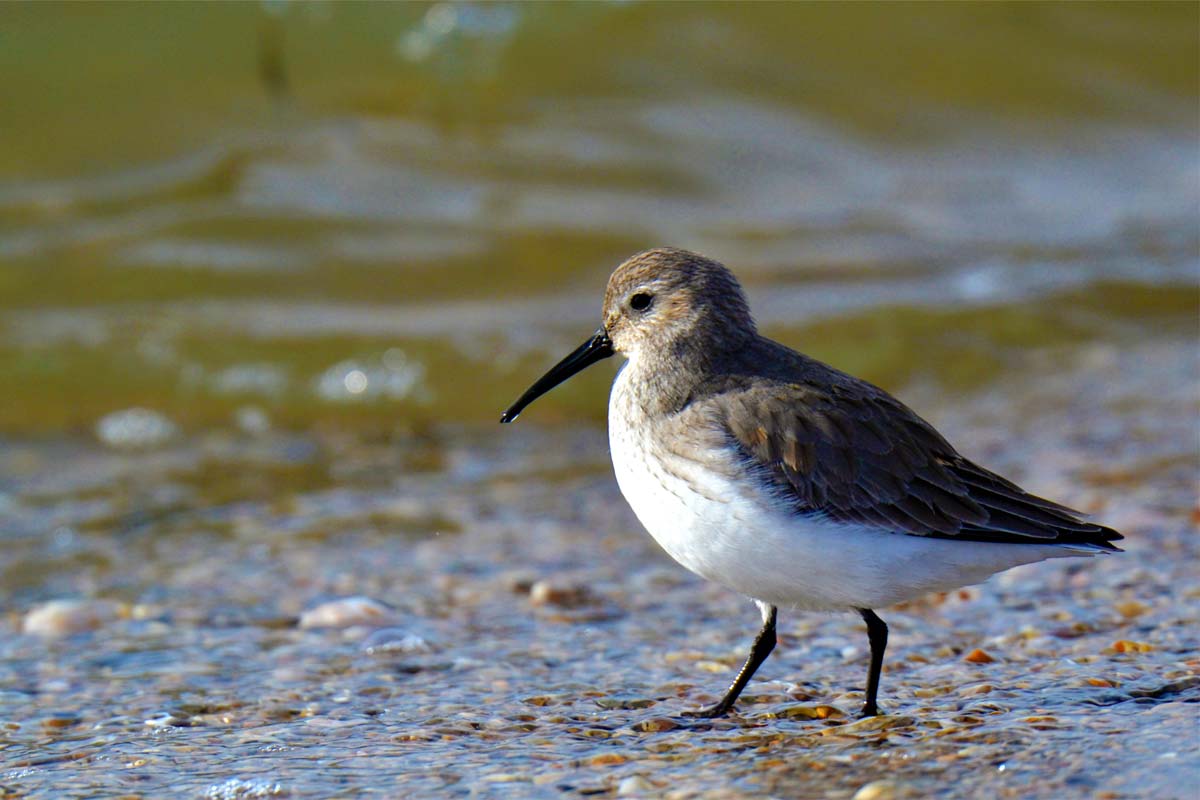
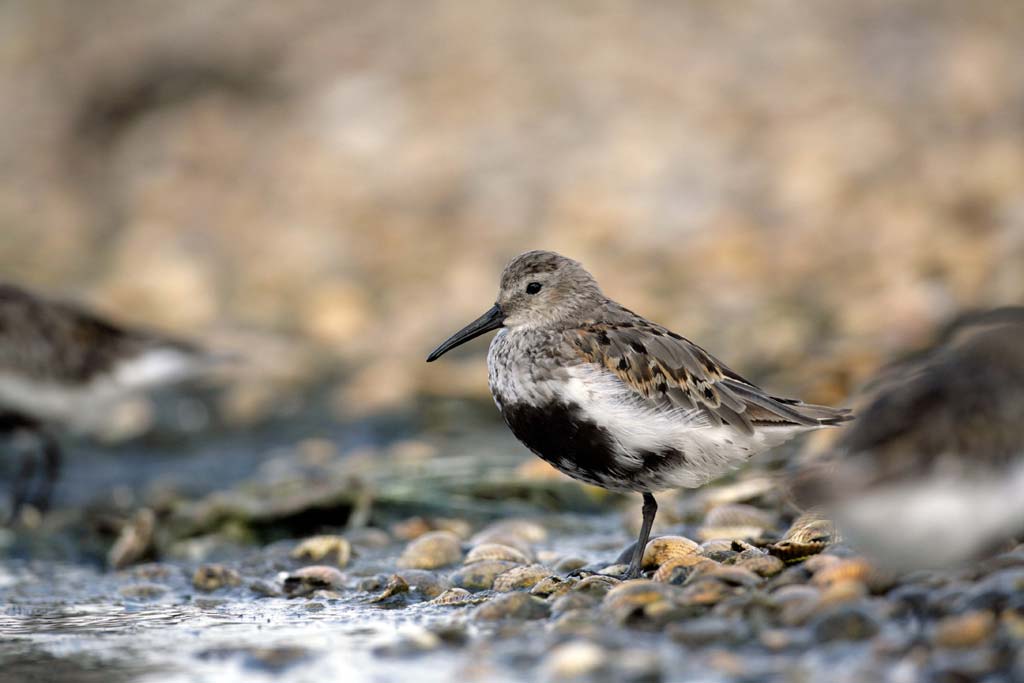
Dunlin
Scientific name: Calidris alpina
Family scolopacidae
Phenology
- Mainland
- Wintering and passage migrant
- Madeira
- Passage migrant
- Azores
- Passage migrant
Conservation status
Learn more- Mainland
- Madeira
- Azores
- IUCN Global
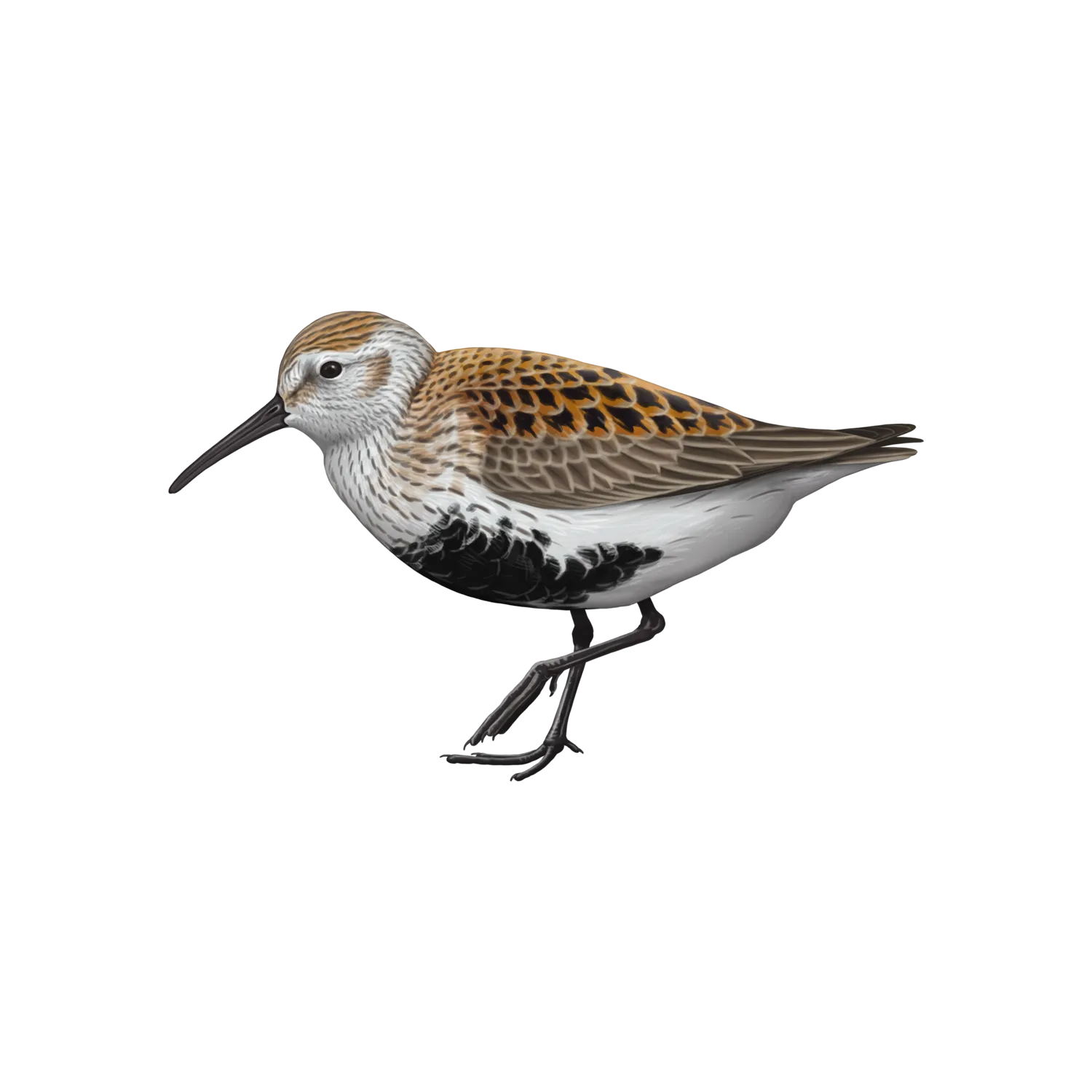
Data
Presentation
Distribution, movements and phenology
The Dunlin breeds between May and July in the Arctic and in subarctic and cold temperate regions of Eurasia and North America. It subsequently migrates to temperate and tropical areas of the Northern Hemisphere (Billerman et al. 2026).
In Portugal, wintering birds originate mainly from Scandinavia and Russia, including a small proportion from the Baltic region and the United Kingdom (Delany et al. 2009). Temporarily, they are joined by birds passing through on migrations towards the north-west African coast, mostly originating from colonies in Iceland (Catry et al. 2010a; Lopes et al. 2006). The species occurs mainly in estuarine areas on the Mainland, notably in the Tagus and Sado estuaries, the Ria Formosa and the Ria de Aveiro, and is also a regular visitor to the Mondego and Guadiana estuaries. It is less common in coastal lagoons, in some reservoirs in the Alentejo interior and on the non-estuarine coast (Lecoq et al 2013; Equipa Atlas 2018). In the Azores and Madeira, it occurs only sporadically, due to their distance from the main migratory route used and the limited availability of suitable habitat on the islands.
Abundance and population trends
The global population has been estimated at between three and seven million mature individuals, with a declining trend (BirdLife International 2025). In Portugal, over 90% of the wintering population is concentrated in the Tagus and Sado estuaries, Ria Formosa and Ria de Aveiro, totalling around 40,000 birds in the early 2010s (Equipa Atlas 2018). The small proportion that uses the non-estuarine coast represents only 1% of this population (Lecoq et al 2013). Despite the increasing trend observed in Europe (Wetlands International 2025), in Portugal the species appears to be in decline in the Tagus and Sado estuaries and in the Ria Formosa, where 70 to 80% of the national population occurs (Catry et al. 2011b; Alonso et al. 2022; Belo et al. 2023; Araújo 2025), alongside a negative trend on the non-estuarine coast (Velde 2025); the species has consequently failed to achieve Good Environmental Status for the abundance indicator on the Mainland. In the Azores and Madeira, the species occurs in very small numbers (Equipa Atlas 2018). Nevertheless, the Azores population has not achieved Good Environmental Status, unlike the Madeira population.
Ecology and habitat
The Dunlin is the most common wader in the estuaries and other coastal wetlands of Mainland Portugal. It makes very little use of the non-estuarine coast, visiting the beaches adjacent to coastal lagoons and estuaries sporadically. It also actively uses salt pans and flooded agricultural fields. It feeds on small invertebrates, mainly bivalves, annelids, insect larvae, amphipods and polychaetes (Lopes et al. 1998; Lourenço 2019; Billerman et al. 2026).
Threats and conservation
The causes of the global population decline are unknown (BirdLife International 2025). At a national level, the decline in populations may stem from local factors, or from changes in their migratory and wintering areas (Catry et al. 2011b), potentially shared along the East Atlantic Flyway (Lourenço et al. 2018; Schekkerman et al. 2018; Belo et al. 2023). The degradation of some wintering areas and the potential for infrastructure development in these areas constitute significant threats, with the potential to reduce the quality of foraging areas (Catry et al. 2021). Climate change may also cause waders to shift their wintering grounds to latitudes closer to their breeding grounds, contributing to a decline in populations in more southerly regions (Rehfisch et al. 2004).
- Autor
Nuno Oliveira
Wetlands International (2025). Waterbird Population Estimates. Downloaded from http://wpe.wetlands.org on 30.11.2025. Bibliography:
Velde PMV (2025). Analysis of population trends of overwintering coastal birds in continental Portugal in relation to habitat type. Tese de Mestrado em Biologia Marinha. Faculdade de Ciências e Tecnologia. Universidade do Algarve. Bibliography:
Schekkerman H, Fall KG, Nagy S & van Roomen M (2018). Patterns in trends of waterbird populations using the coastal East Atlantic Flyway, update 2017. In van Roomen M, Nagy S, Citegetse G & Schekkerman H (eds.). East Atlantic Flyway Assessment 2017: the status of coastal waterbird populations and their sites. Wadden Sea Flyway Initiative p/a CWSS, Wilhelmshaven, Germany, Wetlands International, Wageningen, The Netherlands, BirdLife International, Cambridge, United Kingdom. Bibliography:
Rehfisch MM, Austin GE, Freeman SN, Armitage MJS & Burton NHK (2004). The possible impact of climate change on the future distributions and numbers of waders on Britain’s non-estuarine coast. Ibis 146: 70–81. Bibliography:
Lourenço PM, Alonso H, Alves JA, Carvalho AT, Catry T, Costa H, Costa JS, Dias MP, Encarnação V, Fernandes P, Leal AI, Martins RC, Moniz F, Pardal S, Rocha A & Santos CD (2018). Monitoring waterbird populations in the Tejo estuary, Portugal: report for the decade 2007-2016. Airo 25: 3-3. Bibliography:
Lourenço PM (2019). Internet photography forums as sources of avian dietary data: bird diets in Continental Portugal. Airo 26:3-26. Bibliography:
Lopes RJ, Marques JC & Wennerberg L (2006). Migratory connectivity and temporal segregation of dunlin (Calidris alpina) in Portugal: evidence from morphology, ringing recoveries and mtDNA. Journal of Ornithology, 147(2), 385-394. Bibliography:
Lopes RJ, Cabral JA, Múrias T & Marques JC (1998). Contribuição para o conhecimento da dieta de Pilrito-comum Calidris alpina e da Tarambola-cinzenta Pluvialis squatarola no estuário do Mondego. Airo 9: 27–32. Bibliography:
Lecoq M, Lourenço PM, Catry P, Andrade J & Granadeiro JP (2013). Wintering waders on the Portuguese mainland non-estuarine coast: results of the 2009-2011 survey. Wader Study Group Bulletin 120: 66-70. Bibliography:
Equipa Atlas (2018). Atlas das Aves Invernantes e Migradoras de Portugal 2011-2013. Sociedade Portuguesa para o Estudo das Aves, LabOr- Laboratório de Ornitologia – ICAAM - Universidade de Évora, Instituto da Conservação da Natureza e das Florestas, Instituto das Florestas e Conservação da Natureza (Madeira), Secretaria Regional da Energia, Ambiente e Turismo (Açores) e Associação Portuguesa de Anilhadores de Aves. Lisboa. Bibliography:
Delany S, Dodman T, Stroud D & Scott D (2009). An atlas of wader population in Africa and western Eurasia. Wetlands International, Wageningen. Bibliography:
Catry T, Ventura F, Dias MP, Santos CD, Martins RC, Palmeirim JM & Granadeiro JP (2021). Estimating the conservation cost of the projected new international Lisbon airport for migratory shorebirds of the Tagus estuary, Portugal. Bird Conservation International 32(2): 232-245. Bibliography:
Catry T, Alves JA, Andrade J, Costa H, Dias MP, Fernandes P, Leal A,Lourenço PM, Martins RC, Moniz F, Pardal S, Rocha A, Santos CD, Encarnação V & Granadeiro JP (2011b). Long-term declines of wader populations at the Tagus estuary, Portugal: a response to global or local factors? Bird Conservation International 21: 438-453. Bibliography:
BirdLife International (2025). IUCN Red List for birds. Downloaded from https://datazone.birdlife.org on 30.11.2025. Bibliography:
Billerman SM, Keeney BL, Kirwan GM, Medrano F, Sly ND & Smith MG (eds.) (2026). Birds of the World. Cornell Laboratory of Ornithology, Ithaca, NY, USA. Bibliography:
Belo JR, Dias MP, Jara J, Almeida A, Morais F, Silva C, Valadeiro J & Alves JA (2023). Synchronous declines of wintering waders and high-tide roost area in a temperate estuary: Results of a 10-year monitoring programme. Waterbirds 45(2): 141-149. Bibliography:
Araújo AMP (2025). Long term changes in the Ria Formosa’s intertidal system: has the tide changed beyond repair? Tese de Mestrado em Biologia Marinha, Pescas e Conservação. Faculdade de Ciências e Tecnologia. Universidade do Algarve. Bibliography:
Alonso H, Andrade J, Teodósio J & Lopes A (coord.) (2022). O estado das aves em Portugal, 2022. 2ª edição. Sociedade Portuguesa para o Estudo das Aves, Lisboa. Bibliography:
Catry P, Costa H, Elias G & Matias R (2010a). Aves de Portugal, Ornitologia do Território Continental. Assírio e Alvim, Lisboa Glossary:
Individuals capable of breeding, used as a reference in population estimates. Glossary:
Molluscs with two shells, such as clams and cockles, common in intertidal environments. Glossary:
Small crustaceans abundant in aquatic and intertidal environments, important in the marine food chain. Glossary:
Persistent changes in global or regional climate patterns, influenced by natural and anthropogenic factors. Glossary:
Areas where birds remain outside the breeding season, generally associated with favourable conditions for feeding and survival. Glossary:
A species or parameter that reflects the state of an ecosystem or environmental changes. Glossary:
The direction of change in the size of a population over time (increase, decline or stability). Glossary:
A concept defined under the Marine Strategy Framework Directive (MSFD), referring to the condition of the elements of the marine environment, including birds. It aims to assess whether ecosystems are healthy, balanced and capable of supporting ecological functions and human uses in a sustainable manner. The ultimate goal is for the components and ecosystems to achieve Good Environmental Status. Glossary:
A group of birds associated with coastal or inland wetlands, generally found in habitats such as mudflats, saltmarshes, estuaries, lagoon margins, sandy areas and flooded zones. Some of these species also use the sandy and rocky coasts of Portugal. Glossary:
Annelid worms belonging to the class Polychaeta. Glossary:
A period generally corresponding to the winter months, which may include part of autumn.