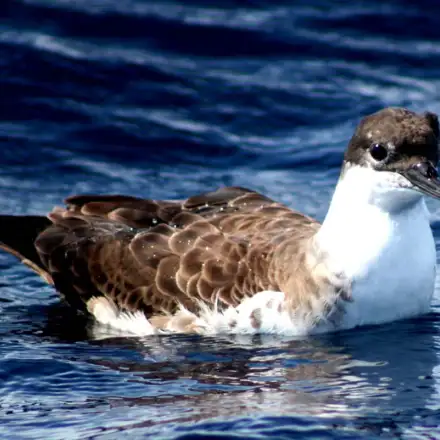
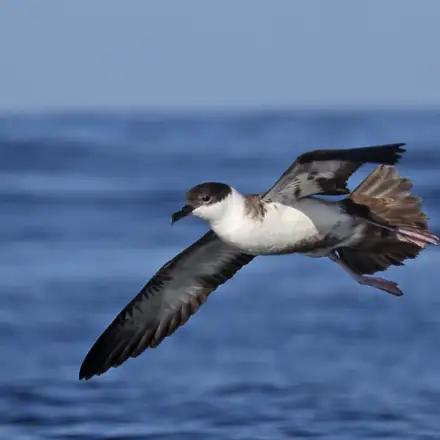
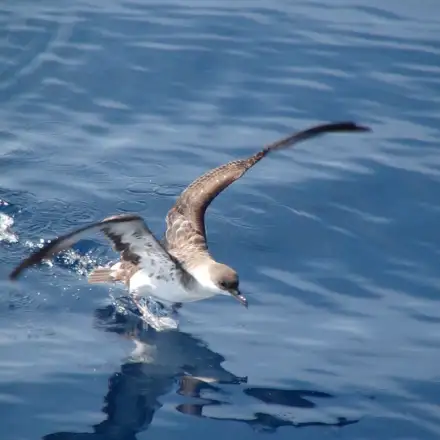
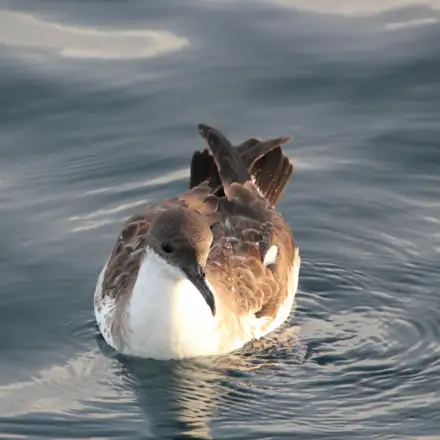
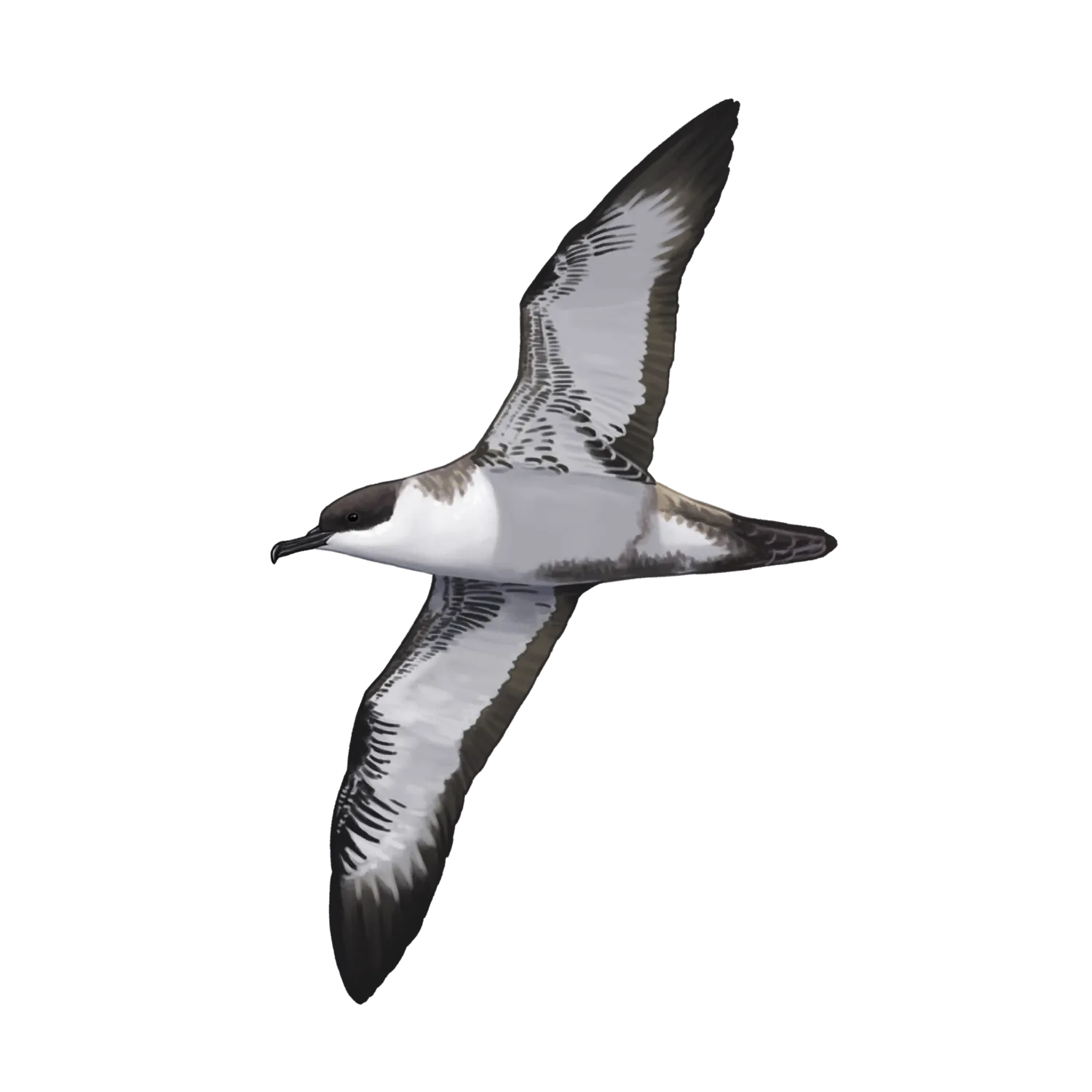
Great Shearwater
Scientific name: Ardenna gravis
Family procellariidae
Phenology
- Mainland
- Passage migrant
- Madeira
- Passage migrant
- Azores
- Passage migrant
Conservation status
Learn more- Mainland
- Madeira
- Azores
- IUCN Global
Data
Maps
Distribution | Non-breeding
Scale
Minimum value:
Maximum value:
Scale
Minimum value:
Maximum value:
Scale
Minimum value:
Maximum value:
Scale
Minimum value:>
Maximum value:<
Scale
Minimum value:
Maximum value:
Scale
Minimum value:>
Maximum value:>
Distribution based on seabird tracking data (locations/hexagone).
Colony(ies) of origin:
Device:
Data period / number of individuals:
Data period / number of individuals:
Distribution of seabird breeding colonies or sites (number of breeding pairs).
Distribution based on marine censuses (probability of occurrence).
Observed density based on marine censuses (birds/ km2).
Confirmed occurence during marines censuses.
Abundance of waders derived from Project Arenaria coastal surveys (birds/square).
Passage rates derived from RAM coastal surveys (birds/hour).
No data available for the selected period.
Presentation
Distribution, movements and phenology
The Great Shearwater breeds in the South Atlantic, on the Tristan da Cunha archipelago, and in the Falkland Islands between mid-September and late May (Cuthbert 2005; Billerman et al. 2026). After breeding, it begins a long migration across the North-west Atlantic, reaching the coast of Canada, before heading eastwards, passing through the waters of the United Kingdom and the Iberian Peninsula (Billerman et al. 2026). In Portugal, it occurs throughout almost the entire EEZ during summer and autumn, being closer to the coast in summer and further out to sea in autumn (Meirinho et al. 2014), when it heads south towards its breeding grounds (Catry et al. 2010a; Billerman et al. 2026). Based on data from 44 birds fitted with GLS between 2009 and 2014 from colonies on Gough Island, greater use of the Portuguese EEZ was observed throughout September, although some birds used these waters as early as June. Their movements were concentrated mainly in the Azores sub-area and the north-west region of Madeira. On the Mainland, however, records were scarce, despite the species being known to occur frequently, with considerable concentrations along the southern coast (Araújo et al. 2022a).
Abundance and population trends
The global population was estimated at over 10 million mature individuals in 2004 (Brooke 2004). No estimates have been made since then, although the population is thought to be stable (BirdLife International 2025).
In Mainland Portugal, the population was estimated at between 5,399 and 25,379 individuals for the period between 2012 and 2015 (Araújo et al. 2022a). Despite significant interannual variations, an upward trend has been observed since 2015, reflected in the population abundance indicator, which justifies the population’s Good Environmental Status. In the case of the Azores and Madeira, however, the available information does not allow for firm conclusions to be drawn regarding the species’ population trends.
Ecology and habitat
During its wintering period, the Great Shearwater uses both coastal waters and those further offshore, preferring the latter during its pre-breeding migration. This essentially pelagic bird feeds mainly on fish, cephalopods, and crustaceans, caught at the surface or while diving (Billerman et al. 2026). It frequently feeds on discards from commercial fishing, mainly following trawlers (Paz et al. 2018), but also vessels using other fishing gear, notably gillnets and longliners (Bugoni et al. 2008; Pereira et al. 2025a).
Threats and conservation
In its breeding areas, the Great Shearwater is still caught for food (BirdLife International 2025). At sea, the greatest threat relates to bycatch in fishing gear operated in the North-east Atlantic, primarily longlines, trawls and gillnets (Perez & Wahrlich 2005; Bugoni et al. 2008; Hatch et al. 2016; Paz et al. 2018), the latter being a threat also reported in Mainland Portugal (Pereira et al. 2025a). Other causes of mortality may be related to heavy metal contamination and the ingestion of plastics (Pierce et al. 2004; Barbieri et al. 2007).
- Autor
Tânia Nascimento
- Owners/sources of tracking data
Pierce KE, Harris RJ, Larned LS & Pokras MA (2004). Obstruction and starvation associated with plastic ingestion in a Northern Gannet Morus bassanus and a Greater Shearwater Puffinus gravis. Marine Ornithology 32: 187-189. Bibliography:
Perez JAA & Wahrlich R (2005). A bycatch assessment of the gillnet monkfish Lophius gastrophysus fishery off southern Brazil. Fisheries Research 72: 81-95. Bibliography:
Pereira JM, Ramos JA, Almeida A, Marçalo A, Carvalho F, Fagundes, I, Gonçalves JMS, Frade M, Oliveira N, Nascimento T & Paiva VH (2025a). Seasonal variation in seabird abundance and bycatch at artisanal bottom-set net fisheries in the southern Iberian Atlantic coast. Ocean & Coastal Management 267: 107660. Bibliography:
Paz JA, Pon JPS, Favero M, Blanco G & Copello S (2018). Seabird interactions and by-catch in the anchovy pelagic trawl fishery operating in northern Argentina. Aquatic Conservation Marine and Freshwater Ecosystems 28: 850–860. Bibliography:
Meirinho A, Barros N, Oliveira N, Catry P, Lecoq M, Paiva V, Geraldes P, Granadeiro JP, Ramírez I & Andrade J (2014). Atlas das Aves Marinhas de Portugal. Sociedade Portuguesa para o Estudo das Aves. Bibliography:
Hatch JM, Wiley D, Murray KT & Welch L (2016). Integrating satellite-tagged seabird and fishery-dependent data: A case study of Great Shearwaters (Puffinus gravis) and the U.S. New England sink gillnet fishery. Conservation Letters 9: 43-50. Bibliography:
Cuthbert RJ (2005). Breeding biology, chick growth and provisioning of Great Shearwaters (Puffinus gravis) at Gough Island, South Atlantic Ocean. Emu 105 (4): 305-310. Bibliography:
Bugoni L, Neves TS , Leite NO , Carvalho D, Sales G, Furness RW, Stein CE, Peppes FV, Giffoni BB & Monteiro DS (2008). Potential bycatch of seabirds and turtles in hook-and-line fisheries of the Itaipava Fleet, Brazil. Fisheries Research 90: 217-224. Bibliography:
Brooke M (2004). Albatrosses and petrels across the world. Oxford University Press, Oxford, UK. Bibliography:
BirdLife International (2025). IUCN Red List for birds. Downloaded from https://datazone.birdlife.org on 30.11.2025. Bibliography:
Billerman SM, Keeney BL, Kirwan GM, Medrano F, Sly ND & Smith MG (eds.) (2026). Birds of the World. Cornell Laboratory of Ornithology, Ithaca, NY, USA. Bibliography:
Barbieri E, Garcia CAB, Passos EA, Aragão KAS & Alves JPH (2007). Heavy metal concentration in tissues of Puffinus gravis sampled on the Brazilian coast. Revista Brasileira de Ornitologia 15(1): 69-72 Bibliography:
Araújo H, Correia-Rodrigues P, Bastos-Santos J, Ferreira M, Pereira AT, Martinez-Cedeira J, Vingada J & Eira C (2022a). Seabird abundance and distribution off western Iberian waters estimated through aerial surveys. Marine Ornithology 50: 71-80. Bibliography:
Catry P, Costa H, Elias G & Matias R (2010a). Aves de Portugal, Ornitologia do Território Continental. Assírio e Alvim, Lisboa Data:
Ronconi R & Ryan P (2010). Dataset 665: Great Shearwater, Ardenna gravis, PTT, At-Sea, At-Sea, High Seas, 2013–2015. BirdLife International Seabird Tracking Database. Downloaded from https://data.seabirdtracking.org/dataset/665/ on 30.11.2025. Data:
Gonzalez-Solis J & Ryan P (2014). Dataset 982: Great Shearwater, Ardenna gravis, Geolocator (GLS), Gough Island, Gough, Saint Helena, Ascension and Tristan da Cunha, 2008–2014. BirdLife International Seabird Tracking Database. Downloaded from https://data.seabirdtracking.org/dataset/982/ on 30.11.2025. Glossary:
Individuals capable of breeding, used as a reference in population estimates. Glossary:
A group of marine arthropods that are important in the marine food chain. Glossary:
A group of marine molluscs that includes squids, cuttlefish and octopuses. Glossary:
Equipment used to catch marine animals, such as nets, longlines or traps. Glossary:
A species or parameter that reflects the state of an ecosystem or environmental changes. Glossary:
The direction of change in the size of a population over time (increase, decline or stability). Glossary:
A concept defined under the Marine Strategy Framework Directive (MSFD), referring to the condition of the elements of the marine environment, including birds. It aims to assess whether ecosystems are healthy, balanced and capable of supporting ecological functions and human uses in a sustainable manner. The ultimate goal is for the components and ecosystems to achieve Good Environmental Status. Glossary:
Refers to the unintentional capture of marine species during fishing. Animals may become entangled in hooks or fishing nets. It is usually associated with commercial fishing, but can also occur in recreational fishing. Bycatch is one of the main threats to seabirds at sea. Glossary:
Under the United Nations Convention on the Law of the Sea, coastal states are entitled to declare an EEZ comprising maritime area beyond their territorial waters. The national EEZ is delimited by an imaginary line situated 200 nautical miles from the coast, separating national waters from international or shared waters. Within its EEZ, each state has rights such as the exploitation of marine resources, the conduct of scientific research and the regulation of fishing by foreign vessels. Glossary:
The portion of the catch taken by commercial fishing vessels that is returned to the sea, often dead or dying. Discarded fish often belong to species of no commercial value, individuals below the minimum legal landing size, or individuals whose landing is not permitted, for example due to quota restrictions. Discards may also consist of parts of the catch, namely offal and heads, which, after on-board processing, are rejected and discarded at sea. Discards have a strong impact on marine ecosystems and influence many aspects of the distribution, foraging behaviour and population dynamics of seabirds, particularly species and individuals that habitually follow vessels. Glossary:
A static net, often nearly invisible and with variable mesh size, used to catch a wide variety of fish. It is set in the sea at varying depths and later retrieved. It is a non-selective fishing gear that frequently catches seabirds, marine mammals and reptiles. Glossary:
Referring to the period preceding breeding. Glossary:
The area or environment where organisms that do not depend on the seafloor normally live. It is the typical ecological environment of open ocean waters. The pelagic ecosystem does not include only the open sea; it also comprises the waters covering the continental shelf. The pelagic zone begins below the influence of tides and extends into the open ocean, at depths ranging from a few tens of metres to approximately 6,000 metres, and is divided into different layers. Glossary:
A fishing gear consisting of a main line (mother line) from which secondary lines with hooks attached branch off. It is left in the sea and can be placed on the seabed to catch deep-sea species (e.g. scabbardfish) or at the surface to catch large pelagic fish (e.g. swordfish). Glossary:
A period generally corresponding to the winter months, which may include part of autumn. Glossary:
A small device attached to birds to study their large-scale movements (usually migration), which works by recording light intensity (from which the duration of night and the local midday time are estimated, and consequently the latitude and longitude on each day).