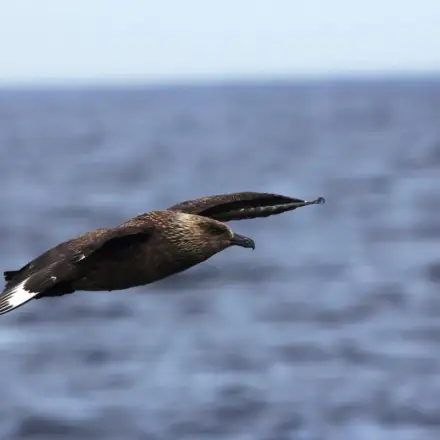
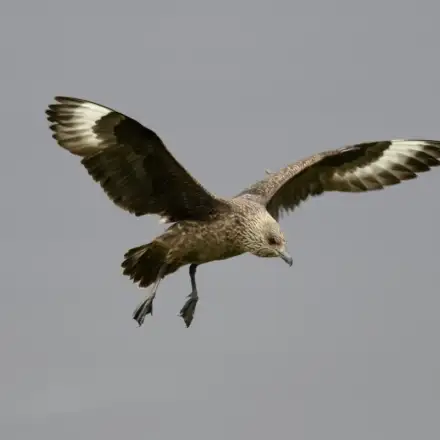
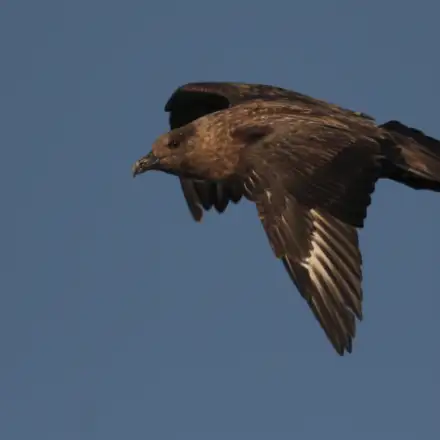
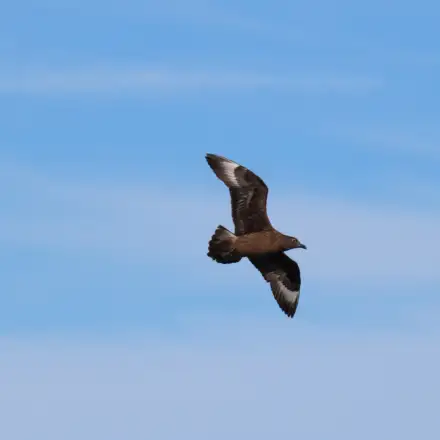
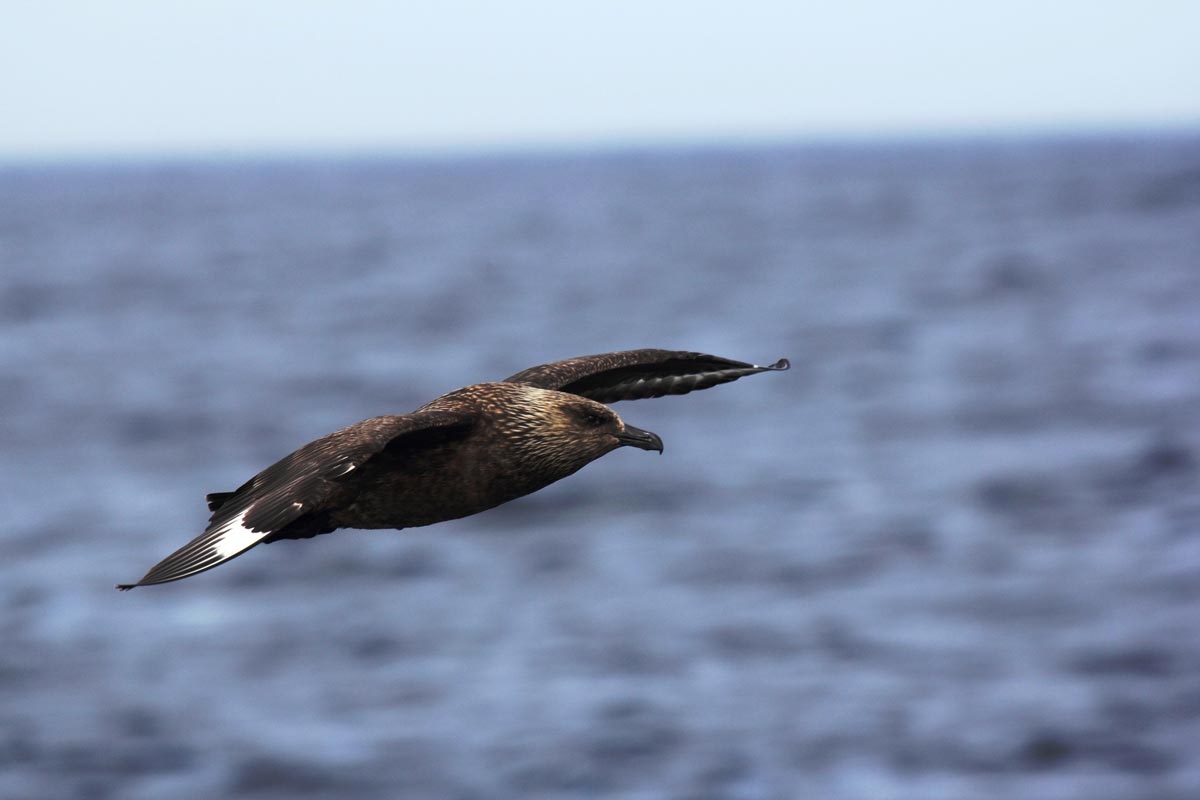
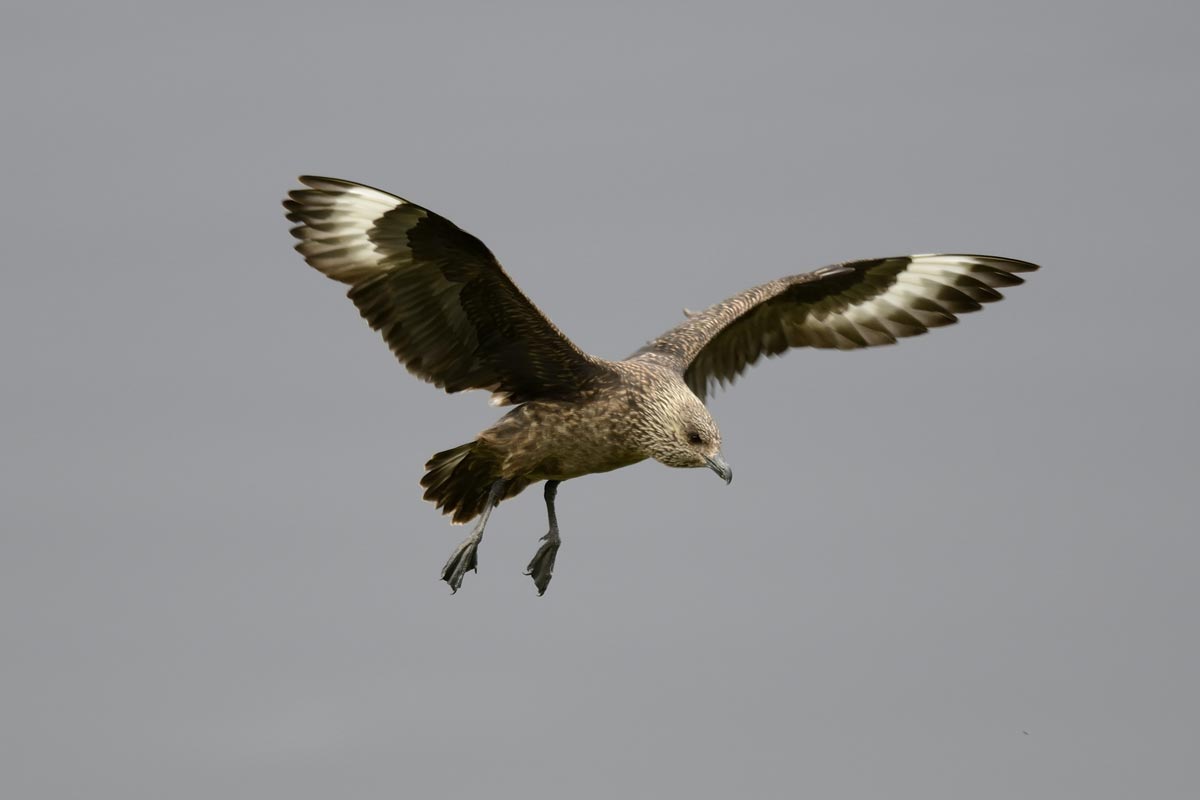
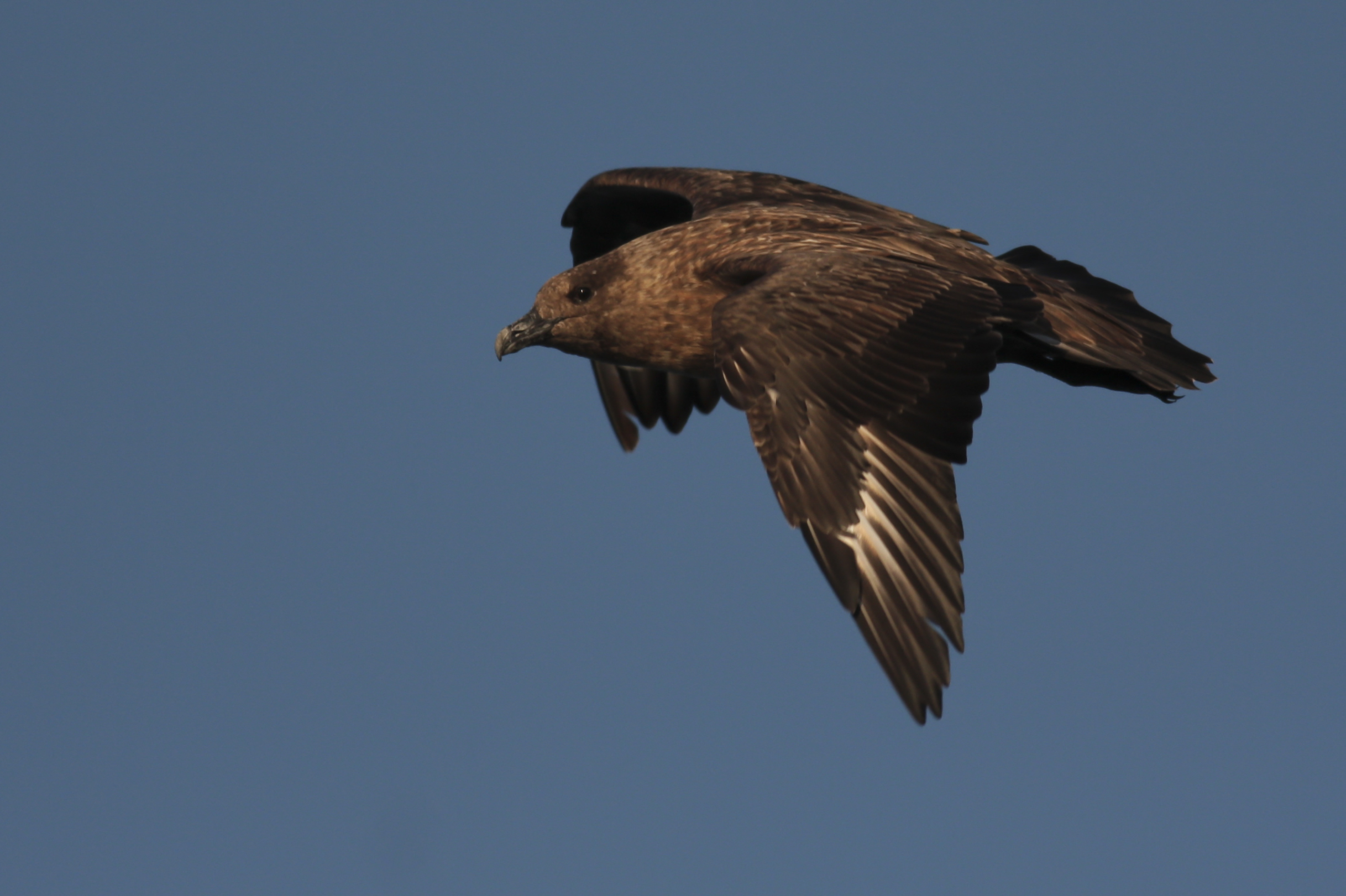
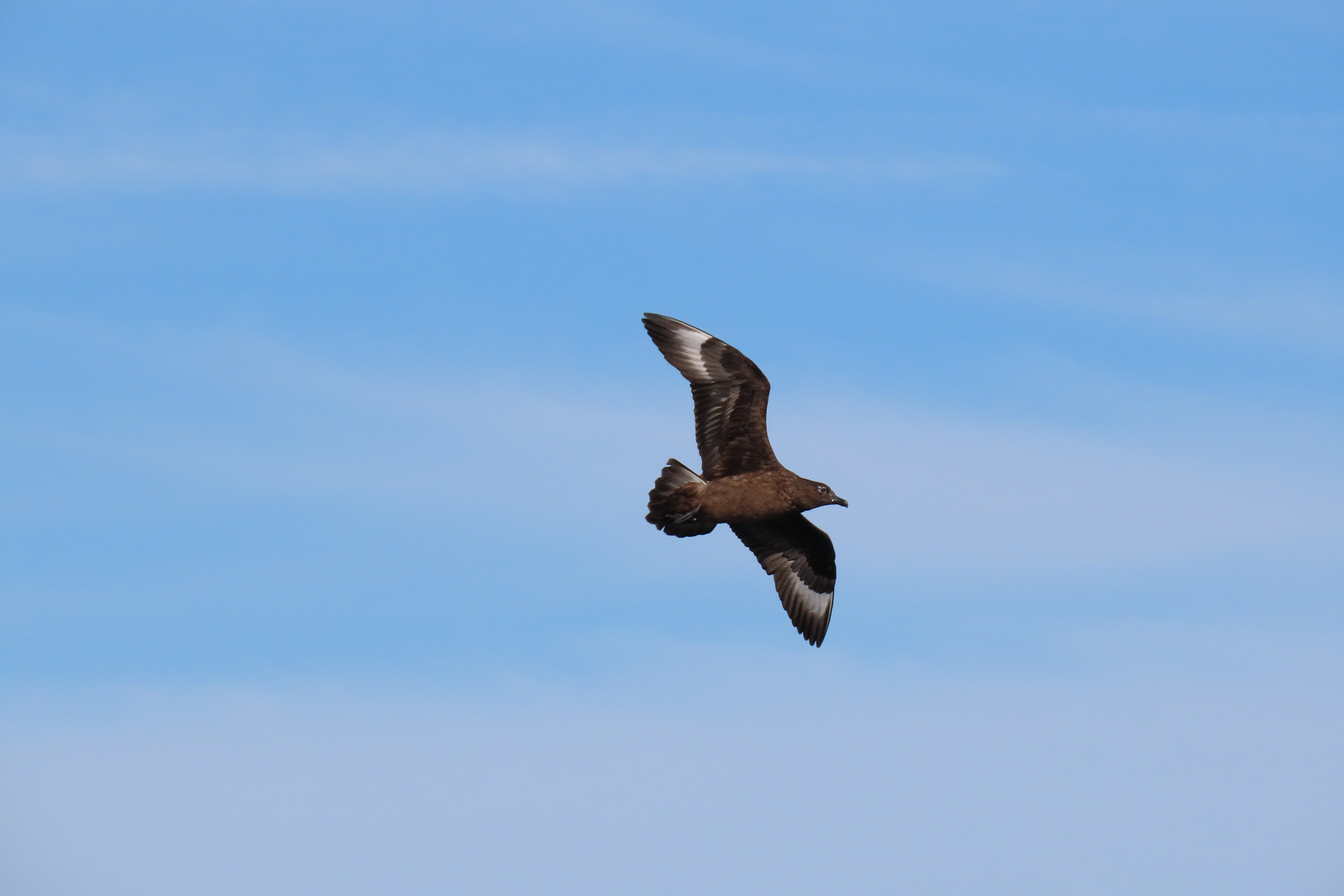
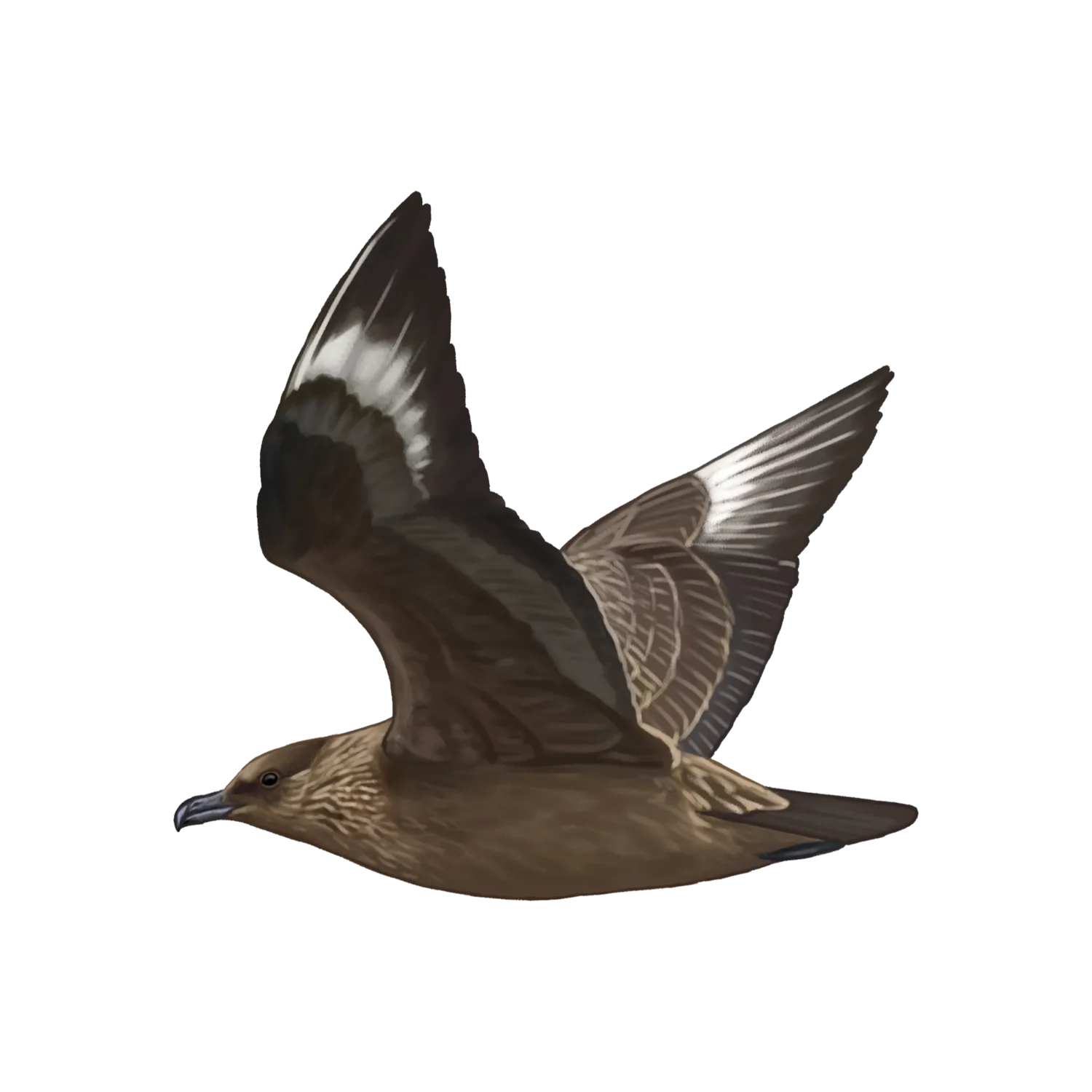
Great Skua
Scientific name: Catharacta skua
Family stercorariidae
Phenology
- Mainland
- Wintering and passage migrant
- Madeira
- Passage migrant
- Azores
- Wintering and passage migrant
Conservation status
Learn more- Mainland
- Madeira
- Azores
- IUCN Global
Data
Maps
Distribution | Breeding
Scale
Minimum value:
Maximum value:
Scale
Minimum value:
Maximum value:
Scale
Minimum value:
Maximum value:
Scale
Minimum value:>
Maximum value:<
Scale
Minimum value:
Maximum value:
Scale
Minimum value:>
Maximum value:>
Distribution based on seabird tracking data (locations/hexagone).
Colony(ies) of origin:
Device:
Data period / number of individuals:
Data period / number of individuals:
Distribution of seabird breeding colonies or sites (number of breeding pairs).
Distribution based on marine censuses (probability of occurrence).
Observed density based on marine censuses (birds/ km2).
Confirmed occurence during marines censuses.
Abundance of waders derived from Project Arenaria coastal surveys (birds/square).
Passage rates derived from RAM coastal surveys (birds/hour).
No data available for the selected period.
Presentation
Distribution, movements and phenology
The Great Skua breeds between May and September in northern Europe, notably in Scotland, Iceland, the Faroe Islands, Norway, and Russia (Billerman et al. 2026). It winters off the coasts of France and the Iberian Peninsula as far south as West Africa, with some individuals dispersing as far as Newfoundland, Brazil, and the Caribbean (Furness et al. 2006; Magnusdottir et al. 2012; Billerman et al. 2026). In Portugal, it occurs off the Mainland coast throughout the year, with the highest concentration in autumn and winter, particularly near estuarine areas (Catry et al. 2010; Araújo et al. 2022a). It is rare in the archipelagos, occurring most frequently in the Azores between December and March, and in Madeira during post-breeding migration between July and October; it is also observed during spring migration and winter (eBird 2026). Individual tracking data from 74 birds from Norway, Iceland, and Scotland fitted with GLS tags between 2008 and 2022 corroborate the extensive use of the entire Portuguese EEZ. These data also suggest that the Madeira sub-area is important in winter, and is likely an area regularly used by populations wintering on the African coast (Magnusdottir et al. 2012).
Abundance and population trends
The global population is estimated at between 16,300 and 17,200 breeding pairs, with a stable trend (BirdLife International 2025). In Portugal, sightings of this species were rare in the 20th century, but have increased significantly since then, becoming quite conspicuous along the Mainland coast, particularly in winter (Catry et al. 2010). This population was estimated at 5,370 to 9,702 individuals for the period between 2010 and 2015 (Araújo et al. 2022a), reflecting the region’s important role as a migratory corridor, used by around 7% of the species’ global population during post-breeding migration (Leitão et al. 2014). Nevertheless, although these figures show significant interannual variations, a downward trend has been observed in recent years, reflected in the indicator relating to population abundance, with the Mainland population failing to achieve Good Environmental Status. In the case of the Azores and Madeira, however, the available information does not allow for firm conclusions to be drawn regarding the population trends in these regions.
Ecology and habitat
During the breeding season, it is a semi-colonial but highly territorial bird. Nesting takes place on flat terrain with some vegetation (BirdLife International 2025). At sea and during the non-breeding season, it exhibits essentially pelagic behaviour, utilising mainly the continental shelf. It has a varied and opportunistic diet, frequently following fishing vessels (Valeiras 2003; Pereira et al. 2025a) and displaying kleptoparasitic behaviour, chasing other seabirds to steal their food.
Threats and conservation
The Great Skua relies on fishing discards, particularly during the breeding season, and the species may be affected by policies aimed at reducing discards (BirdLife International 2025). Furthermore, a decline in the stocks of its main prey species may lead to population declines and reduced breeding success.
- Autor
Hany Alonso
- Owners/sources of tracking data
Furness et al. 2009a, Furness et al. 2009b, Furness et al. 2010
Valeiras J (2003). Attendance of scavenging seabirds at trawler discards off Galicia, Spain. Scientia Marina 67(Suppl. 2): 77-82. Bibliography:
Pereira JM, Ramos JA, Almeida A, Marçalo A, Carvalho F, Fagundes, I, Gonçalves JMS, Frade M, Oliveira N, Nascimento T & Paiva VH (2025a). Seasonal variation in seabird abundance and bycatch at artisanal bottom-set net fisheries in the southern Iberian Atlantic coast. Ocean & Coastal Management 267: 107660. Bibliography:
Magnusdottir E, Leat EH K, Bourgeon S, Strøm H, Petersen A, Phillips R, Hanssen SA, Bustnes JO, Hersteinsson P & Furness RW (2012). Wintering areas of Great Skuas Stercorarius skua breeding in Scotland, Iceland and Norway. Bird Study 59 (1): 1-9. Bibliography:
Leitão AH, Canário F, Pires N & Tomé R (2014). A importância do Cabo de S. Vicente (Sagres, Sudoeste de Portugal) como corredor migratório para aves marinhas. In SPEA (ed.). Livro de resumos do VIII congresso de ornitologia da SPEA (1.ª edição). Sociedade Portuguesa para o Estudo das Aves, Lisboa. Bibliography:
Furness RW, Crane JE, Bearhop S, Garthe S, Käkelä A, Käkelä R, Kelly A, Kubetzki U, Votier SC & Waldron S (2006). Techniques to link migration patterns of seabirds with diet specialization, condition and breeding performance. Ardea 94: 631–638 Bibliography:
eBird (2026). eBird: An online database of bird distribution and abundance (web application). eBird, Cornell Lab of Ornithology, Ithaca, New York. Downloaded from http://www.ebird.org on 02.02.2026. Bibliography:
BirdLife International (2025). IUCN Red List for birds. Downloaded from https://datazone.birdlife.org on 30.11.2025. Bibliography:
Billerman SM, Keeney BL, Kirwan GM, Medrano F, Sly ND & Smith MG (eds.) (2026). Birds of the World. Cornell Laboratory of Ornithology, Ithaca, NY, USA. Bibliography:
Araújo H, Correia-Rodrigues P, Bastos-Santos J, Ferreira M, Pereira AT, Martinez-Cedeira J, Vingada J & Eira C (2022a). Seabird abundance and distribution off western Iberian waters estimated through aerial surveys. Marine Ornithology 50: 71-80. Bibliography:
Catry P, Costa H, Elias G & Matias R (2010a). Aves de Portugal, Ornitologia do Território Continental. Assírio e Alvim, Lisboa Data:
Furness R, Petersen A & Magnusdottir E (2010). Dataset 1099: Great Skua, Catharacta skua, Geolocator (GLS), Bear Island, Norway, Norway, 2008–2010. BirdLife International Seabird Tracking Database. Downloaded from https://data.seabirdtracking.org/dataset/1099/ on 30.11.2025. Data:
Furness R, Petersen A & Magnusdottir E (2009b). Dataset 1101: Great Skua, Catharacta skua, Geolocator (GLS), Foula, Shetland, United Kingdom, 2008–2009. BirdLife International Seabird Tracking Database. Downloaded from https://data.seabirdtracking.org/dataset/1101/ on 30.11.2025. Data:
Furness R, Petersen A & Magnusdottir E (2009a). Dataset 1100: Great Skua, Catharacta skua, Geolocator (GLS), Breidamerkursandur, Iceland, Iceland, 2008–2009. BirdLife International Seabird Tracking Database. Downloaded from https://data.seabirdtracking.org/dataset/1100/ on 30.11.2025. Glossary:
Preferred routes and geographical areas where the movement of individuals is concentrated during migrations. Glossary:
A species or parameter that reflects the state of an ecosystem or environmental changes. Glossary:
Monitoring the movements of individuals using tracking devices. Glossary:
The direction of change in the size of a population over time (increase, decline or stability). Glossary:
A concept defined under the Marine Strategy Framework Directive (MSFD), referring to the condition of the elements of the marine environment, including birds. It aims to assess whether ecosystems are healthy, balanced and capable of supporting ecological functions and human uses in a sustainable manner. The ultimate goal is for the components and ecosystems to achieve Good Environmental Status. Glossary:
A term used in fisheries science referring to a population unit of fish (or shellfish) that is commercially exploited, belonging to the same species, within a given geographical area, and harvested by a specific fishery. Glossary:
Under the United Nations Convention on the Law of the Sea, coastal states are entitled to declare an EEZ comprising maritime area beyond their territorial waters. The national EEZ is delimited by an imaginary line situated 200 nautical miles from the coast, separating national waters from international or shared waters. Within its EEZ, each state has rights such as the exploitation of marine resources, the conduct of scientific research and the regulation of fishing by foreign vessels. Glossary:
The portion of the catch taken by commercial fishing vessels that is returned to the sea, often dead or dying. Discarded fish often belong to species of no commercial value, individuals below the minimum legal landing size, or individuals whose landing is not permitted, for example due to quota restrictions. Discards may also consist of parts of the catch, namely offal and heads, which, after on-board processing, are rejected and discarded at sea. Discards have a strong impact on marine ecosystems and influence many aspects of the distribution, foraging behaviour and population dynamics of seabirds, particularly species and individuals that habitually follow vessels. Glossary:
Referring to the period following breeding. Glossary:
The portion of the seabed that begins at the coastline and slopes gently downwards to the continental slope (where the slope is much steeper). On average, the continental shelf extends to a depth of 200 metres. Glossary:
The area or environment where organisms that do not depend on the seafloor normally live. It is the typical ecological environment of open ocean waters. The pelagic ecosystem does not include only the open sea; it also comprises the waters covering the continental shelf. The pelagic zone begins below the influence of tides and extends into the open ocean, at depths ranging from a few tens of metres to approximately 6,000 metres, and is divided into different layers. Glossary:
A small device attached to birds to study their large-scale movements (usually migration), which works by recording light intensity (from which the duration of night and the local midday time are estimated, and consequently the latitude and longitude on each day). Glossary:
A feeding method in which one individual steals food from another.