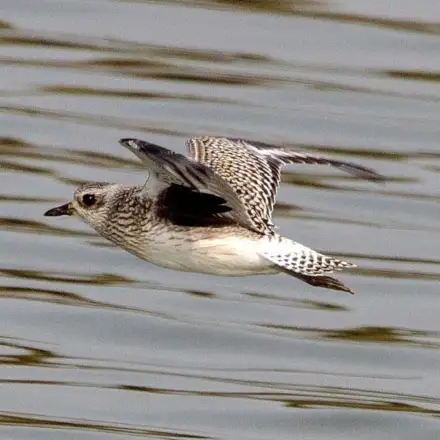
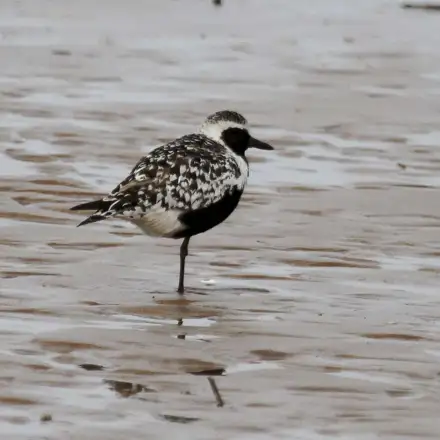
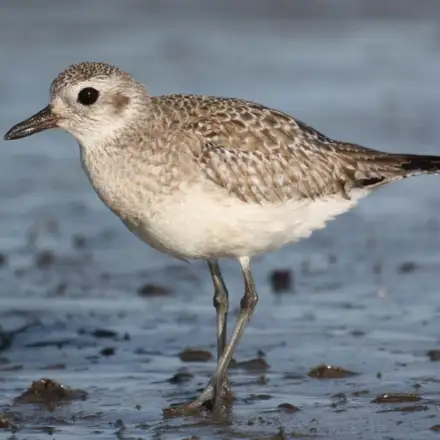
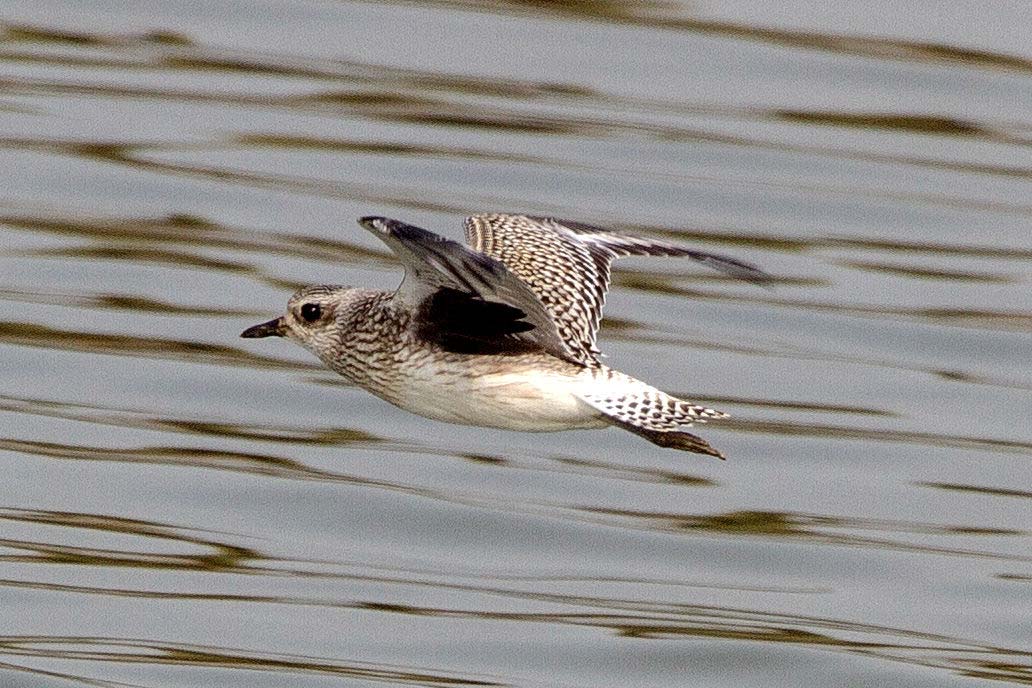
Grey Plover
Scientific name: Pluvialis squatarola
Family charadriidae
Phenology
- Mainland
- Wintering and passage migrant
- Madeira
- Vagrant
- Azores
- Vagrant
Conservation status
Learn more- Mainland
- Madeira
- Azores
- IUCN Global
Data
Presentation
Distribution, movements and phenology
The Grey Plover breeds between May and August in the Arctic regions of Russia and North America (Billerman et al. 2026). In Portugal, birds from Siberian populations occur during their migrations, with a significant proportion remaining throughout the winter. Furthermore, some non-breeding individuals remain throughout the year (Lourenço et al. 2018). The Grey Plover occurs mainly in the Mainland’s wetlands and coastal areas (Equipa Atlas 2018). It is most abundant in the southern half of the region, particularly in the Tagus and Sado estuaries, the Santo André Lagoon and the Ria Formosa. To a lesser extent, it occurs in some estuaries in the north-west and in the Ria de Aveiro. A small proportion also uses much of the non-estuarine coastline (Lecoq et al. 2013). In the Azores and Madeira, the species occurs as a vagrant, having been observed mainly along the coastlines of the various islands in these archipelagos.
Abundance and population trends
The global population has been estimated at between 1,000,000 and 2,500,000 breeding birds, with a declining trend (BirdLife International 2025). In Mainland Portugal, the wintering population has been estimated at around 6,500 individuals, of which 1–2% utilise the marine coastline (Lecoq et al. 2013). Compared with older records (Catry et al. 2010a), the population appears to be stable (Lourenço et al. 2018; Belo et al. 2023), despite a notable decline in the small proportion using the non-estuarine coast (Lecoq et al. 2013). Despite all these uncertainties, this population appears to have achieved Good Environmental Status for the abundance indicator. In the Azores and Madeira, however, the population size is very low, both in winter and during migration (Equipa Atlas 2018). Furthermore, these populations show a negative trend and have not achieved Good Environmental Status.
Ecology and habitat
The Grey Plover is found mainly in estuaries and other coastal wetlands (Equipa Atlas 2018). Although it prefers areas with fine, loose sediments, along the coast it also inhabits rocky areas with a wide intertidal zone (Lourenço et al. 2013). In the Azores and Madeira, it has a preference for coastal areas, although it is also observed in more inland parts of the islands. During the wintering period, the diet consists of invertebrates, mainly polychaetes, bivalves and crustaceans, both globally (Billerman et al. 2026) and nationally (Moreira 1996; Lopes et al. 1998; Lourenço 2019).
Threats and conservation
Globally, habitat degradation and conversion appear to be the main threats at feeding and resting sites during migration and wintering. Additionally, climate change may compromise breeding success and lead to a significant reduction in nesting habitat. Key sources of pressure include urban development, the expansion of the aquaculture industry, the establishment of hydrocarbon refineries, and disturbance associated with the fishing industry (BirdLife International 2025). In Portugal, disturbance at feeding and resting sites may constitute a threat to the wintering population.
- Autor
Nuno Oliveira
Moreira F (1996). Diet and feeding behaviour of grey plovers Pluvialis squatarola and redshanks Tringa totanus in a southern European estuary. Ardeola 43: 145–156. Bibliography:
Lourenço PM, Catry P, Lecoq M, Ramírez I & Granadeiro JP (2013). Role of disturbance, geology and other environmental factors in determining abundance and diversity in coastal avian communities during winter. Marine Ecology Progress Series 479: 223-234. Bibliography:
Lourenço PM, Alonso H, Alves JA, Carvalho AT, Catry T, Costa H, Costa JS, Dias MP, Encarnação V, Fernandes P, Leal AI, Martins RC, Moniz F, Pardal S, Rocha A & Santos CD (2018). Monitoring waterbird populations in the Tejo estuary, Portugal: report for the decade 2007-2016. Airo 25: 3-3. Bibliography:
Lourenço PM (2019). Internet photography forums as sources of avian dietary data: bird diets in Continental Portugal. Airo 26:3-26. Bibliography:
Lopes RJ, Cabral JA, Múrias T & Marques JC (1998). Contribuição para o conhecimento da dieta de Pilrito-comum Calidris alpina e da Tarambola-cinzenta Pluvialis squatarola no estuário do Mondego. Airo 9: 27–32. Bibliography:
Lecoq M, Lourenço PM, Catry P, Andrade J & Granadeiro JP (2013). Wintering waders on the Portuguese mainland non-estuarine coast: results of the 2009-2011 survey. Wader Study Group Bulletin 120: 66-70. Bibliography:
Equipa Atlas (2018). Atlas das Aves Invernantes e Migradoras de Portugal 2011-2013. Sociedade Portuguesa para o Estudo das Aves, LabOr- Laboratório de Ornitologia – ICAAM - Universidade de Évora, Instituto da Conservação da Natureza e das Florestas, Instituto das Florestas e Conservação da Natureza (Madeira), Secretaria Regional da Energia, Ambiente e Turismo (Açores) e Associação Portuguesa de Anilhadores de Aves. Lisboa. Bibliography:
BirdLife International (2025). IUCN Red List for birds. Downloaded from https://datazone.birdlife.org on 30.11.2025. Bibliography:
Billerman SM, Keeney BL, Kirwan GM, Medrano F, Sly ND & Smith MG (eds.) (2026). Birds of the World. Cornell Laboratory of Ornithology, Ithaca, NY, USA. Bibliography:
Belo JR, Dias MP, Jara J, Almeida A, Morais F, Silva C, Valadeiro J & Alves JA (2023). Synchronous declines of wintering waders and high-tide roost area in a temperate estuary: Results of a 10-year monitoring programme. Waterbirds 45(2): 141-149. Bibliography:
Catry P, Costa H, Elias G & Matias R (2010a). Aves de Portugal, Ornitologia do Território Continental. Assírio e Alvim, Lisboa Glossary:
Molluscs with two shells, such as clams and cockles, common in intertidal environments. Glossary:
A group of marine arthropods that are important in the marine food chain. Glossary:
Coastal zone between high and low tide, subject to alternating submersion and exposure. Glossary:
Persistent changes in global or regional climate patterns, influenced by natural and anthropogenic factors. Glossary:
A species or parameter that reflects the state of an ecosystem or environmental changes. Glossary:
The direction of change in the size of a population over time (increase, decline or stability). Glossary:
A concept defined under the Marine Strategy Framework Directive (MSFD), referring to the condition of the elements of the marine environment, including birds. It aims to assess whether ecosystems are healthy, balanced and capable of supporting ecological functions and human uses in a sustainable manner. The ultimate goal is for the components and ecosystems to achieve Good Environmental Status. Glossary:
Annelid worms belonging to the class Polychaeta. Glossary:
A period generally corresponding to the winter months, which may include part of autumn.