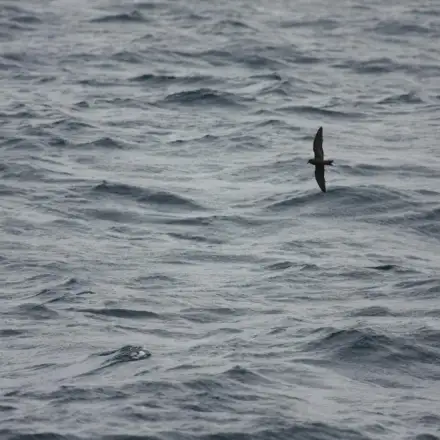
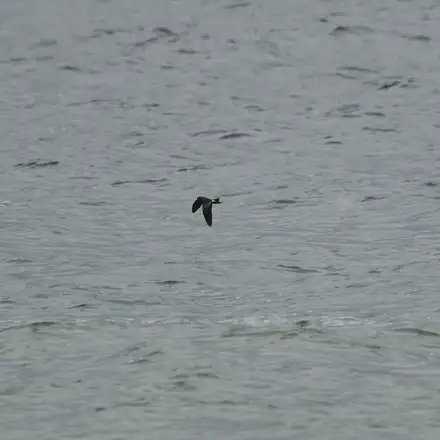
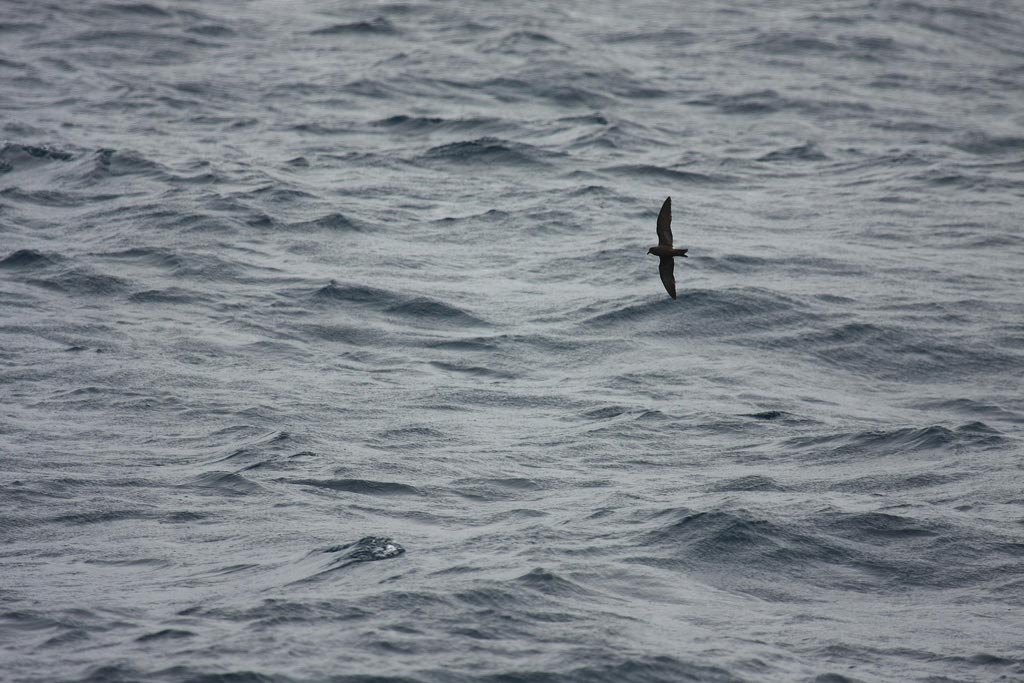
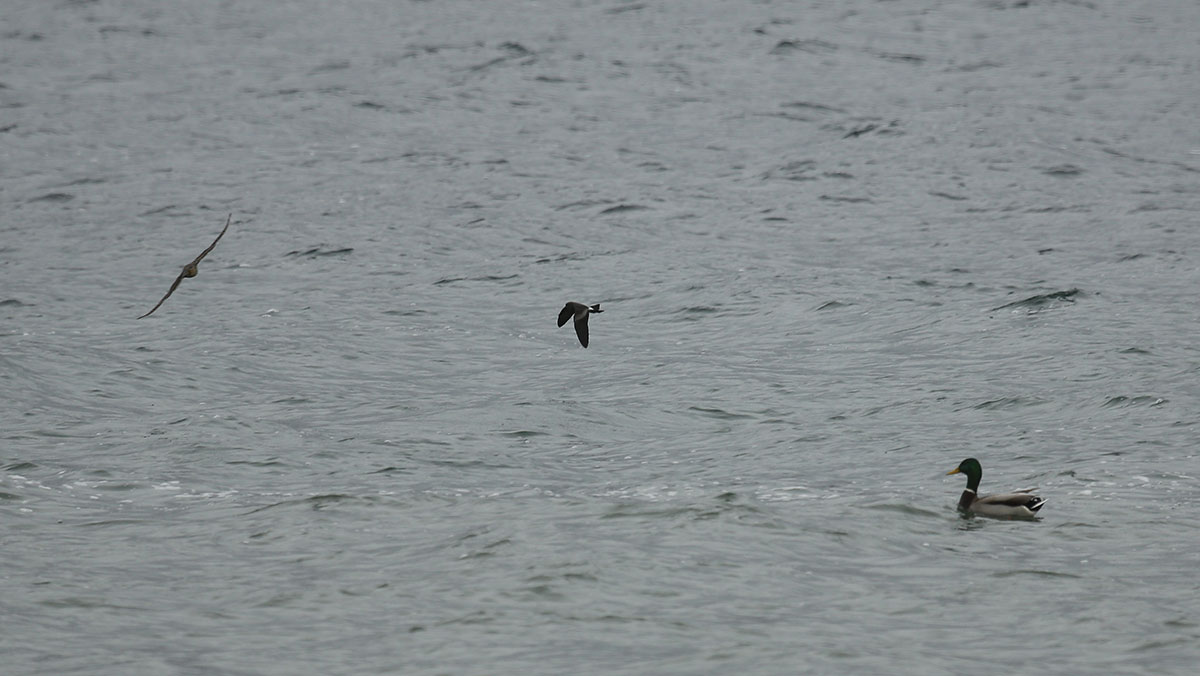
Leach's Storm-petrel
Scientific name: Hydrobates leucorhous
Family hydrobatidae
Phenology
- Mainland
- Passage migrant
- Madeira
- Passage migrant
- Azores
- Passage migrant
Conservation status
Learn more- Mainland
- Madeira
- Azores
- IUCN Global
Data
Maps
Distribution | Non-breeding
Scale
Minimum value:
Maximum value:
Scale
Minimum value:
Maximum value:
Scale
Minimum value:
Maximum value:
Scale
Minimum value:>
Maximum value:<
Scale
Minimum value:
Maximum value:
Scale
Minimum value:>
Maximum value:>
Distribution based on seabird tracking data (locations/hexagone).
Colony(ies) of origin:
Device:
Data period / number of individuals:
Data period / number of individuals:
Distribution of seabird breeding colonies or sites (number of breeding pairs).
Distribution based on marine censuses (probability of occurrence).
Observed density based on marine censuses (birds/ km2).
Confirmed occurence during marines censuses.
Abundance of waders derived from Project Arenaria coastal surveys (birds/square).
Passage rates derived from RAM coastal surveys (birds/hour).
No data available for the selected period.
Presentation
Distribution, movements and phenology
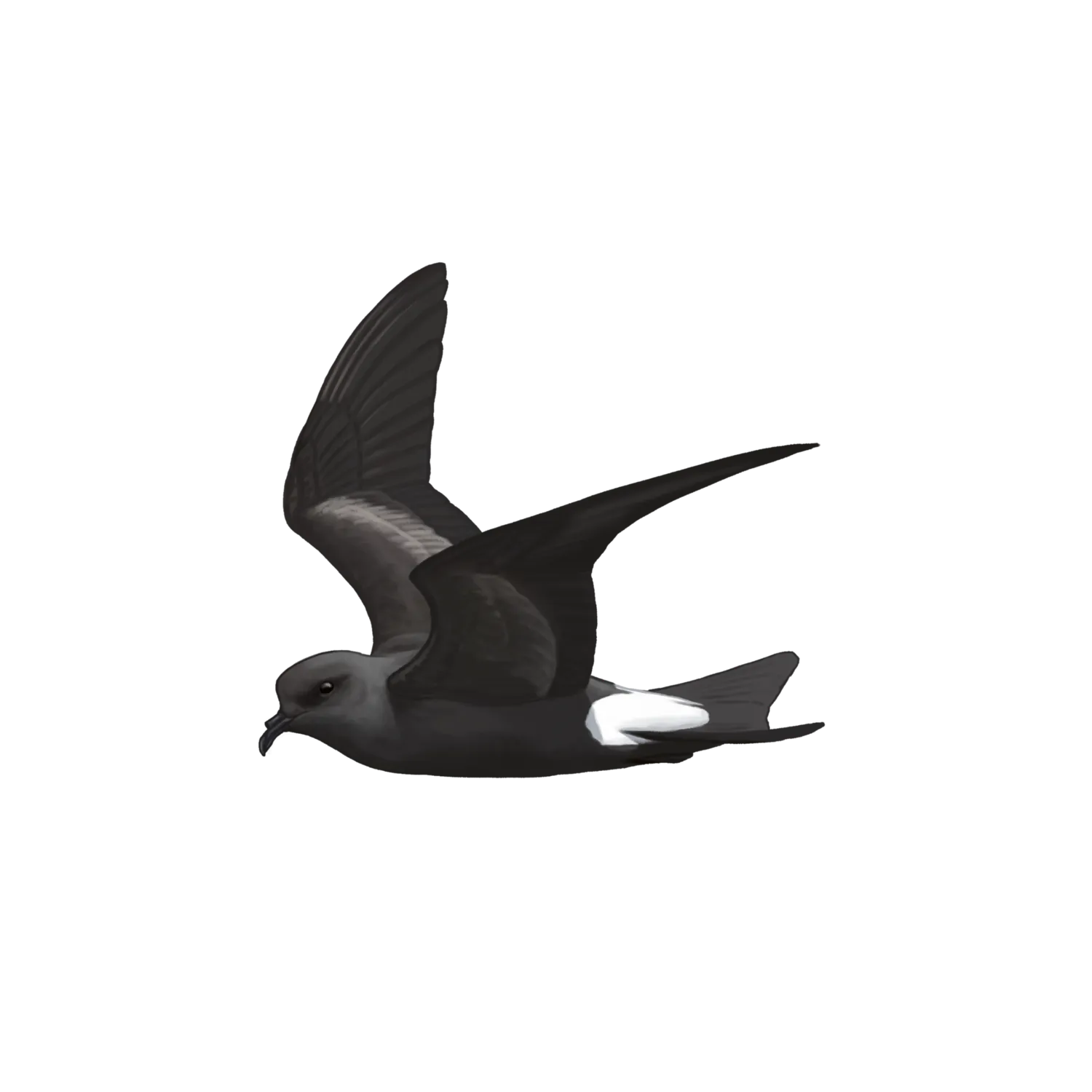
The Leach's Storm-petrel breeds on oceanic islands in the North Atlantic, the North Pacific and off the coast of South Africa (Billerman et al. 2026). The breeding season for the North Atlantic population runs from May to September, after which the birds migrate towards the tropical Atlantic, occasionally reaching South Africa and the western Indian Ocean. During this period, the small portion of the population passing through Portuguese waters appears to prefer deep-sea areas (Meirinho et al. 2014), and is observed near the Mainland coast following major storms (Catry et al. 2010a). In winter, the distribution becomes more restricted again, although some birds remain in the Azores (Hurling et al. 2024). Subsequently, during the spring migration, it occurs more abundantly in deeper waters. Based on the individual tracking of a small sample of 8 birds fitted with GLS devices, originating from two colonies in Canada in 2012, the use of the Portuguese EEZ during migratory periods is confirmed, particularly in the Azores sub-area, and less frequently in the Madeira sub-area.
Abundance and population trends
The global population of the Leach's Storm-petrel has been estimated at around 6.7 to 8.3 million pairs, with a very sharp decline in the main breeding colonies (BirdLife International 2025). Its occurrence is relatively well documented along the coast of Mainland Portugal, appearing following severe storms during autumn and winter. During this period, it is equally common in the Azores and Madeira. However, there is no information regarding its abundance or population trends for any of the three regions, making it impossible to assess the environmental status of these populations.
Ecology and habitat
The Leach's Storm-petrel is a pelagic bird found in areas where ocean currents converge or where upwelling occurs, as well as over continental shelves. It feeds during the day or at night on small mesopelagic fish, mainly from the families Myctophidae and Sternoptychidae, as well as cephalopods and planktonic crustaceans (Hedd & Montevecchi 2006; Silva et al. 2024).
Threats and conservation
Globally, the population of this species has declined sharply in its largest breeding colonies, located in Canada and Europe, leading to its recent reclassification to an unfavourable conservation status. This sharp decline (>30%) is mainly linked to predation by invasive mammals (rats, mice and foxes) and by native species (large gulls and skuas) (Jones 2013; BirdLife International 2025). At sea, the greatest threats stem from attraction to lights and consequent collisions, spatial changes in prey distribution and contaminants (Pollet et al. 2023).
- Autor
Nuno Oliveira
- Owners/sources of tracking data
Silva MC, Catry P, Newton J, Nunes VL & Wakefield ED (2024). Diet of non-breeding leach’s storm-petrels (Hydrobates leucorhous) in the sub-polar frontal zone of the North Atlantic. Marine Biology 171(8): 148. Bibliography:
Pollet IL, Lenske AK, Ausems ANMA, Barbraud C, Bedolla-Guzmán Y, Bicknell AWJ, Bolton M, Bond AL, Delord K, Diamond AW, Fifield DA, Gjerdrum C, Halpin LR, Hansen ES, Hedd A, Hoeg R, Major HL, Mauck RA, McClelland G, McFarlane Tranquilla L, Montevecchi WA, Parker M, Pratte I, Rail J-F, Robertson GJ, Rock JC, Ronconi RA, Shutler D, Stenhouse IJ, Takahashi A, Watanuki Y, Welch LJ, Wilhelm SI, Wong SNP & Mallory ML (2023). Experts’ opinions on threats to Leach’s Storm-Petrels (Hydrobates leucorhous) across their global range. Avian Conservation and Ecology 18(1): art11. Bibliography:
Meirinho A, Barros N, Oliveira N, Catry P, Lecoq M, Paiva V, Geraldes P, Granadeiro JP, Ramírez I & Andrade J (2014). Atlas das Aves Marinhas de Portugal. Sociedade Portuguesa para o Estudo das Aves. Bibliography:
Jones IL (2013). Evolutionary lag of predator avoidance by island seabirds, and what happens when naturally occurring colonists become ‘invasive’. Ibis 155: 1-3 Bibliography:
Hurling S, Hedd A, Hansen S H & Studholme K (2024). Year-round distribution and foraging behaviour of Icelandic Leach's and European Storm-petrel populations revealed. Conference: 16th International Seabird Conference. Coimbra, Portugal. Bibliography:
Hedd A & Montevecchi WA (2006). Diet and trophic position of Leach’s storm-petrel Oceanodroma leucorhoa during breeding and moult, inferred from stable isotope analysis of feathers. Marine Ecology Progress Series 322: 291-301. Bibliography:
BirdLife International (2025). IUCN Red List for birds. Downloaded from https://datazone.birdlife.org on 30.11.2025. Bibliography:
Billerman SM, Keeney BL, Kirwan GM, Medrano F, Sly ND & Smith MG (eds.) (2026). Birds of the World. Cornell Laboratory of Ornithology, Ithaca, NY, USA. Bibliography:
Catry P, Costa H, Elias G & Matias R (2010a). Aves de Portugal, Ornitologia do Território Continental. Assírio e Alvim, Lisboa Data:
Pollet IL (2012b). Dataset 1707: Leach's Storm-petrel, Hydrobates leucorhous, Geolocator (GLS), Country Island, Country Island, Canada, 2012. BirdLife International Seabird Tracking Database. Downloaded from https://data.seabirdtracking.org/dataset/1707/ on 30.11.2025. Data:
Pollet IL (2012a). Dataset 1706: Leach's Storm-petrel, Hydrobates leucorhous, Geolocator (GLS), Bon Portage, Bon Portage, Canada, 2012. BirdLife International Seabird Tracking Database. Downloaded from https://data.seabirdtracking.org/dataset/1706/ on 30.11.2025. Glossary:
A group of marine arthropods that are important in the marine food chain. Glossary:
A group of marine molluscs that includes squids, cuttlefish and octopuses. Glossary:
Monitoring the movements of individuals using tracking devices. Glossary:
The direction of change in the size of a population over time (increase, decline or stability). Glossary:
A concept defined under the Marine Strategy Framework Directive (MSFD), referring to the condition of the elements of the marine environment, including birds. It aims to assess whether ecosystems are healthy, balanced and capable of supporting ecological functions and human uses in a sustainable manner. The ultimate goal is for the components and ecosystems to achieve Good Environmental Status. Glossary:
Under the United Nations Convention on the Law of the Sea, coastal states are entitled to declare an EEZ comprising maritime area beyond their territorial waters. The national EEZ is delimited by an imaginary line situated 200 nautical miles from the coast, separating national waters from international or shared waters. Within its EEZ, each state has rights such as the exploitation of marine resources, the conduct of scientific research and the regulation of fishing by foreign vessels. Glossary:
The portion of the seabed that begins at the coastline and slopes gently downwards to the continental slope (where the slope is much steeper). On average, the continental shelf extends to a depth of 200 metres. Glossary:
The area or environment where organisms that do not depend on the seafloor normally live. It is the typical ecological environment of open ocean waters. The pelagic ecosystem does not include only the open sea; it also comprises the waters covering the continental shelf. The pelagic zone begins below the influence of tides and extends into the open ocean, at depths ranging from a few tens of metres to approximately 6,000 metres, and is divided into different layers. Glossary:
A marine organism living in the water column generally between 200 and 1,000 metres in depth. Glossary:
A small device attached to birds to study their large-scale movements (usually migration), which works by recording light intensity (from which the duration of night and the local midday time are estimated, and consequently the latitude and longitude on each day). Glossary:
Classification of the threat level of a species according to its probability of extinction. The criteria for this classification generally follow internationally recognised rules defined by the International Union for Conservation of Nature (IUCN) (http://www.redlist.org) and are based on population size, range and population trend. This status may be national or international. Glossary:
A phenomenon involving interaction between the ocean and the atmosphere, in which warm surface waters move away from the coast and are replaced by cooler, nutrient-rich waters from the depths.