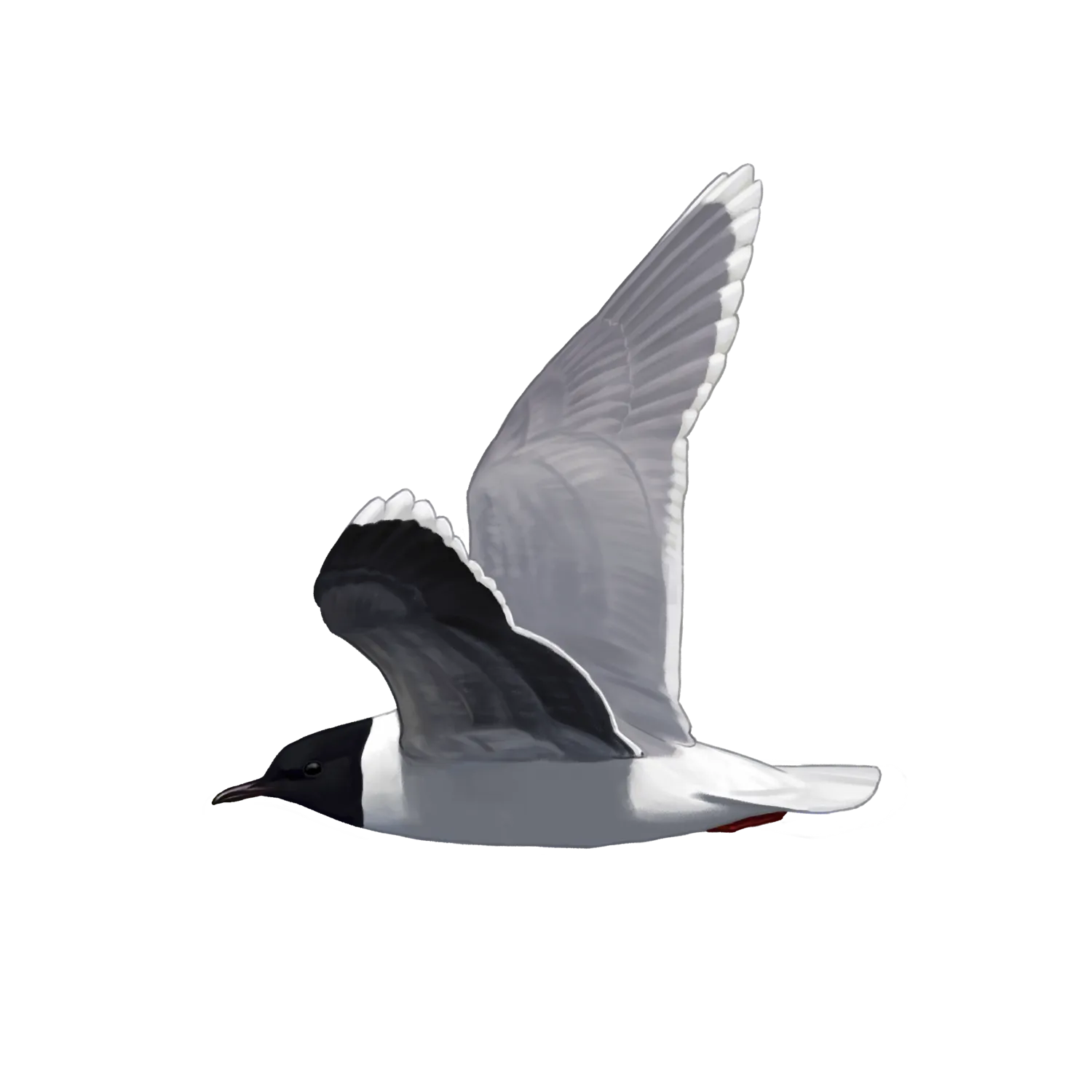
Little Gull
Scientific name: Hydrocoloeus minutus
Family laridae
Phenology
- Mainland
- Wintering and passage migrant
- Madeira
- Vagrant
- Azores
- Vagrant
Conservation status
Learn more- Mainland
- Madeira
- Azores
- IUCN Global
Data
Maps
Occurrence | Spring
Scale
Minimum value:
Maximum value:
Scale
Minimum value:
Maximum value:
Scale
Minimum value:
Maximum value:
Scale
Minimum value:>
Maximum value:<
Scale
Minimum value:
Maximum value:
Scale
Minimum value:>
Maximum value:>
Distribution based on seabird tracking data (locations/hexagone).
Colony(ies) of origin:
Device:
Data period / number of individuals:
Data period / number of individuals:
Distribution of seabird breeding colonies or sites (number of breeding pairs).
Distribution based on marine censuses (probability of occurrence).
Observed density based on marine censuses (birds/ km2).
Confirmed occurence during marines censuses.
Abundance of waders derived from Project Arenaria coastal surveys (birds/square).
Passage rates derived from RAM coastal surveys (birds/hour).
No data available for the selected period.
Presentation
Distribution, movements and phenology
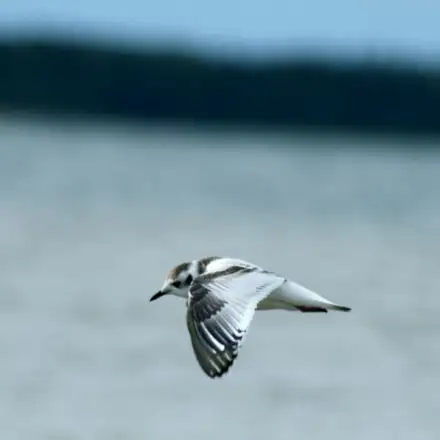
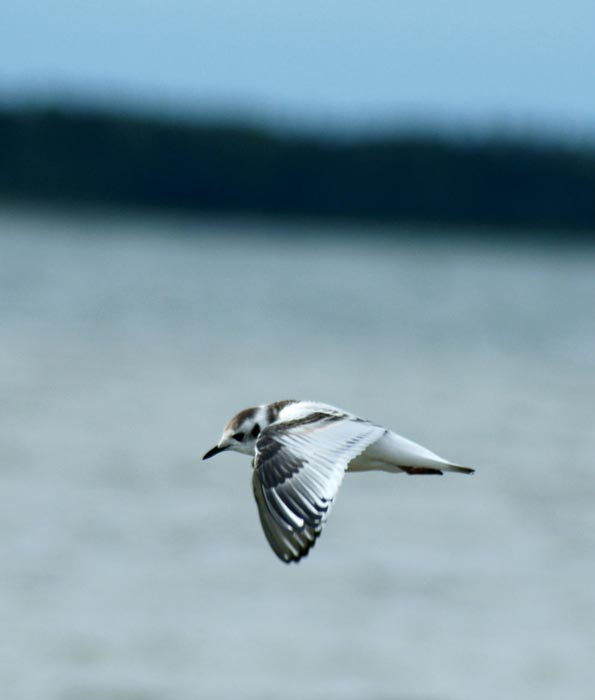
This gull breeds in Scandinavia, the Baltic states, Russia and Siberia, as well as in the Great Lakes region of the USA. Outside the breeding season, it migrates to the Mediterranean, Black and Caspian Seas and to the north-east coast of America (del Hoyo et al. 1996). In Mainland Portugal, the species occurs sporadically along the entire coastline, being observed mainly during periods of migratory passage and during winter (Catry et al. 2010a). Although the movements of the species are poorly documented, most individuals from Western European populations are thought to winter and migrate at sea, occurring over the continental shelf (Hutchinson & Neath 1978; del Hoyo et al. 1996). The occurrence of the species in greater numbers along the coast is linked to adverse weather conditions, particularly strong westerly winds (Catry et al. 2010a). The birds observed in Portugal are likely to originate from Russian and Baltic Sea populations (del Hoyo et al. 1996). Some of the individuals observed migrating along the Portuguese coast may winter in the western Mediterranean, where the species’ most important wintering area in the Western Palearctic is located (Finlayson 1992). In the Azores, records of this gull are very rare (Birding Azores 2014), and its occurrence in the Madeira archipelago is also exceptional.
Abundance and population trends
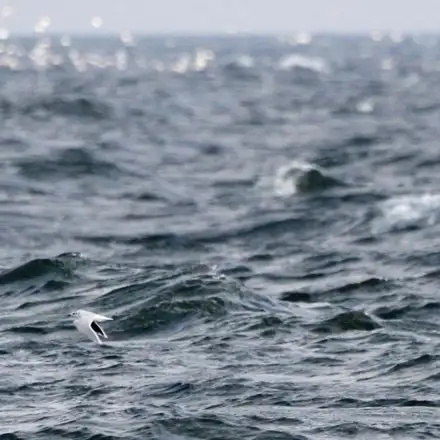
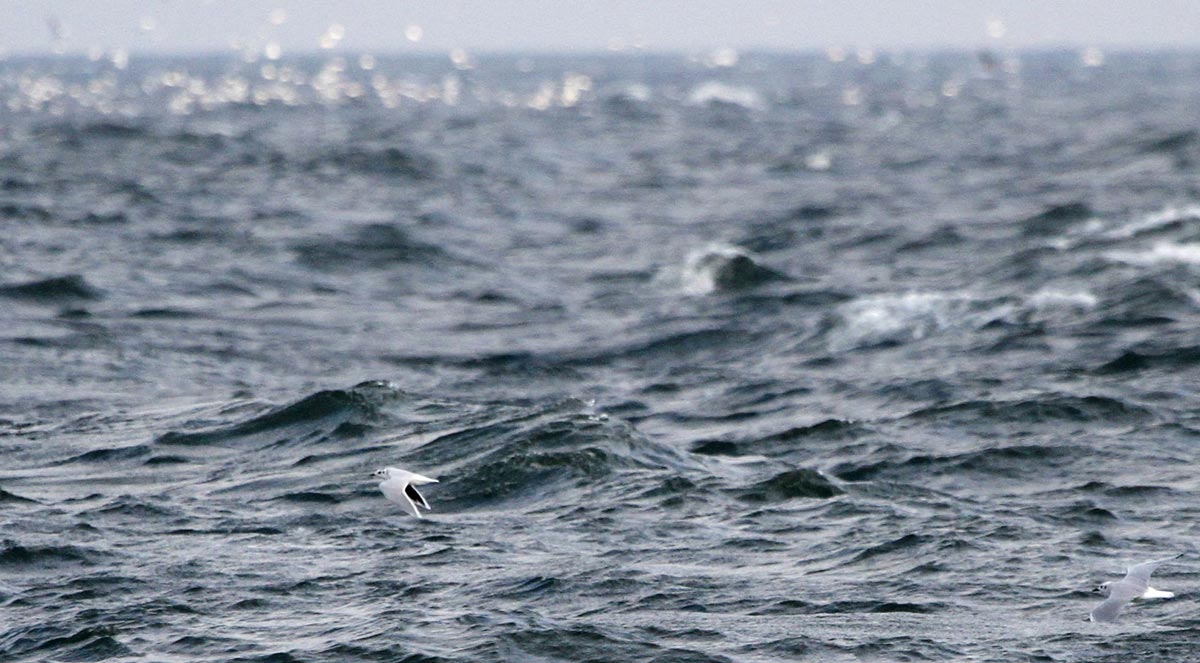
It is a very scarce species in Mainland Portugal, with observations involving larger numbers referring to only a few dozen birds (Catry et al. 2010a; Ornithological Reports). In January 1996, 41 individuals were recorded during winter bird counts in Portuguese wetlands (Costa & Rufino 1996). The highest record of the species in Portugal involved 120 to 150 birds in the Douro estuary (Hoogendoorn et al. 2003) during the pre-breeding migration period. The fact that this gull has pelagic habits may explain the very low number of individuals recorded in the Iberian Peninsula during coastal censuses (Bermejo et al. 1986). In the marine censuses carried out as part of this atlas, the Little Gull was not recorded during the winter period. At sea, the species was only recorded singly or in small groups in March and April, with most of these records relating to 2009, following a period of severe storms in the North Atlantic (AEMET 2011).
Ecology and habitat
During the breeding season, this gull frequents inland wetlands, whilst during the wintering and migratory seasons it occurs along the coast. In Portugal, it can be observed along the coastline, on beaches, in estuarine areas, coastal lagoons, salt pan complexes or aquaculture sites (Catry et al. 2010a). The species is primarily insectivorous during the breeding months, with its diet varying in the winter months to include small fish and marine invertebrates (del Hoyo et al. 1996).
Threats and conservation
Globally, the population trend for this species is one of slight increase (Delany & Scott 2006; BirdLife International 2014), although no information is available in Portugal to confirm this trend. No specific threats to this gull are known, and the status of its populations is of little concern.
- Autor
Delany S & Scott D (2006). Waterbird population estimates. Wetlands International, Wageningen, The Netherlands. Bibliography:
AEMET - Agencia Estatal de Meteorologia (2011). Análisis preliminar de la situación del 22-25 de enero de 2009. Un caso de ciclogénesis explosiva extraordinaria. Bibliography:
Bermejo A, Carrera E, de Juana E & Teixeira AM (1986). Primer censo general de gaviotas y charranes (Laridae) invernantes en la Península Ibérica (Enero de 1984). Ardeola 33: 47–68. Bibliography:
Hoogendoorn W, Adriaens P, Cederroth C, Smet G & Lindholm A (2003). Interesting gull records at Porto, Portugal, in March-April 2001. Dutch Birding 25(4): 235-246. Bibliography:
Costa LT & Rufino R (1996). Contagens de aves aquáticas em Portugal – Janeiro de 1996. Airo 7:69-76. Bibliography:
Observations published in Ornithological Reports, see Book Atlas of Seabirds of Portugal – pp. 207. Bibliography:
Finlayson JC (1992). Birds of the Strait of Gibraltar. T & AD Poyser, London, UK. Bibliography:
Hutchinson CD & Neath B (1978). Little Gulls in Britain and Ireland. British Birds 71: 563-582. Bibliography:
del Hoyo J, Elliot A & Sargatal J (eds.) (1996). Handbook of the birds of the world. Vol. 3. Lynx Edicions, Barcelona Bibliography:
Meirinho A, Barros N, Oliveira N, Catry P, Lecoq M, Paiva V, Geraldes P, Granadeiro JP, Ramírez I & Andrade J (2014). Atlas das Aves Marinhas de Portugal. Sociedade Portuguesa para o Estudo das Aves. Bibliography:
BirdLife International (2014). http://www.birdlife.org/europe-and-central-asia/european-red-list-birds-0 Bibliography:
Birding Azores (2014). http://www.birdingazores.com/ Bibliography:
Catry P, Costa H, Elias G & Matias R (2010a). Aves de Portugal, Ornitologia do Território Continental. Assírio e Alvim, Lisboa Glossary:
Referring to the period preceding breeding. Glossary:
The area or environment where organisms that do not depend on the seafloor normally live. It is the typical ecological environment of open ocean waters. The pelagic ecosystem does not include only the open sea; it also comprises the waters covering the continental shelf. The pelagic zone begins below the influence of tides and extends into the open ocean, at depths ranging from a few tens of metres to approximately 6,000 metres, and is divided into different layers. Glossary:
A period generally corresponding to the winter months, which may include part of autumn.