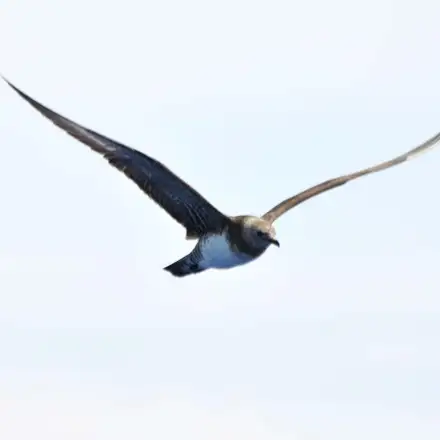
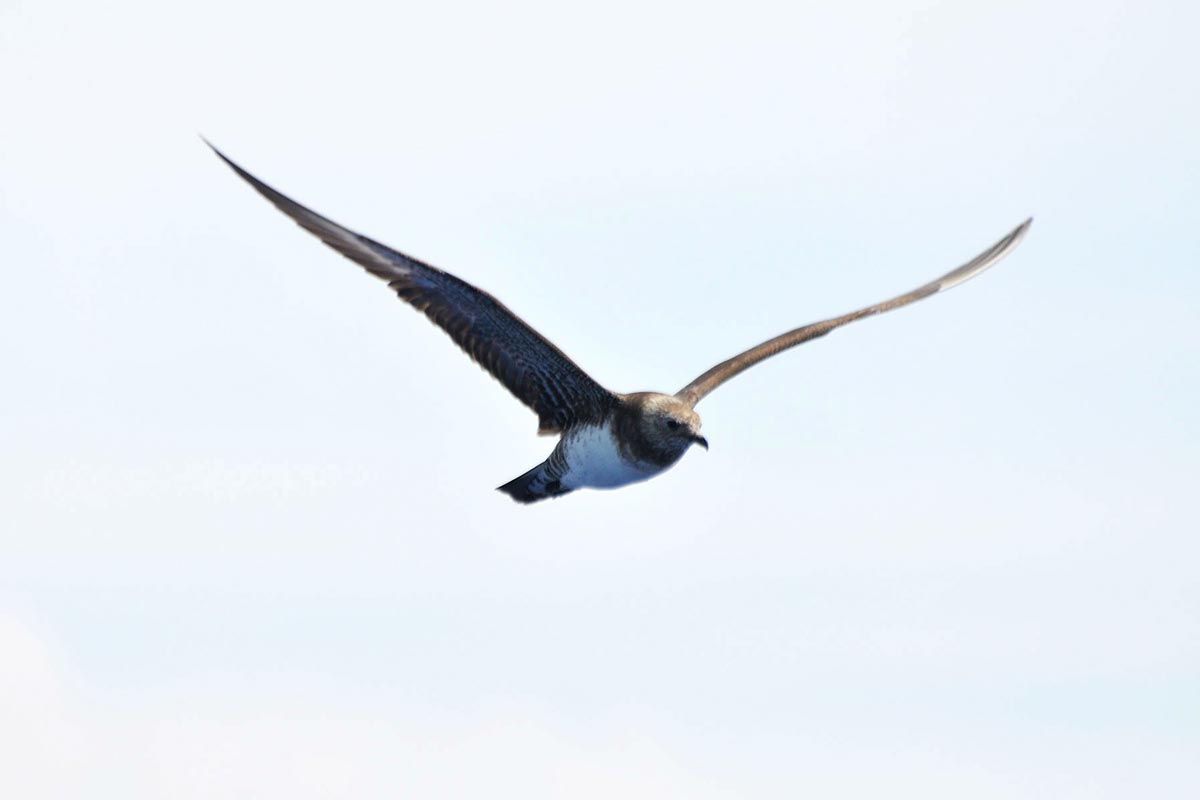
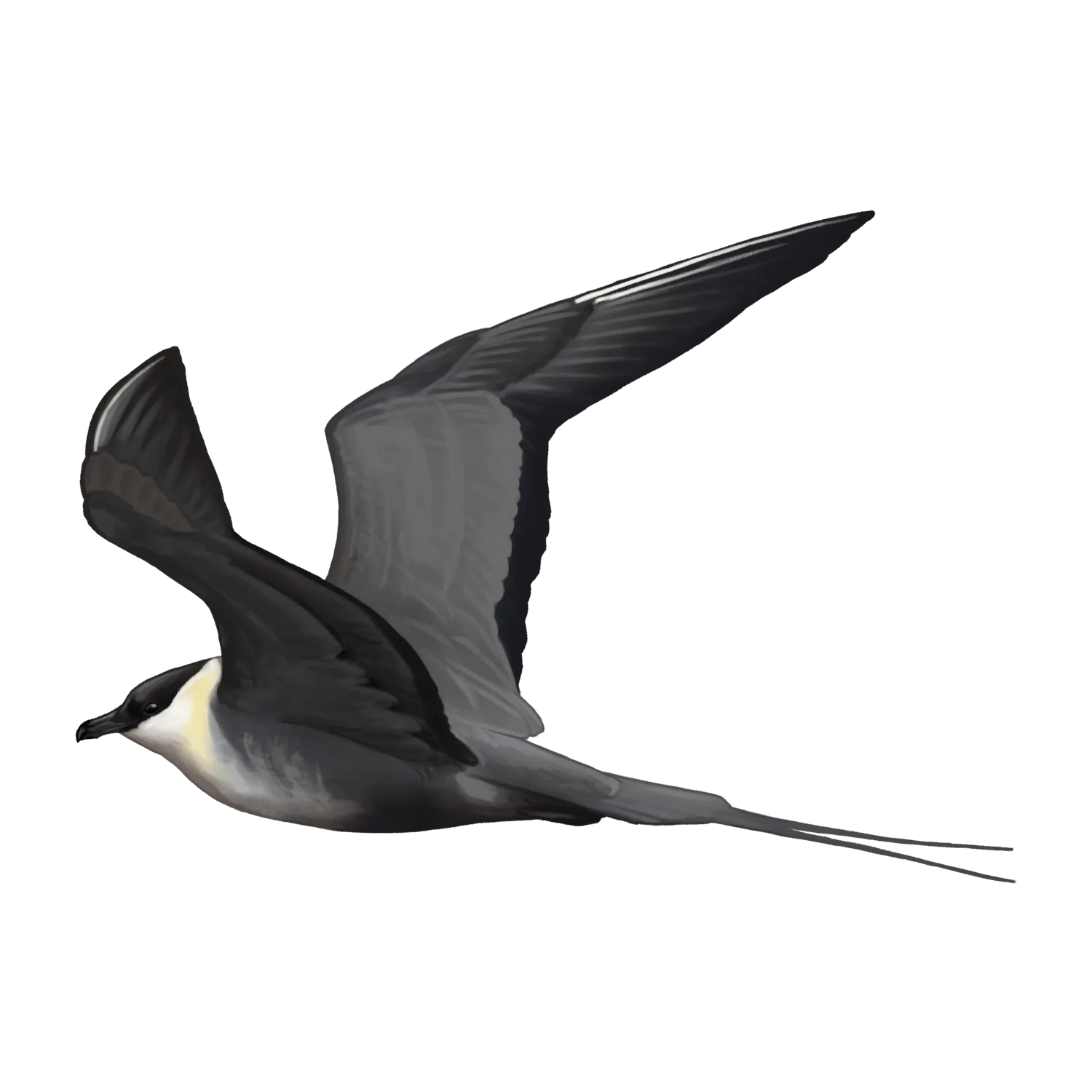
Long-tailed Jaeger
Scientific name: Stercorarius longicaudus
Family stercorariidae
Phenology
- Mainland
- Passage migrant
- Madeira
- Passage migrant
- Azores
- Passage migrant
Conservation status
Learn more- Mainland
- Madeira
- Azores
- IUCN Global
Data
Maps
Distribution | Breeding
Scale
Minimum value:
Maximum value:
Scale
Minimum value:
Maximum value:
Scale
Minimum value:
Maximum value:
Scale
Minimum value:>
Maximum value:<
Scale
Minimum value:
Maximum value:
Scale
Minimum value:>
Maximum value:>
Distribution based on seabird tracking data (locations/hexagone).
Colony(ies) of origin:
Device:
Data period / number of individuals:
Data period / number of individuals:
Distribution of seabird breeding colonies or sites (number of breeding pairs).
Distribution based on marine censuses (probability of occurrence).
Observed density based on marine censuses (birds/ km2).
Confirmed occurence during marines censuses.
Abundance of waders derived from Project Arenaria coastal surveys (birds/square).
Passage rates derived from RAM coastal surveys (birds/hour).
No data available for the selected period.
Presentation
Distribution, movements and phenology
The Long-tailed Jaeger breeds between June and August in the circumpolar Arctic region and winters in the seas of the southern hemisphere (Gilg et al. 2013; Billerman et al. 2026). The Atlantic population uses the Atlantic Ocean Marine Flyway, with a portion of the population frequently utilising the Portuguese EEZ during migrations (Gilg et al. 2013). On the Mainland, it occurs mainly during post-breeding migration between August and October, preferring pelagic waters but also the continental shelf, and is observed passing close to headlands, particularly after storms (Moore 2000; Sittler et al. 2011; Elmberg et al. 2020). It is also a regular visitor to the Azores and Madeira during migration (Sittler et al. 2011; Meirinho et al. 2014).
Based on data from 38 birds, from colonies in Greenland, Sweden and Norway, fitted with GLS, use of the Portuguese EEZ was observed during both phenological periods, but with greater occurrence during the migratory periods (April, May, August and September). Most records were concentrated in the Azores sub-area, followed by the Madeira sub-area, with extensive use of both. On the Mainland, occurrences were very sporadic.
Abundance and population trends
The global population has been estimated at around 250,000 to 749,999 mature individuals (BirdLife International 2025). The population is thought to be stable, with no evidence of any decline or substantial threat. In recent decades, there has been an increase in sightings of this species in Portugal, likely due to increased observation efforts. However, the lack of systematic information regarding its abundance and population trends has prevented an assessment of the species’ environmental status within the Portuguese EEZ.
Ecology and habitat
The Long-tailed Jaeger is a highly pelagic marine species outside the breeding season. It nests on the ground in the Arctic and sub-Arctic tundra and also in the alpine tundra up to an altitude of 1,300 metres in Scandinavia (BirdLife International 2025). During the breeding season, it feeds on lemmings, shrews, various insects, berries and small birds (Billerman et al. 2026). In winter, its diet consists mainly of fish, sometimes obtained through kleptoparasitism.
Threats and conservation
Low food availability can lead to declines in breeding success, as productivity fluctuates in line with changes in the lemmings population, a key prey item during the breeding season (Billerman et al. 2026). However, no specific threats to the Long-tailed Jaeger have been described.
- Autor
Tânia Nascimento
- Owners/sources of tracking data
Borge Moe & Sveinn Are Hansen, Lang 2013, Olivier Gilg, Sittler et al. 2011, van Bemmelen et al. 2017
Sittler B, Aebischer A & Gilg O (2011). Post-breeding migration of four Long-tailed Skuas (Stercorarius longicaudus) from North and East Greenland to West Africa. Journal of Ornithology 152: 375-381. Bibliography:
Moore CC (2000). Movimentações invulgares de aves marinhas junto ao cabo Carvoeiro. Pardela 13: 7-10. Bibliography:
Meirinho A, Barros N, Oliveira N, Catry P, Lecoq M, Paiva V, Geraldes P, Granadeiro JP, Ramírez I & Andrade J (2014). Atlas das Aves Marinhas de Portugal. Sociedade Portuguesa para o Estudo das Aves. Bibliography:
Gilg O, Moe B, Hanssen SA, Schmidt NM, Sittler B, Hansen J, Reneerkens J, Sabard B, Chastel O, Moreau J, Phillips RA, Oudman T, Biersma EM, Fenstad AA, Lang J & Bollache L (2013). Trans-equatorial migration routes, staging sites and wintering areas of a High-Arctic avian predator: The Long-tailed Skua (Stercorarius longicaudus). PLoS ONE 8(5): e64614. Bibliography:
Elmberg J, Hirschfeld E, Cardoso H & Hessel R (2020). Seabird migration at Cabo Carvoeiro (Peniche, Portugal) in autumn 2015. Marine Ornithology 48: 231-244. Bibliography:
BirdLife International (2025). IUCN Red List for birds. Downloaded from https://datazone.birdlife.org on 30.11.2025. Bibliography:
Billerman SM, Keeney BL, Kirwan GM, Medrano F, Sly ND & Smith MG (eds.) (2026). Birds of the World. Cornell Laboratory of Ornithology, Ithaca, NY, USA. Data:
Sittler B, Aebischer A & Gilg O (2011) Post-breeding migration of four Long-tailed Skuas (Stercorarius longicaudus) from North and East Greenland to West Africa. Journal of Ornithology 152: 375-381. Data:
van Bemmelen R, Moe B, Hanssen SA, Schmidt NM, Hansen J, Lang J, Sittler B, Bollache L, Tulp I, Klaassen R & Gilg O (2017). Flexibility in otherwise consistent non-breeding movements of a long-distance migratory seabird, the long-tailed skua. Marine Ecology Progress Series 578: 197–211. Data:
Lang J (2013). Dataset 1098: Long-tailed Jaeger, Stercorarius longicaudus, Geolocator (GLS), Karupelv, Greenland, Greenland, 2010–2013. BirdLife International Seabird Tracking Database. Downloaded from https://data.seabirdtracking.org/dataset/1098/ on 30.11.2025. Glossary:
A rocky, steep and prominent geographical area that projects into the sea, often forming a cape. Glossary:
Individuals capable of breeding, used as a reference in population estimates. Glossary:
A measure of a population’s breeding success, generally expressed as the average number of chicks produced per pair. Glossary:
A concept defined under the Marine Strategy Framework Directive (MSFD), referring to the condition of the elements of the marine environment, including birds. It aims to assess whether ecosystems are healthy, balanced and capable of supporting ecological functions and human uses in a sustainable manner. The ultimate goal is for the components and ecosystems to achieve Good Environmental Status. Glossary:
Under the United Nations Convention on the Law of the Sea, coastal states are entitled to declare an EEZ comprising maritime area beyond their territorial waters. The national EEZ is delimited by an imaginary line situated 200 nautical miles from the coast, separating national waters from international or shared waters. Within its EEZ, each state has rights such as the exploitation of marine resources, the conduct of scientific research and the regulation of fishing by foreign vessels. Glossary:
The name given to the extensive plains with low-growing vegetation and no trees, characteristic of Arctic and sub-Arctic regions. The tundra is generally a very cold region with low precipitation. Glossary:
Referring to the period following breeding. Glossary:
The portion of the seabed that begins at the coastline and slopes gently downwards to the continental slope (where the slope is much steeper). On average, the continental shelf extends to a depth of 200 metres. Glossary:
The area or environment where organisms that do not depend on the seafloor normally live. It is the typical ecological environment of open ocean waters. The pelagic ecosystem does not include only the open sea; it also comprises the waters covering the continental shelf. The pelagic zone begins below the influence of tides and extends into the open ocean, at depths ranging from a few tens of metres to approximately 6,000 metres, and is divided into different layers. Glossary:
Name given to a group of small herbivorous rodents found in the Arctic tundra and sub-Arctic regions, belonging to the family Cricetidae. Glossary:
A small device attached to birds to study their large-scale movements (usually migration), which works by recording light intensity (from which the duration of night and the local midday time are estimated, and consequently the latitude and longitude on each day). Glossary:
A feeding method in which one individual steals food from another.