Manx Shearwater
Scientific name: Puffinus puffinus
Family procellariidae
Phenology
- Mainland
- Passage migrant
- Madeira
- Summer breeder and passage migrant
- Azores
- Summer breeder and passage migrant
Conservation status
Learn more- Mainland
- Madeira
- Azores
- IUCN Global
Data
Maps
Distribution | Breeding
Scale
Minimum value:
Maximum value:
Scale
Minimum value:
Maximum value:
Scale
Minimum value:
Maximum value:
Scale
Minimum value:>
Maximum value:<
Scale
Minimum value:
Maximum value:
Scale
Minimum value:>
Maximum value:>
Distribution based on seabird tracking data (locations/hexagone).
Colony(ies) of origin:
Device:
Data period / number of individuals:
Data period / number of individuals:
Distribution of seabird breeding colonies or sites (number of breeding pairs).
Distribution based on marine censuses (probability of occurrence).
Observed density based on marine censuses (birds/ km2).
Confirmed occurence during marines censuses.
Abundance of waders derived from Project Arenaria coastal surveys (birds/square).
Passage rates derived from RAM coastal surveys (birds/hour).
No data available for the selected period.
Presentation
Distribution, movements and phenology
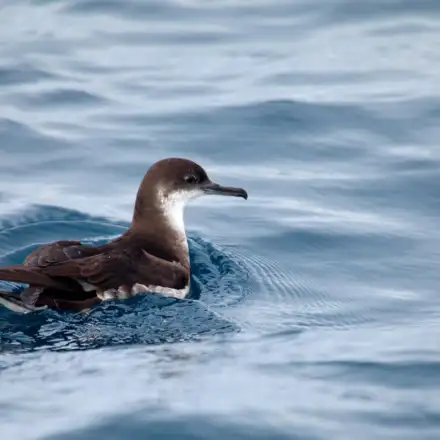
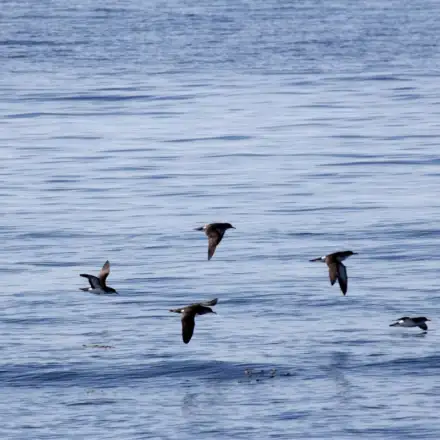
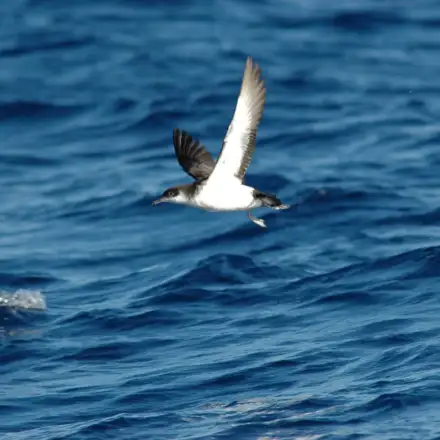
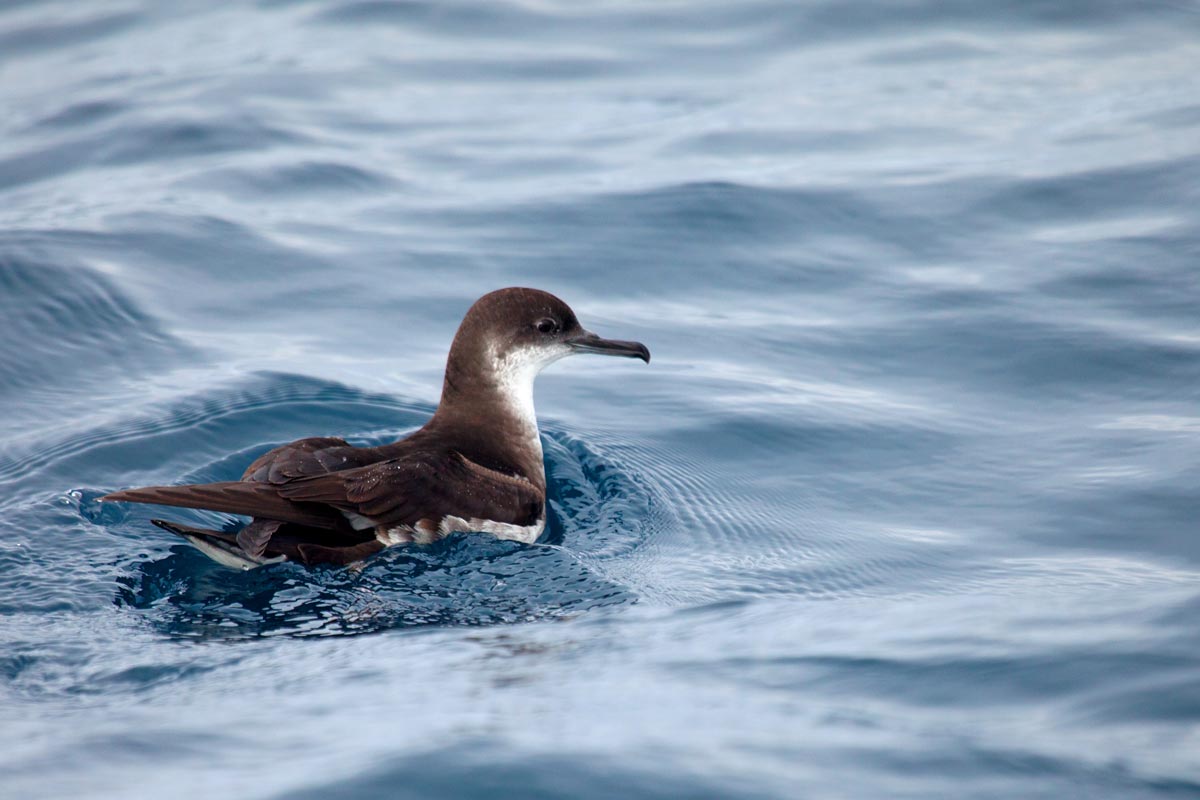
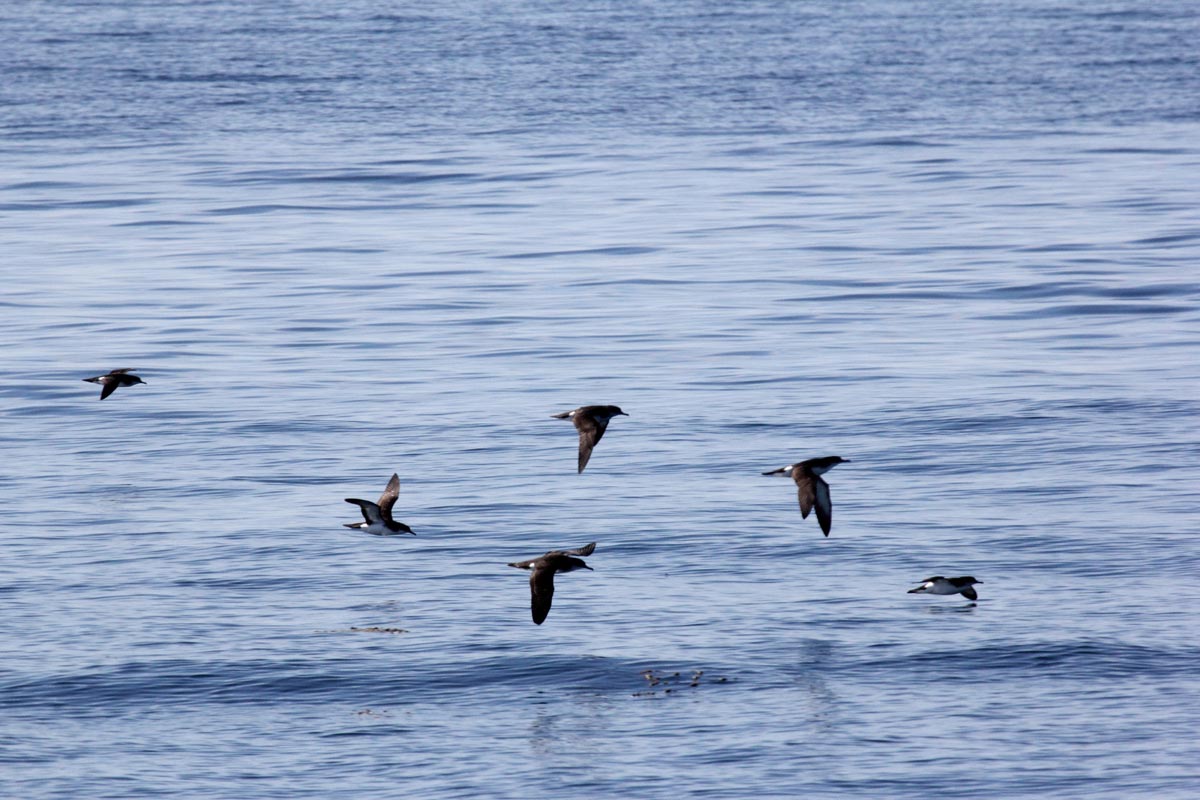
The Manx Shearwater breeds in the North Atlantic between February and August, mainly in the United Kingdom and Ireland, with small colonies in Canada, the United States, Iceland, Spain and Portugal (Billerman et al. 2026). In Portugal, it breeds on the island of Madeira and on the islands of Flores and Corvo in the Azores (Equipa Atlas 2022). It has also recently been recorded on the islands of São Miguel, Santa Maria, Terceira, São Jorge and Faial, although it has not been possible to confirm breeding there. The species is most frequent and abundant in Portuguese waters during post-breeding migration, especially between August and October, when birds from the largest populations, originating from the British Isles, pass through our waters (Meirinho et al. 2014; Elmberg et al. 2020), heading towards their wintering grounds in South America (Guilford et al. 2009). Data from 12 birds fitted with GLS between 2006 and 2014 in Iceland show that these birds use the Azores region during both phenological periods, being particularly frequent during the breeding season. They appear to have a preference for the deep waters of the western half of the region. The species has not been recorded on the Mainland or in Madeira.
Abundance and population trends
The global population has been estimated at 680,000 to 790,000 mature birds, with an unknown trend (BirdLife International 2025). In Mainland Portugal, 16,086 birds were counted migrating southwards in autumn 2015 (Elmberg et al. 2020). Based on the data used for the environmental status assessment, an estimate of around 5,300 to 19,000 individuals was obtained for the continental shelf in 2024. Estimates of breeding populations in the archipelagos are very outdated and subject to a high degree of uncertainty. In the Azores, the population was estimated at 115 to 240 pairs, whilst in Madeira it was estimated at 1,250 to 5,000 pairs (Equipa Atlas 2022). The species was likely much more numerous in the Azores several centuries ago (Monteiro et al. 1996a).
Despite the lack of more concrete estimates, the Mainland population failed to achieve Good Environmental Status for the abundance indicator. It was not possible to carry out this assessment for the waters of the Azores and Madeira.
Ecology and habitat
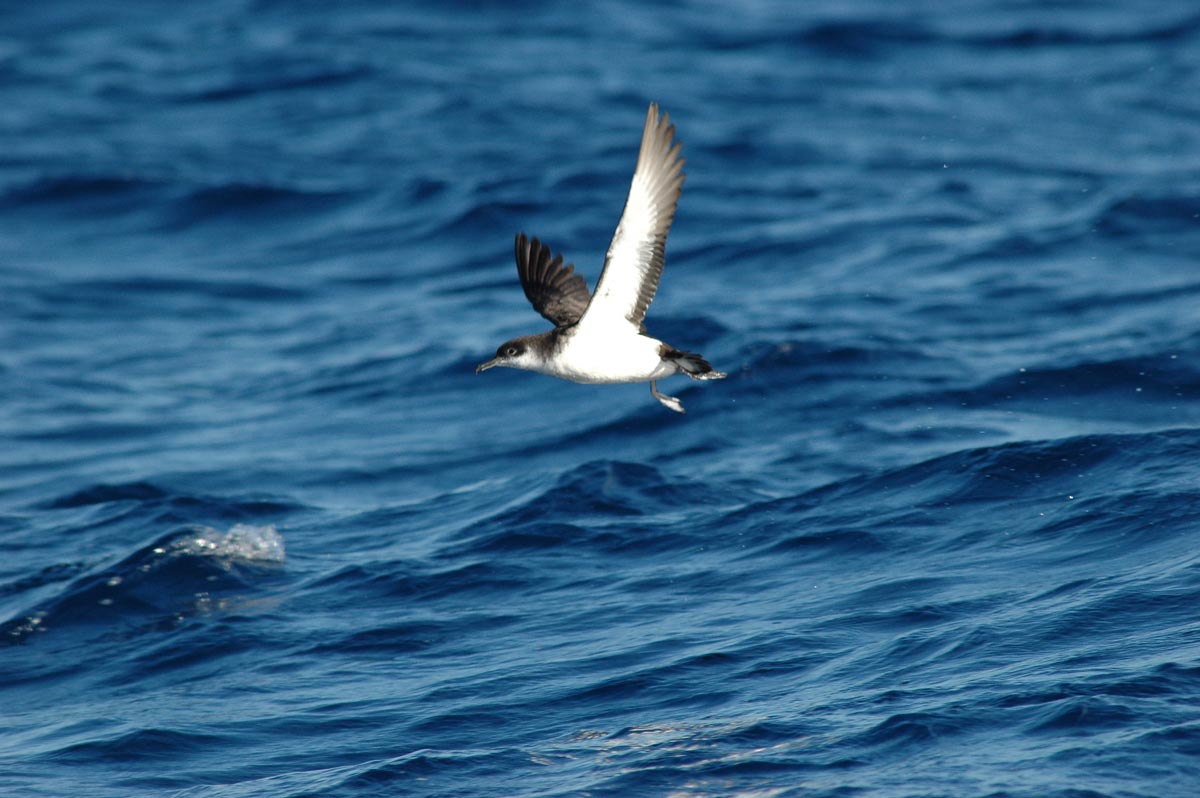
Despite its typically pelagic habits, the Manx Shearwater exploits both deeper waters and areas close to the coast. It feeds on fish (mainly small pelagic species), cephalopods and crustaceans, as well as fishing discards (Billerman et al. 2026). In Madeira, it nests on cliffs in the interior of the island, above 500 metres in altitude, in areas of laurel forest (Nunes et al. 2010), appearing to breed two months earlier than in other nesting areas (Hervias et al. 2013). In the Azores, and particularly on Corvo and Flores, the colonies are located on steep and inaccessible cliffs.
Threats and conservation
In Portugal, in the distant past, this species suffered a sharp reduction in its colonies as a result of the introduction of terrestrial predators and direct capture for the exploitation of oil, meat and feathers (Monteiro et al. 1999; Oliveira 1999). Currently, the most significant threat remains the presence of introduced predators in breeding areas. Light pollution is also a major threat. When fledglings leave their nests, they are dazzled and forced to ground, leaving them vulnerable to collision with vehicles or predation by dogs, cats and other mammals. Between 2009 and 2025, 125 fledglings were rescued on the island of Corvo, having become disoriented by street lighting.
- Autor
Tânia Pipa
- Owners/sources of tracking data
Nunes J, Nunes M, Fagundes AI & Valkenburg T (2010). Contributo para a conservação do Fura-bucho-do-Atlântico Puffinus puffinus, uma espécie ameaçada na ilha da Madeira. Airo 20: 12-21. Bibliography:
Monteiro LR , Ramos JA, Pereira JC, Monteiro PR, Feio RS, Thompson DR, Bearshop S, Furness RW, Laranjo M, Hilton G, Neves VC, Groz MP & Thompson KR (1999). Status and distribution of Fea’s Petrel, Bulwer’s Petrel, Manx Shearwater, Little Shearwater and Band-rumped Storm-Petrel in the Azores Archipelago. Waterbirds 22(3): 358-366. Bibliography:
Monteiro LR, Ramos JA, Furness RW (1996a). Past and present status and conservation of the seabirds breeding in the Azores Archipelago. Biological Conservation 78: 319–328. Bibliography:
Meirinho A, Barros N, Oliveira N, Catry P, Lecoq M, Paiva V, Geraldes P, Granadeiro JP, Ramírez I & Andrade J (2014). Atlas das Aves Marinhas de Portugal. Sociedade Portuguesa para o Estudo das Aves. Bibliography:
Guilford T, Meade J, Willis J, Phillips RA, Roberts S, Collett T, Freeman R & Perrins CM (2009). Migration and stopover in a small pelagic seabird, the Manx Shearwater Puffinus puffinus: insights from machine learning. Proceedings of the Royal Society B 276: 1215-1223. Bibliography:
Equipa Atlas (2022). III Atlas das Aves Nidificantes de Portugal (2016-2021). SPEA, ICNF, LabOr/UÉ, IFCN. Portugal. Bibliography:
Elmberg J, Hirschfeld E, Cardoso H & Hessel R (2020). Seabird migration at Cabo Carvoeiro (Peniche, Portugal) in autumn 2015. Marine Ornithology 48: 231-244. Bibliography:
BirdLife International (2025). IUCN Red List for birds. Downloaded from https://datazone.birdlife.org on 30.11.2025. Bibliography:
Billerman SM, Keeney BL, Kirwan GM, Medrano F, Sly ND & Smith MG (eds.) (2026). Birds of the World. Cornell Laboratory of Ornithology, Ithaca, NY, USA. Bibliography:
Hervías S, Henriques A, Oliveira N, Pipa T, Cowen H, Ramos J A, Nogales M, Geraldes P, Silva C, Ybáñez R R & Oppel S (2013). Studying the effects of multiple invasive mammals on Cory’s shearwater nest survival. Biological Invasions 15: 143-155. Bibliography:
Oliveira P (1999). A conservação e gestão das aves do arquipélago da Madeira. Parque Natural da Madeira Data:
Gonzalez-Solis J (2014b). Dataset 1083: Manx Shearwater, Puffinus puffinus, Geolocator (GLS), Heimaey, Iceland, Iceland, 2006–2014. BirdLife International Seabird Tracking Database. Downloaded from https://data.seabirdtracking.org/dataset/1083/ on 30.11.2025. Glossary:
A group of marine arthropods that are important in the marine food chain. Glossary:
A group of marine molluscs that includes squids, cuttlefish and octopuses. Glossary:
Alteration of natural night-time light levels due to artificial lighting. Glossary:
Areas where birds remain outside the breeding season, generally associated with favourable conditions for feeding and survival. Glossary:
A species or parameter that reflects the state of an ecosystem or environmental changes. Glossary:
The direction of change in the size of a population over time (increase, decline or stability). Glossary:
A concept defined under the Marine Strategy Framework Directive (MSFD), referring to the condition of the elements of the marine environment, including birds. It aims to assess whether ecosystems are healthy, balanced and capable of supporting ecological functions and human uses in a sustainable manner. The ultimate goal is for the components and ecosystems to achieve Good Environmental Status. Glossary:
Referring to the period following breeding. Glossary:
The portion of the seabed that begins at the coastline and slopes gently downwards to the continental slope (where the slope is much steeper). On average, the continental shelf extends to a depth of 200 metres. Glossary:
The area or environment where organisms that do not depend on the seafloor normally live. It is the typical ecological environment of open ocean waters. The pelagic ecosystem does not include only the open sea; it also comprises the waters covering the continental shelf. The pelagic zone begins below the influence of tides and extends into the open ocean, at depths ranging from a few tens of metres to approximately 6,000 metres, and is divided into different layers. Glossary:
A small device attached to birds to study their large-scale movements (usually migration), which works by recording light intensity (from which the duration of night and the local midday time are estimated, and consequently the latitude and longitude on each day). Glossary:
A term generally applied to a species introduced deliberately or accidentally into a specific location or region outside its original range. Depending on its adaptation to the new environment, an introduced species may or may not become naturalised and proliferate.