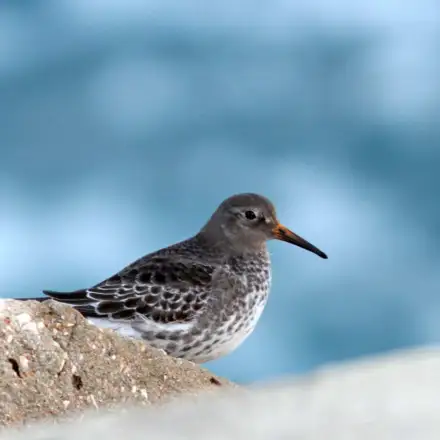
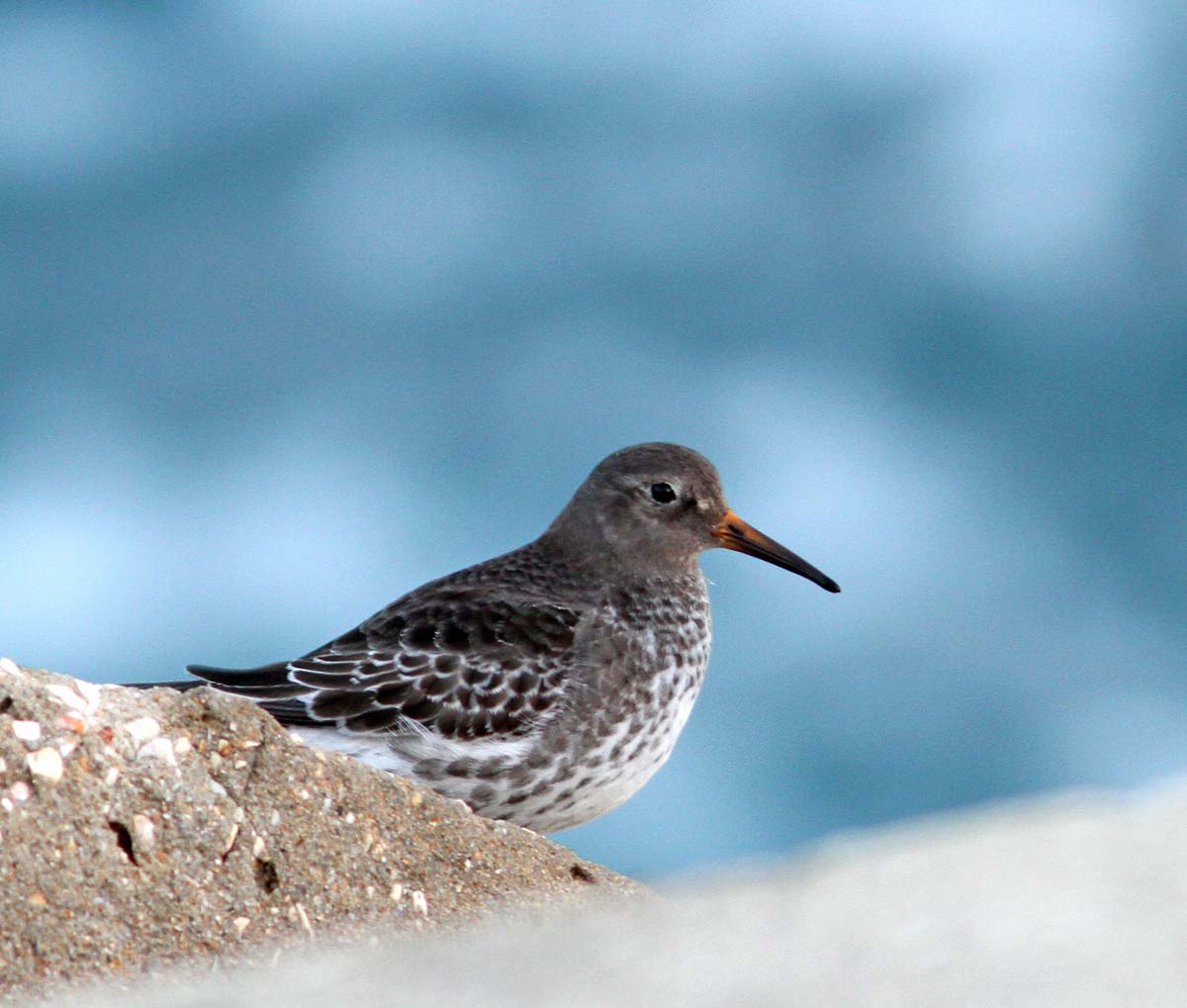
Purple Sandpiper
Scientific name: Calidris maritima
Family scolopacidae
Phenology
- Mainland
- Wintering
- Madeira
- Vagrant
- Azores
- Wintering
Conservation status
Learn more- Mainland
- Madeira
- Azores
- IUCN Global
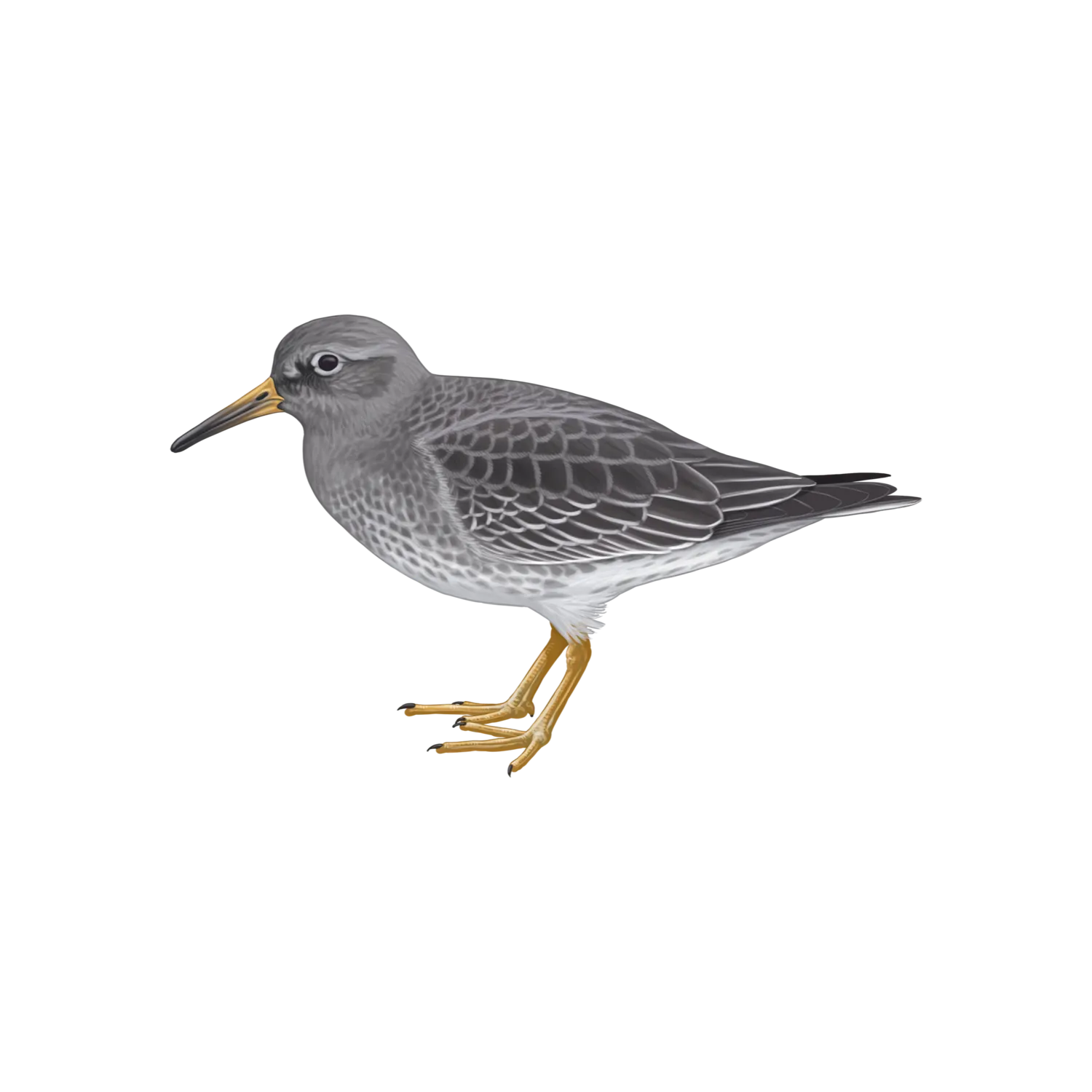
Data
Presentation
Distribution, movements and phenology
The Purple Sandpiper breeds in Arctic and sub-Arctic regions of the Americas, Asia and Europe, from May to July (Billerman et al. 2026). It winters preferentially in cold temperate latitudes, with Portugal lying close to the southern limit of its range (Delany et al. 2009). Birds occurring in our country are assumed to originate from European or Canadian populations (Catry et al. 2010a). On the Mainland, it is a regular visitor to the rocky coast, although with a very localised distribution (Equipa Atlas 2018). The first birds arrive at an advanced stage of migration, in November, and may remain until April or May. The species also occurs regularly in the Azores during autumn and winter. The Madeira archipelago lies outside its typical distribution area, and the species may occur there as a vagrant.
Abundance and population trends
The global population has been estimated at between 204,000 and 287,000 individuals (Wetlands International 2025), with a declining trend (BirdLife International 2025). The species is scarce in Portugal, with counts of fewer than twenty individuals recorded on the Mainland coast as part of Project Arenaria. As it is a wader that is difficult to detect, the population may be slightly underestimated. The high number of Purple Sandpipers recorded in the past (Catry et al. 2010a) may also reflect a fluctuation in the species’ abundance in the country (Lecoq et al. 2013). In fact, the values estimated in the present work indicate that this population has achieved Good Environmental Status for the abundance indicator. In the Azores, although information on abundance and population trends is scarce, the population appears not to have achieved Good Environmental Status.
Ecology and habitat
During winter, the Purple Sandpiper is a true specialist of rocky shores exposed to the ocean. It also utilises similar artificial structures, such as fishing harbour jetties or piers built along sandy shores. At this time of year, it feeds mainly on gastropods, insects, crustaceans, annelids and small amounts of marine vegetation (Billerman et al. 2026), with barnacles and mussels playing a key role (Johnston et al. 2025).
Threats and conservation
Human activities and the loss or degradation of coastal habitat have been identified as the main threats to this species in its wintering grounds. A sharp decline in the population is also predicted due to the effects of climate change (Rehfisch et al. 2004).
- Autor
Nuno Oliveira
Wetlands International (2025). Waterbird Population Estimates. Downloaded from http://wpe.wetlands.org on 30.11.2025. Bibliography:
Rehfisch MM, Austin GE, Freeman SN, Armitage MJS & Burton NHK (2004). The possible impact of climate change on the future distributions and numbers of waders on Britain’s non-estuarine coast. Ibis 146: 70–81. Bibliography:
Lecoq M, Lourenço PM, Catry P, Andrade J & Granadeiro JP (2013). Wintering waders on the Portuguese mainland non-estuarine coast: results of the 2009-2011 survey. Wader Study Group Bulletin 120: 66-70. Bibliography:
Johnston EM, Mittelhauser GH, Foster JT, Mau RL, Gibson AA, Gillece JD, Klemmer AJ & Olsen BJ (2025). Barnacles dominate the winter diet of Calidris maritima (Purple Sandpiper) in Maine: A bona fide dietary shift or molecular techniques revealing an unknown diet composition? Ornithology 142(3): 1-13. Bibliography:
Equipa Atlas (2018). Atlas das Aves Invernantes e Migradoras de Portugal 2011-2013. Sociedade Portuguesa para o Estudo das Aves, LabOr- Laboratório de Ornitologia – ICAAM - Universidade de Évora, Instituto da Conservação da Natureza e das Florestas, Instituto das Florestas e Conservação da Natureza (Madeira), Secretaria Regional da Energia, Ambiente e Turismo (Açores) e Associação Portuguesa de Anilhadores de Aves. Lisboa. Bibliography:
Delany S, Dodman T, Stroud D & Scott D (2009). An atlas of wader population in Africa and western Eurasia. Wetlands International, Wageningen. Bibliography:
BirdLife International (2025). IUCN Red List for birds. Downloaded from https://datazone.birdlife.org on 30.11.2025. Bibliography:
Billerman SM, Keeney BL, Kirwan GM, Medrano F, Sly ND & Smith MG (eds.) (2026). Birds of the World. Cornell Laboratory of Ornithology, Ithaca, NY, USA. Bibliography:
Catry P, Costa H, Elias G & Matias R (2010a). Aves de Portugal, Ornitologia do Território Continental. Assírio e Alvim, Lisboa Glossary:
The southernmost extent of a species’ range. Glossary:
A group of molluscs that includes snails and whelks, common in coastal habitats and frequently consumed by waders. Glossary:
A group of marine arthropods that are important in the marine food chain. Glossary:
Persistent changes in global or regional climate patterns, influenced by natural and anthropogenic factors. Glossary:
Areas where birds remain outside the breeding season, generally associated with favourable conditions for feeding and survival. Glossary:
A species or parameter that reflects the state of an ecosystem or environmental changes. Glossary:
The direction of change in the size of a population over time (increase, decline or stability). Glossary:
A concept defined under the Marine Strategy Framework Directive (MSFD), referring to the condition of the elements of the marine environment, including birds. It aims to assess whether ecosystems are healthy, balanced and capable of supporting ecological functions and human uses in a sustainable manner. The ultimate goal is for the components and ecosystems to achieve Good Environmental Status. Glossary:
A group of birds associated with coastal or inland wetlands, generally found in habitats such as mudflats, saltmarshes, estuaries, lagoon margins, sandy areas and flooded zones. Some of these species also use the sandy and rocky coasts of Portugal.