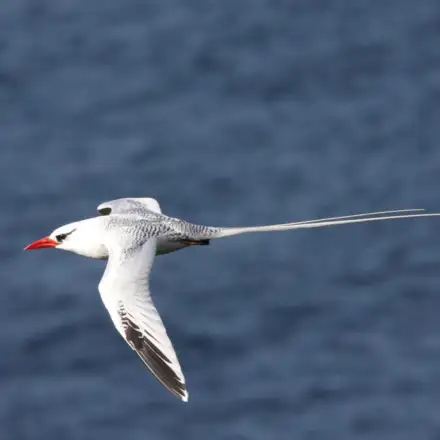
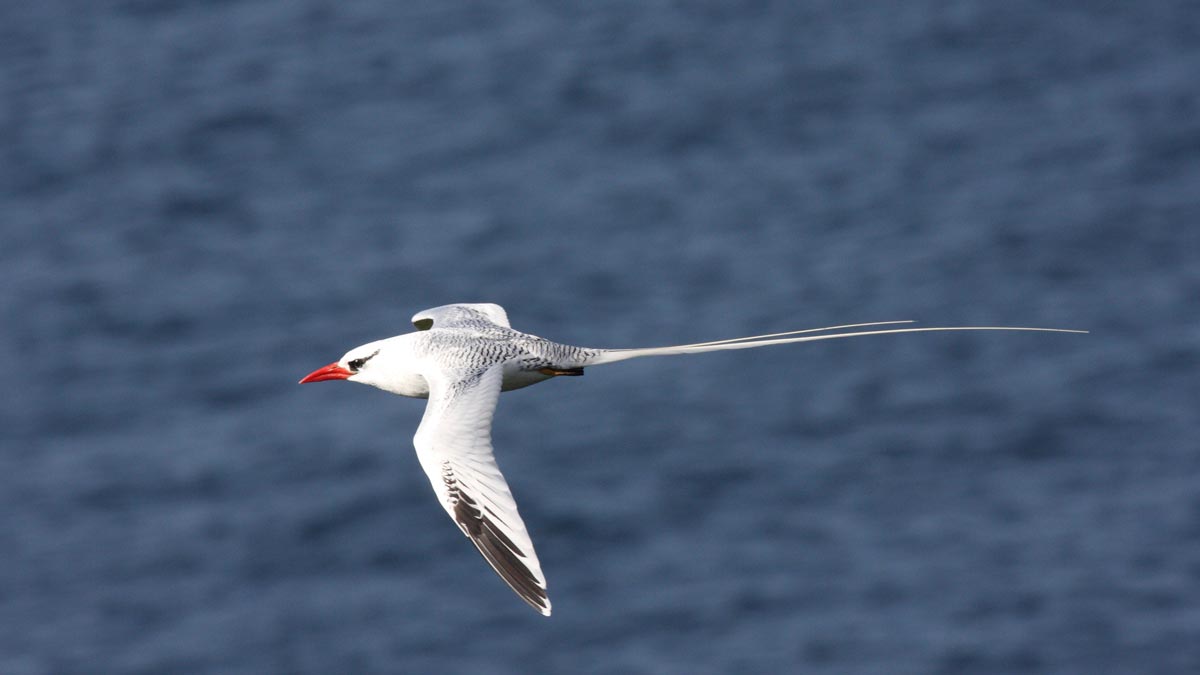
Red-billed Tropicbird
Scientific name: Phaethon aethereus
Family phaethontidae
Phenology
- Mainland
- Vagrant
- Madeira
- Vagrant
- Azores
- Vagrant
Conservation status
Learn more- Mainland
- Madeira
- Azores
- IUCN Global

Data
Maps
Distribution | Non-breeding
Scale
Minimum value:
Maximum value:
Scale
Minimum value:
Maximum value:
Scale
Minimum value:
Maximum value:
Scale
Minimum value:>
Maximum value:<
Scale
Minimum value:
Maximum value:
Scale
Minimum value:>
Maximum value:>
Distribution based on seabird tracking data (locations/hexagone).
Colony(ies) of origin:
Device:
Data period / number of individuals:
Data period / number of individuals:
Distribution of seabird breeding colonies or sites (number of breeding pairs).
Distribution based on marine censuses (probability of occurrence).
Observed density based on marine censuses (birds/ km2).
Confirmed occurence during marines censuses.
Abundance of waders derived from Project Arenaria coastal surveys (birds/square).
Passage rates derived from RAM coastal surveys (birds/hour).
No data available for the selected period.
Presentation
Distribution, movements and phenology
The Red-billed Tropicbird breeds throughout the year, with seasonal peaks, in tropical and subtropical areas of the Atlantic, the north-west Indian Ocean and the eastern Pacific (BirdLife International 2025). It is not recognised as a migratory species, despite its dispersive movements over considerable distances. The birds occurring in Portugal are likely the result of these same movements, originating from the nearest breeding colonies, which are found in Cape Verde and the islands off the coast of Senegal. It is evident from individual tracking data that there is some dispersal of birds breeding in Cape Verde into the waters of Madeira and the Azores, although this information is limited to just two birds in 2008 and 2009. Regular records of this species in our waters may also be related to the relatively recent colonisation of the Canary Islands (Catry 2011; Keller et al. 2020).
Abundance and population trends
The global population has been estimated at around 8,000 to 15,000 breeding pairs, with a declining trend (BirdLife International 2025). In Portugal, this species is quite rare, with no estimates of its abundance or population trend. Records during past marine censuses were fewer than ten birds for the entire area covered by the EEZs of Madeira and the Azores (Meirinho et al. 2014). Occasional sightings have also been very few, despite the regular observation of a few individuals on the Selvagens between the late 1990s and throughout the 2000s (Catry 2011). However, there are no estimates of its abundance or population trends, which has made it impossible to assess its environmental status.
Ecology and habitat
The Red-billed Tropicbird is a strictly marine species that feeds on small fish, particularly flying fish, and squid. Most of its prey is caught following a vertical dive. Some flying fish are also caught in flight.
Threats and conservation
Globally, the Red-billed Tropicbird appears to be most vulnerable to pressures affecting its breeding colonies. Several populations have been severely affected by predation on eggs and chicks by invasive mammals, notably rats and cats (BirdLife International 2025). Habitat loss, due to urban development and construction in coastal areas, has also had a negative effect on these populations. At sea, there are records of bycatch in small-scale fishing gear, particularly line fishing, near breeding colonies in Cape Verde.
- Autores
Sarah Saldanha, Nuno Oliveira
- Owners/sources of tracking data
Meirinho A, Barros N, Oliveira N, Catry P, Lecoq M, Paiva V, Geraldes P, Granadeiro JP, Ramírez I & Andrade J (2014). Atlas das Aves Marinhas de Portugal. Sociedade Portuguesa para o Estudo das Aves. Bibliography:
Keller V, Herrando S, Voříšek P, Franch M, Kipson M, Milanesi P, Martí D, Anton M, Klvaňová A, Kalyakin MV et al. (2020). European Breeding Bird Atlas 2: Distribution, Abundance and Change. European Bird Census Council & Lynx Edicions: Barcelona, Spain. Bibliography:
Catry P (2011). Breve resenha sobre o rabijunco-riscado Phaethon aethereus no mar português: uma espécie em expansão? Airo 21: 24-30. Bibliography:
BirdLife International (2025). IUCN Red List for birds. Downloaded from https://datazone.birdlife.org on 30.11.2025. Data:
Gonzalez-Solis J (2009a). Dataset 984: Red-billed Tropicbird, Phaethon aethereus, Geolocator (GLS), Raso, Raso Islet, Cape Verde, 2008–2009. BirdLife International Seabird Tracking Database. Downloaded from https://data.seabirdtracking.org/dataset/984/ on 30.11.2025. Glossary:
Equipment used to catch marine animals, such as nets, longlines or traps. Glossary:
Standardised bird counts carried out at sea to estimate abundance and distribution. Glossary:
Monitoring the movements of individuals using tracking devices. Glossary:
The direction of change in the size of a population over time (increase, decline or stability). Glossary:
A concept defined under the Marine Strategy Framework Directive (MSFD), referring to the condition of the elements of the marine environment, including birds. It aims to assess whether ecosystems are healthy, balanced and capable of supporting ecological functions and human uses in a sustainable manner. The ultimate goal is for the components and ecosystems to achieve Good Environmental Status. Glossary:
Refers to the unintentional capture of marine species during fishing. Animals may become entangled in hooks or fishing nets. It is usually associated with commercial fishing, but can also occur in recreational fishing. Bycatch is one of the main threats to seabirds at sea. Glossary:
Under the United Nations Convention on the Law of the Sea, coastal states are entitled to declare an EEZ comprising maritime area beyond their territorial waters. The national EEZ is delimited by an imaginary line situated 200 nautical miles from the coast, separating national waters from international or shared waters. Within its EEZ, each state has rights such as the exploitation of marine resources, the conduct of scientific research and the regulation of fishing by foreign vessels.