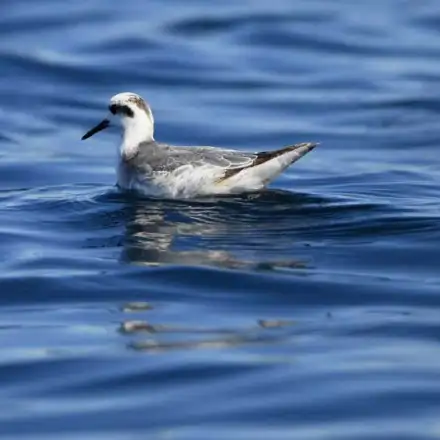
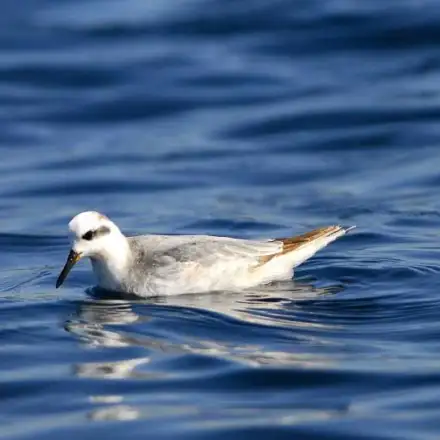
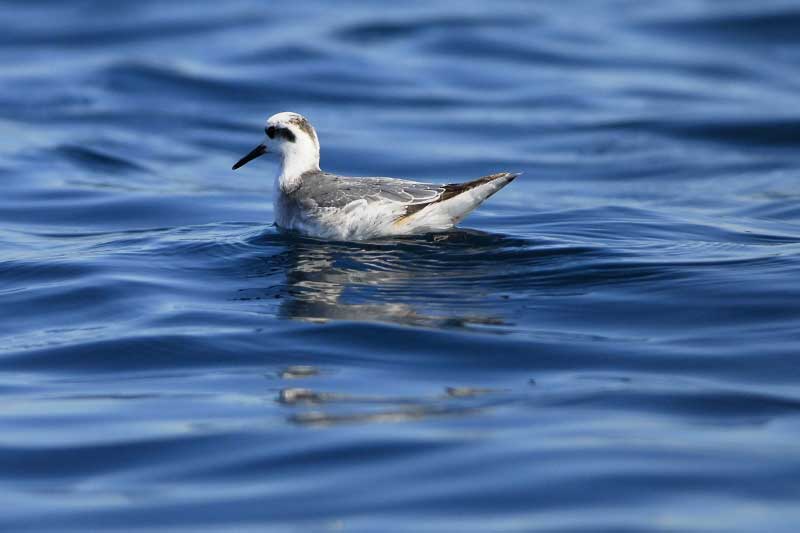
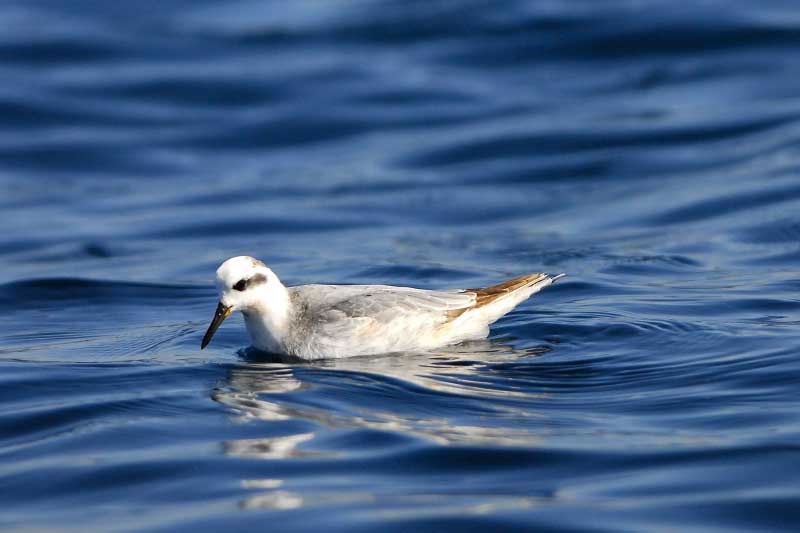
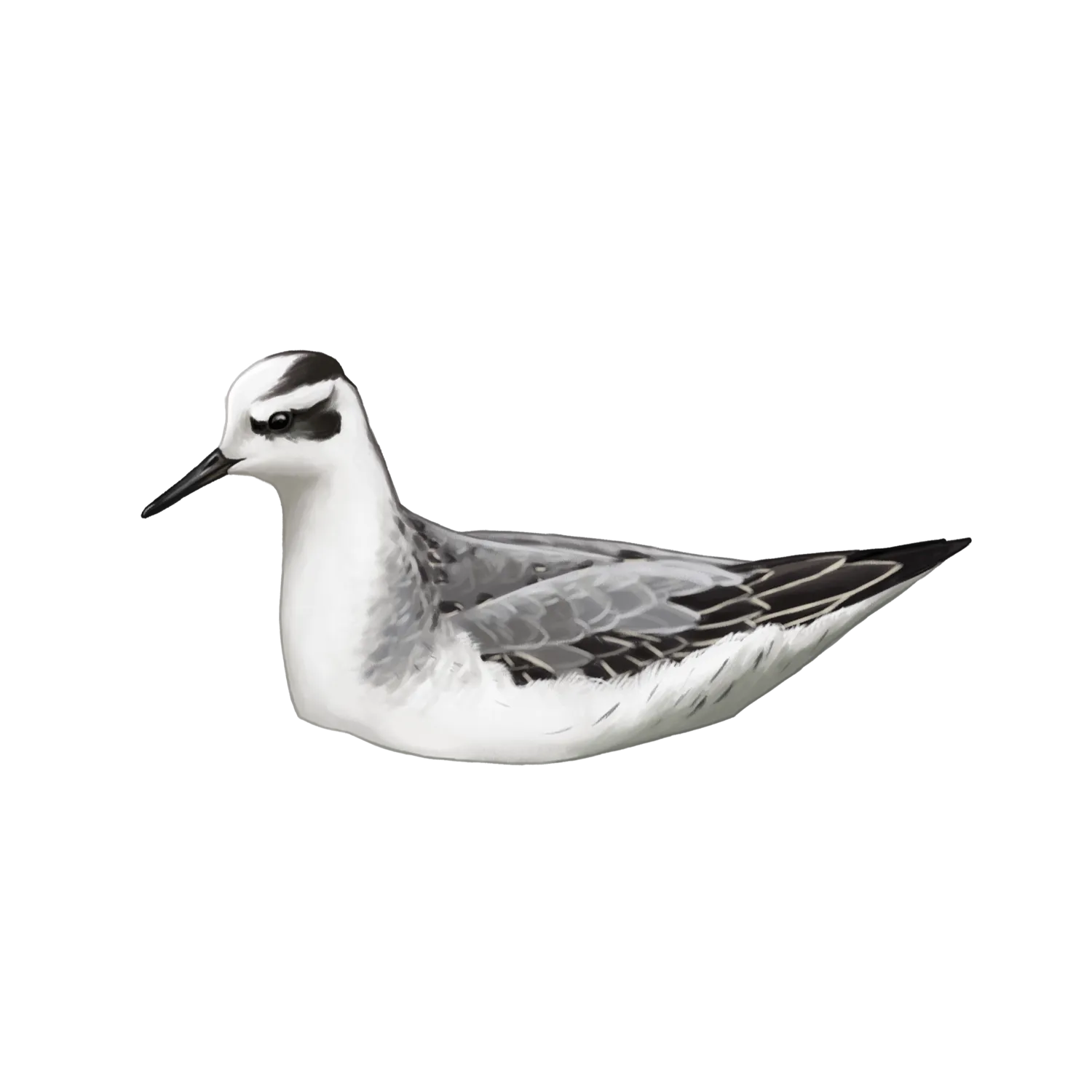
Red Phalarope
Scientific name: Phalaropus fulicarius
Family scolopacidae
Phenology
- Mainland
- Wintering and passage migrant
- Madeira
- Passage migrant
- Azores
- Wintering and passage migrant
Conservation status
Learn more- Mainland
- Madeira
- Azores
- IUCN Global
Data
Maps
Distribution | Breeding
Scale
Minimum value:
Maximum value:
Scale
Minimum value:
Maximum value:
Scale
Minimum value:
Maximum value:
Scale
Minimum value:>
Maximum value:<
Scale
Minimum value:
Maximum value:
Scale
Minimum value:>
Maximum value:>
Distribution based on seabird tracking data (locations/hexagone).
Colony(ies) of origin:
Device:
Data period / number of individuals:
Data period / number of individuals:
Distribution of seabird breeding colonies or sites (number of breeding pairs).
Distribution based on marine censuses (probability of occurrence).
Observed density based on marine censuses (birds/ km2).
Confirmed occurence during marines censuses.
Abundance of waders derived from Project Arenaria coastal surveys (birds/square).
Passage rates derived from RAM coastal surveys (birds/hour).
No data available for the selected period.
Presentation
Distribution, movements and phenology
The Red Phalarope breeds between May and August in the high Arctic regions of Eurasia and North America (Billerman et al. 2026). Its wintering grounds are poorly defined, generally involving the tropical and subtropical waters of the Atlantic and Pacific. Its distribution in Portugal is not well documented; however, it is estimated that it is during migration (spring, and July to October) that our waters are likely to be of greatest importance to the species (Catry et al. 2010a; Meirinho et al. 2014). Despite the limited monitoring effort in deeper waters, the species appears to use these areas predominantly, reaching densities of over 200 birds/km2 in the Mainland sub-area of the EEZ during winter. It only approaches the coast occasionally, typically when driven by adverse weather conditions. In the island regions, the distribution and phenology of this species appear to follow patterns very similar to those observed on the Mainland (Meirinho et al. 2014). Individual tracking of birds visiting Portuguese waters remains very limited. Based on data from just two birds fitted with GLS tags in Greenland in 2014 and 2015, an extensive spatial distribution across the Portuguese EEZ was observed during both phenological periods.
Abundance and population trends
The global population was estimated at 9,000,000 to 12,000,000 breeding individuals, with an unknown trend (BirdLife International 2025), although there are some indications of a decline (Billerman et al. 2026). In Mainland Portugal, the wintering and migratory population was estimated at 3,163 to 8,117 between 2012 and 2015 (Araújo et al. 2022a). Only a small proportion of this population appears to pass close to the coast during migration (Elmberg et al. 2020). The interannual variation in the number of migrating birds, as well as the difficulty in detecting individuals at sea, poses major challenges to estimating their abundance. The lack of systematic information regarding their abundance and population trends has prevented an assessment of the species’ environmental status within the Portuguese EEZ.
Ecology and habitat
During migration and wintering, it is an essentially pelagic bird, being very abundant in upwelling zones associated with oceanic fronts and in very deep waters (Billerman et al. 2026). It feeds primarily on zooplankton, sometimes associating with marine mammals and other bird species. It nests in the tundra, usually near the coast. Like other phalaropes, this species exhibits reversed sexual roles, with the more colourful females competing for the males, who incubate the eggs and feed the chicks.
Threats and conservation
At sea, this phalarope is sensitive to shipping traffic, bycatch and the development of offshore renewable energy (Häkkinen et al. 2023). It is also particularly vulnerable to marine litter, as it may mistake small floating plastic particles for its natural prey (Teboul et al. 2021). Climate change is one of the factors that will have the greatest influence on this species, particularly in breeding areas. Its tendency to form large aggregations in relatively small areas exposes the species to extreme weather events, resulting in episodes of mass mortality (BirdLife International 2025). This species is one of the least monitored, so addressing this gap is a top conservation priority for the species.
- Autores
Olivier Gilg, Rob van Bemmelen
- Owners/sources of tracking data
Teboul E, Orihel DM, Provencher JF, Drever MC, Wilson L & Harrison AL (2021). Chemical identification of microplastics ingested by Red Phalaropes (Phalaropus fulicarius) using Fourier Transform Infrared spectroscopy. Marine Pollution Bulletin 171: 1-7. Bibliography:
Meirinho A, Barros N, Oliveira N, Catry P, Lecoq M, Paiva V, Geraldes P, Granadeiro JP, Ramírez I & Andrade J (2014). Atlas das Aves Marinhas de Portugal. Sociedade Portuguesa para o Estudo das Aves. Bibliography:
Häkkinen H, Petrovan SO, Taylor NG, Sutherland WJ & Pettorelli N (2023). Seabirds in the North-East Atlantic: Climate change vulnerability and potential conservation actions. Open Book Publishers. Bibliography:
Elmberg J, Hirschfeld E, Cardoso H & Hessel R (2020). Seabird migration at Cabo Carvoeiro (Peniche, Portugal) in autumn 2015. Marine Ornithology 48: 231-244. Bibliography:
BirdLife International (2025). IUCN Red List for birds. Downloaded from https://datazone.birdlife.org on 30.11.2025. Bibliography:
Billerman SM, Keeney BL, Kirwan GM, Medrano F, Sly ND & Smith MG (eds.) (2026). Birds of the World. Cornell Laboratory of Ornithology, Ithaca, NY, USA. Bibliography:
Araújo H, Correia-Rodrigues P, Bastos-Santos J, Ferreira M, Pereira AT, Martinez-Cedeira J, Vingada J & Eira C (2022a). Seabird abundance and distribution off western Iberian waters estimated through aerial surveys. Marine Ornithology 50: 71-80. Bibliography:
Catry P, Costa H, Elias G & Matias R (2010a). Aves de Portugal, Ornitologia do Território Continental. Assírio e Alvim, Lisboa Data:
van Bemmelen R, Hanssen SA, Gilg O, Porter R, Mork KS, Bangjord G, Bollache L & Moe B (em revisão). Individual variation in non-breeding movements of Grey Phalaropes across hemispheres. Journal of Avian Biology. Glossary:
Persistent changes in global or regional climate patterns, influenced by natural and anthropogenic factors. Glossary:
Transition zones between water masses with different characteristics (temperature, salinity), frequently associated with high biological productivity. Glossary:
Areas where birds remain outside the breeding season, generally associated with favourable conditions for feeding and survival. Glossary:
Monitoring the movements of individuals using tracking devices. Glossary:
The direction of change in the size of a population over time (increase, decline or stability). Glossary:
A concept defined under the Marine Strategy Framework Directive (MSFD), referring to the condition of the elements of the marine environment, including birds. It aims to assess whether ecosystems are healthy, balanced and capable of supporting ecological functions and human uses in a sustainable manner. The ultimate goal is for the components and ecosystems to achieve Good Environmental Status. Glossary:
Refers to the unintentional capture of marine species during fishing. Animals may become entangled in hooks or fishing nets. It is usually associated with commercial fishing, but can also occur in recreational fishing. Bycatch is one of the main threats to seabirds at sea. Glossary:
Under the United Nations Convention on the Law of the Sea, coastal states are entitled to declare an EEZ comprising maritime area beyond their territorial waters. The national EEZ is delimited by an imaginary line situated 200 nautical miles from the coast, separating national waters from international or shared waters. Within its EEZ, each state has rights such as the exploitation of marine resources, the conduct of scientific research and the regulation of fishing by foreign vessels. Glossary:
The name given to the extensive plains with low-growing vegetation and no trees, characteristic of Arctic and sub-Arctic regions. The tundra is generally a very cold region with low precipitation. Glossary:
The area or environment where organisms that do not depend on the seafloor normally live. It is the typical ecological environment of open ocean waters. The pelagic ecosystem does not include only the open sea; it also comprises the waters covering the continental shelf. The pelagic zone begins below the influence of tides and extends into the open ocean, at depths ranging from a few tens of metres to approximately 6,000 metres, and is divided into different layers. Glossary:
A period generally corresponding to the winter months, which may include part of autumn. Glossary:
A small device attached to birds to study their large-scale movements (usually migration), which works by recording light intensity (from which the duration of night and the local midday time are estimated, and consequently the latitude and longitude on each day). Glossary:
The study of periodic phenomena in living organisms and their relationship with the environment, such as temperature, light and humidity. Some of these cyclical phenomena include, for example, bird migration or plant flowering. Glossary:
A phenomenon involving interaction between the ocean and the atmosphere, in which warm surface waters move away from the coast and are replaced by cooler, nutrient-rich waters from the depths.