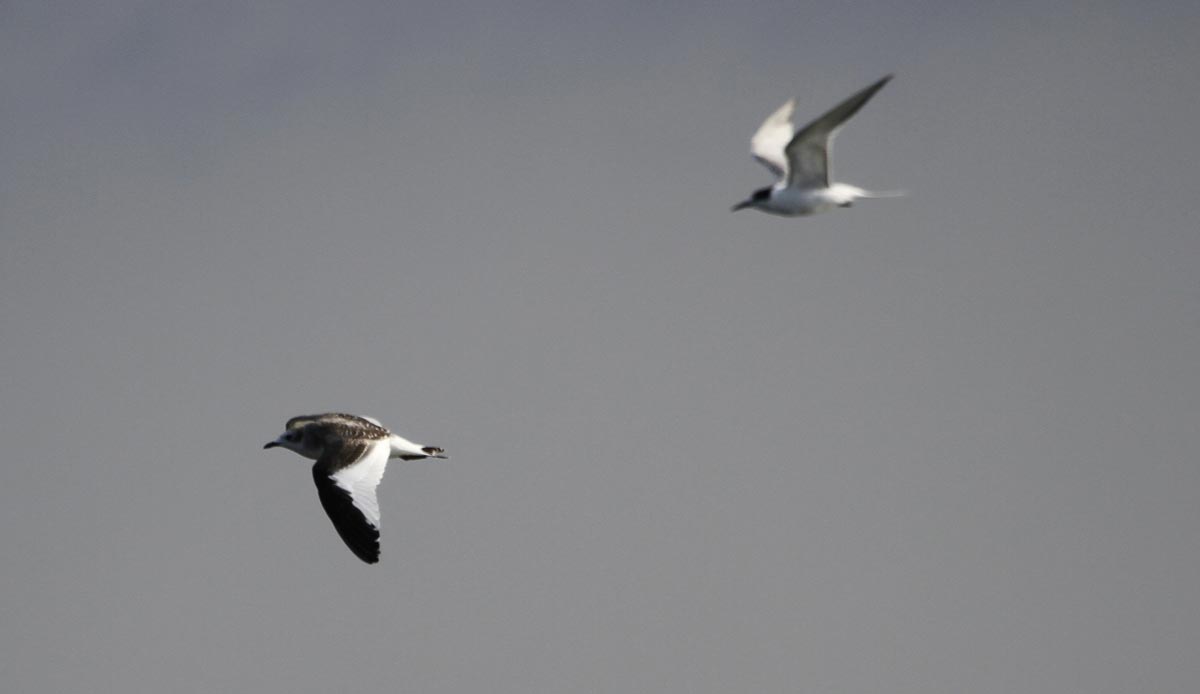
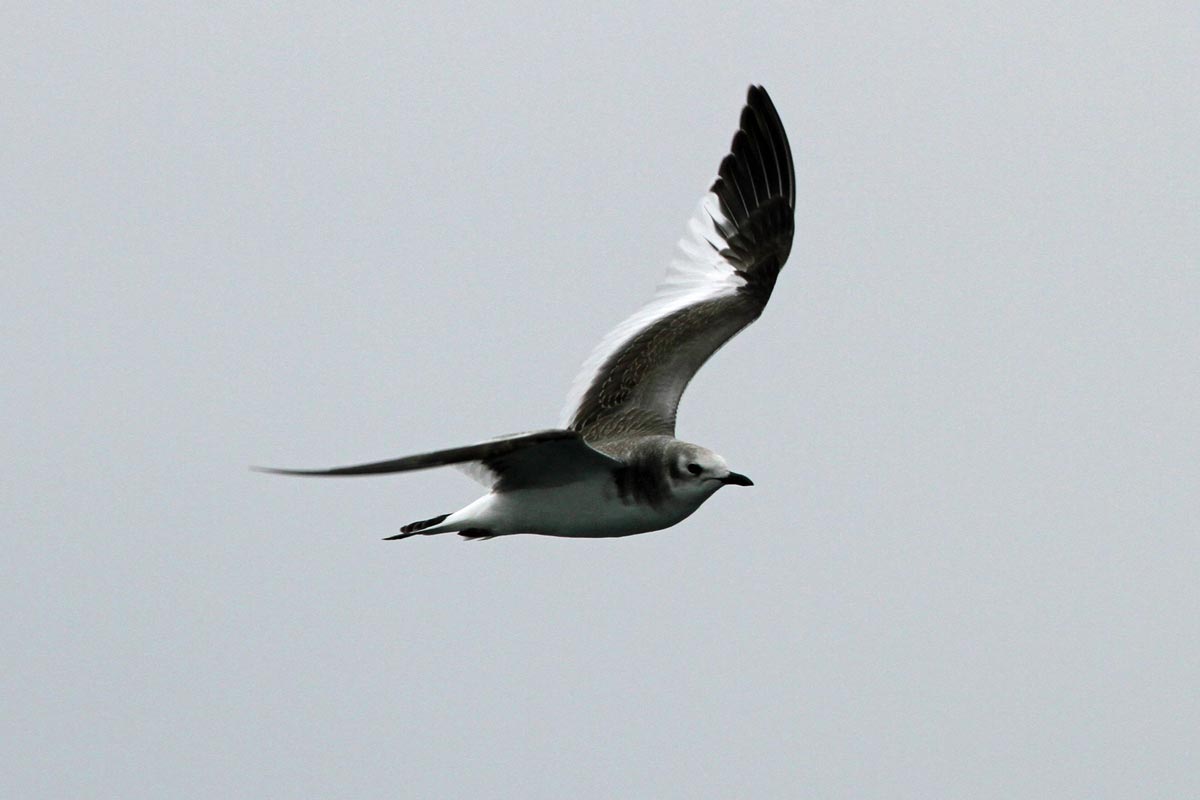
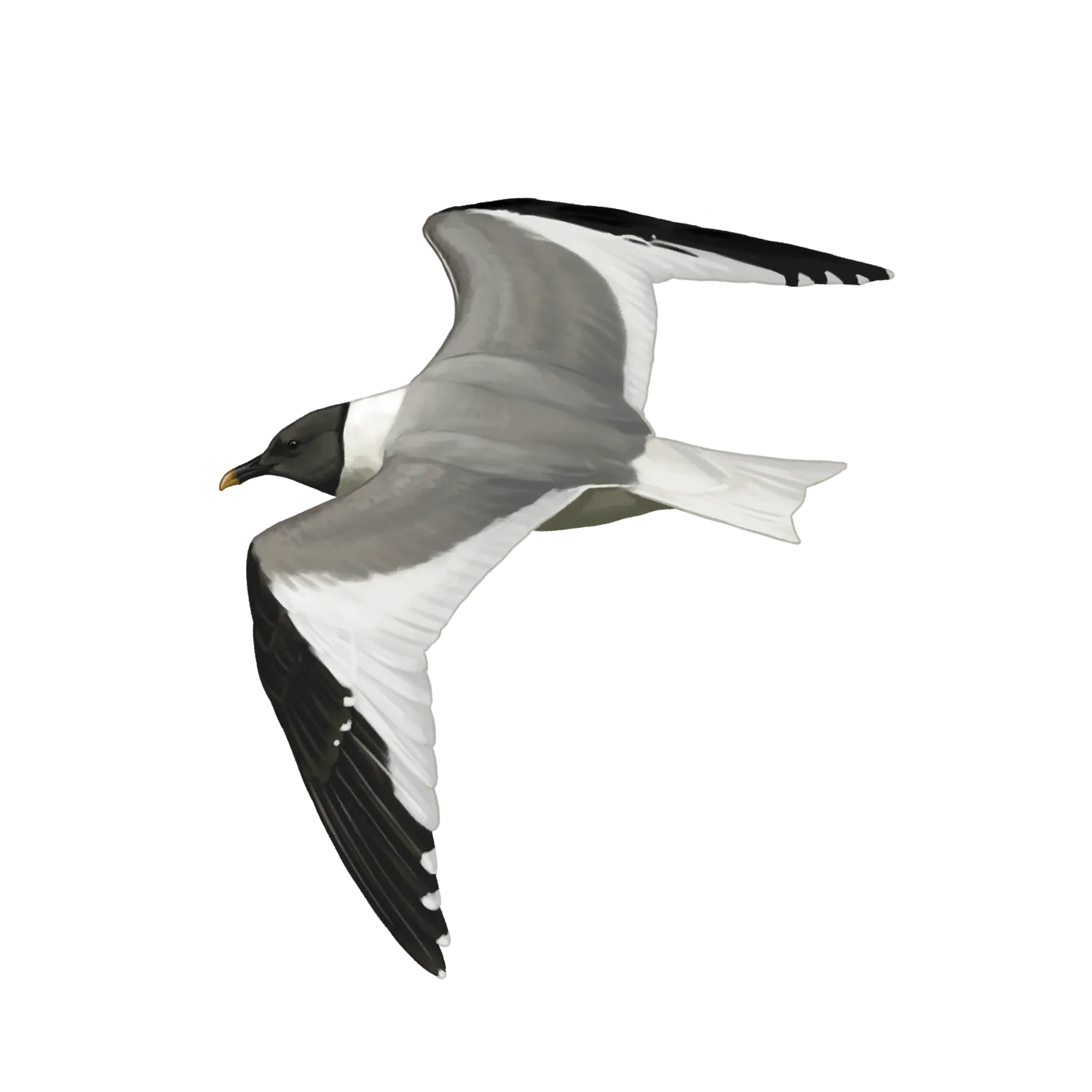
Sabine's Gull
Scientific name: Xema sabini
Family laridae
Phenology
- Mainland
- Passage migrant
- Madeira
- Passage migrant
- Azores
- Passage migrant
Conservation status
Learn more- Mainland
- Madeira
- Azores
- IUCN Global
Data
Maps
Distribution | Breeding
Scale
Minimum value:
Maximum value:
Scale
Minimum value:
Maximum value:
Scale
Minimum value:
Maximum value:
Scale
Minimum value:>
Maximum value:<
Scale
Minimum value:
Maximum value:
Scale
Minimum value:>
Maximum value:>
Distribution based on seabird tracking data (locations/hexagone).
Colony(ies) of origin:
Device:
Data period / number of individuals:
Data period / number of individuals:
Distribution of seabird breeding colonies or sites (number of breeding pairs).
Distribution based on marine censuses (probability of occurrence).
Observed density based on marine censuses (birds/ km2).
Confirmed occurence during marines censuses.
Abundance of waders derived from Project Arenaria coastal surveys (birds/square).
Passage rates derived from RAM coastal surveys (birds/hour).
No data available for the selected period.
Presentation
Distribution, movements and phenology
The Sabine’s Gull breeds in the Arctic between late May and August, exhibiting a circumpolar distribution throughout the breeding season (Billerman et al. 2026). The Atlantic populations breed in Greenland and the archipelagos of Norway, migrating towards south-west Africa (Stenhouse et al. 2011). The species’ post-breeding migration begins in August and continues until November, whilst the pre-breeding migration takes place from February to May (Catry et al. 2010a). It uses the Portuguese EEZ during its migratory movements, but is rarely observed near the coast (Billerman et al. 2026). Based on data from 12 birds fitted with GLS between 2007 and 2011, originating from Canada and Greenland, use of the Portuguese EEZ was recorded mainly between September and October, in line with land-based observations (Catry et al. 2010a). The species was also recorded in late spring, corresponding to the early breeding period, particularly in the Mainland and Azores sub-areas. It appears to prefer deeper waters or waters near the continental slope, as had already been noted in previous works (Meirinho et al. 2014; Araújo et al. 2022a).
Abundance and population trends
The global population shows a stable trend, estimated at around 340,000 mature individuals, of which 2,100 to 4,100 breed in Europe (BirdLife International 2025). It is regularly observed alone or in small flocks, with some exceptional records of several hundred birds (Meirinho et al. 2014). Between 2011 and 2015, the population using the waters off the Mainland during post-breeding migration was estimated at between 727 and 3,356 (Araújo et al. 2022a). Furthermore, during the post-breeding migration in 2015, only 3 birds were counted passing southwards from Cape Carvoeiro, illustrating the species’ pelagic behaviour (Elmberg et al. 2020).
Ecology and habitat
The Sabine’s Gull has markedly pelagic habits outside the breeding season (Olsen & Larsson 2004). It exploits coastal upwelling zones, feeding on zooplankton, crustaceans and fish (Billerman et al. 2026). It is frequently attracted to discards from fishing vessels (Valeiras 2003).
Threats and conservation
No specific threats to this species are known in Europe. However, it may be vulnerable to climate change and changes in habitat (BirdLife International 2025).
- Autor
Nuno Oliveira
- Owners/sources of tracking data
Davis et al. 2016, Mallory 2012, Mark Maftei, Stenhouse & Egevang 2008
Valeiras J (2003). Attendance of scavenging seabirds at trawler discards off Galicia, Spain. Scientia Marina 67(Suppl. 2): 77-82. Bibliography:
Stenhouse I, Egevang C & Phillips RA (2011). Trans-equatorial migration, staging sites and wintering area of Sabine’s Gulls Larus sabini in the Atlantic Ocean. Ibis 154: 42–51. Bibliography:
Olsen KM & Larsson H (2004). Gulls of Europe, Asia and North America. Christopher Helm, London. Bibliography:
Meirinho A, Barros N, Oliveira N, Catry P, Lecoq M, Paiva V, Geraldes P, Granadeiro JP, Ramírez I & Andrade J (2014). Atlas das Aves Marinhas de Portugal. Sociedade Portuguesa para o Estudo das Aves. Bibliography:
Elmberg J, Hirschfeld E, Cardoso H & Hessel R (2020). Seabird migration at Cabo Carvoeiro (Peniche, Portugal) in autumn 2015. Marine Ornithology 48: 231-244. Bibliography:
BirdLife International (2025). IUCN Red List for birds. Downloaded from https://datazone.birdlife.org on 30.11.2025. Bibliography:
Billerman SM, Keeney BL, Kirwan GM, Medrano F, Sly ND & Smith MG (eds.) (2026). Birds of the World. Cornell Laboratory of Ornithology, Ithaca, NY, USA. Bibliography:
Araújo H, Correia-Rodrigues P, Bastos-Santos J, Ferreira M, Pereira AT, Martinez-Cedeira J, Vingada J & Eira C (2022a). Seabird abundance and distribution off western Iberian waters estimated through aerial surveys. Marine Ornithology 50: 71-80. Bibliography:
Catry P, Costa H, Elias G & Matias R (2010a). Aves de Portugal, Ornitologia do Território Continental. Assírio e Alvim, Lisboa Data:
Davis SE, Maftei M & Mallory ML (2016). Migratory connectivity at high latitudes: Sabine's gulls (Xema sabini) from a colony in the Canadian high Arctic migrate to different oceans. PLOS ONE 11(12): e0166043. Data:
Stenhouse I & Egevang C (2008). Dataset 1110: Sabine's Gull, Xema sabini, Geolocator (GLS), Sand Island, Young Sound, Greenland, 2007–2008. BirdLife International Seabird Tracking Database. Downloaded from https://data.seabirdtracking.org/dataset/1110/ on 30.11.2025. Data:
Mallory M (2012). Dataset 1742: Sabine's Gull, Xema sabini, Geolocator (GLS), Nasaruvaalik Island, Nasaruvaalik Island, Canada, 2008–2012. BirdLife International Seabird Tracking Database. Downloaded from https://data.seabirdtracking.org/dataset/1742/ on 30.11.2025. Glossary:
Individuals capable of breeding, used as a reference in population estimates. Glossary:
A group of marine arthropods that are important in the marine food chain. Glossary:
Persistent changes in global or regional climate patterns, influenced by natural and anthropogenic factors. Glossary:
The direction of change in the size of a population over time (increase, decline or stability). Glossary:
Under the United Nations Convention on the Law of the Sea, coastal states are entitled to declare an EEZ comprising maritime area beyond their territorial waters. The national EEZ is delimited by an imaginary line situated 200 nautical miles from the coast, separating national waters from international or shared waters. Within its EEZ, each state has rights such as the exploitation of marine resources, the conduct of scientific research and the regulation of fishing by foreign vessels. Glossary:
A portion of the seabed with a very steep gradient lying between the continental shelf and the continental margin, where the abyssal plains begin. Glossary:
The portion of the catch taken by commercial fishing vessels that is returned to the sea, often dead or dying. Discarded fish often belong to species of no commercial value, individuals below the minimum legal landing size, or individuals whose landing is not permitted, for example due to quota restrictions. Discards may also consist of parts of the catch, namely offal and heads, which, after on-board processing, are rejected and discarded at sea. Discards have a strong impact on marine ecosystems and influence many aspects of the distribution, foraging behaviour and population dynamics of seabirds, particularly species and individuals that habitually follow vessels. Glossary:
Referring to the period preceding breeding. Glossary:
Referring to the period following breeding. Glossary:
The area or environment where organisms that do not depend on the seafloor normally live. It is the typical ecological environment of open ocean waters. The pelagic ecosystem does not include only the open sea; it also comprises the waters covering the continental shelf. The pelagic zone begins below the influence of tides and extends into the open ocean, at depths ranging from a few tens of metres to approximately 6,000 metres, and is divided into different layers. Glossary:
A small device attached to birds to study their large-scale movements (usually migration), which works by recording light intensity (from which the duration of night and the local midday time are estimated, and consequently the latitude and longitude on each day). Glossary:
A phenomenon involving interaction between the ocean and the atmosphere, in which warm surface waters move away from the coast and are replaced by cooler, nutrient-rich waters from the depths.