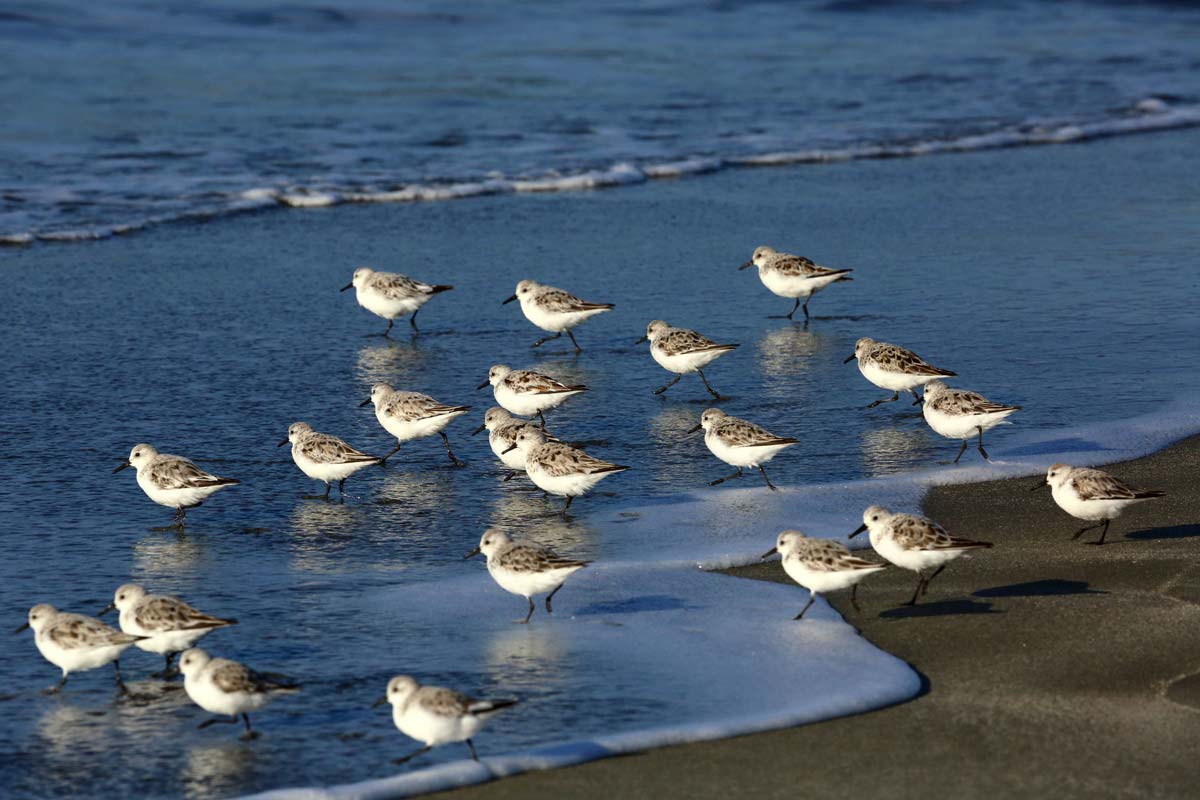
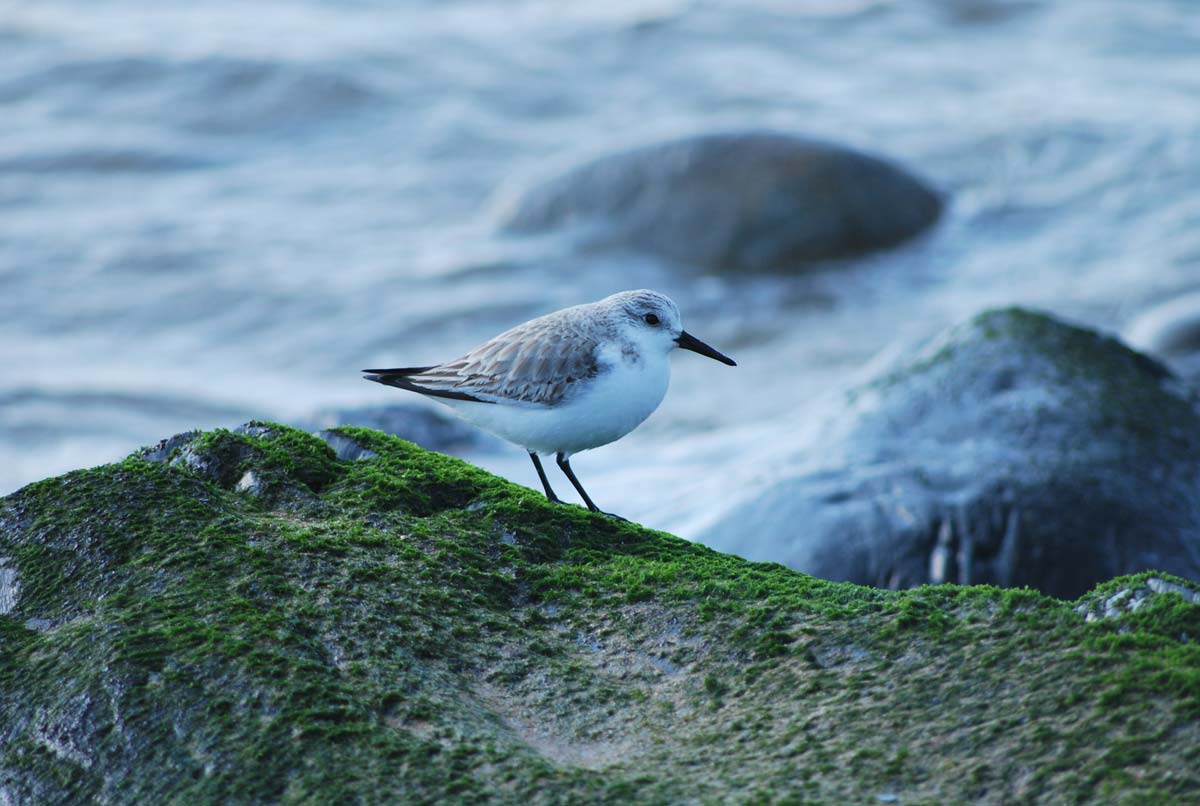
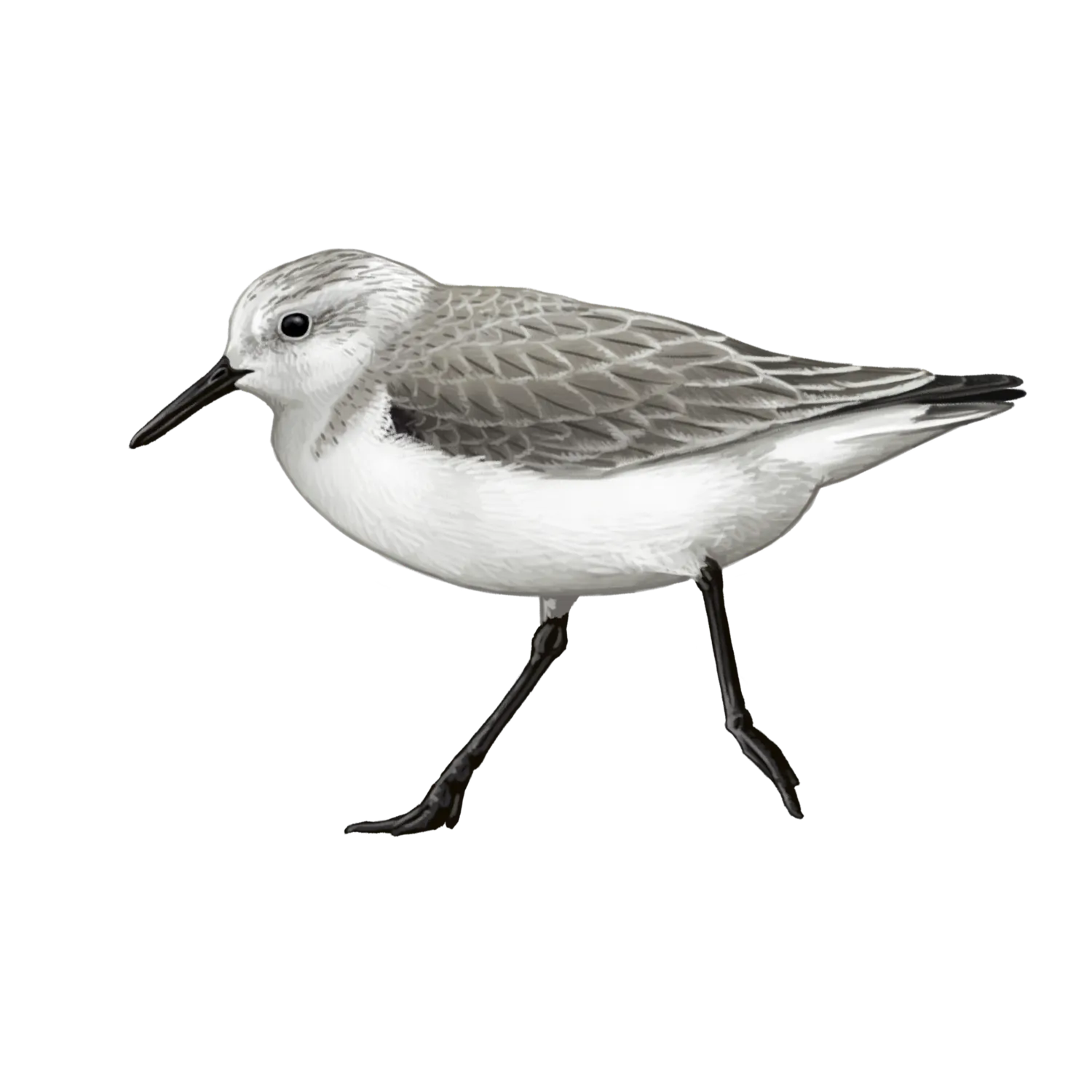
Sanderling
Scientific name: Calidris alba
Family scolopacidae
Phenology
- Mainland
- Wintering and passage migrant
- Madeira
- Wintering and passage migrant
- Azores
- Wintering and passage migrant
Conservation status
Learn more- Mainland
- Madeira
- Azores
- IUCN Global
Data
Maps
Arenaria | Winter
Scale
Minimum value:
Maximum value:
Scale
Minimum value:
Maximum value:
Scale
Minimum value:
Maximum value:
Scale
Minimum value:>
Maximum value:<
Scale
Minimum value:
Maximum value:
Scale
Minimum value:>
Maximum value:>
Distribution based on seabird tracking data (locations/hexagone).
Colony(ies) of origin:
Device:
Data period / number of individuals:
Data period / number of individuals:
Distribution of seabird breeding colonies or sites (number of breeding pairs).
Distribution based on marine censuses (probability of occurrence).
Observed density based on marine censuses (birds/ km2).
Confirmed occurence during marines censuses.
Abundance of waders derived from Project Arenaria coastal surveys (birds/square).
Passage rates derived from RAM coastal surveys (birds/hour).
No data available for the selected period.
Presentation
Distribution, movements and phenology
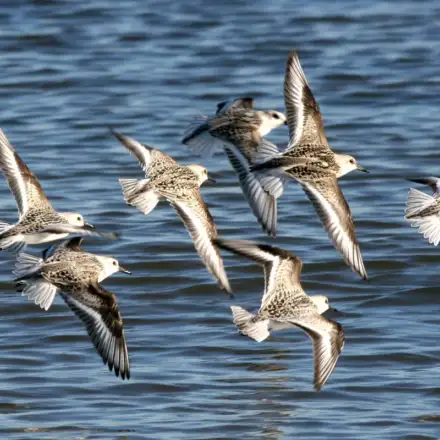
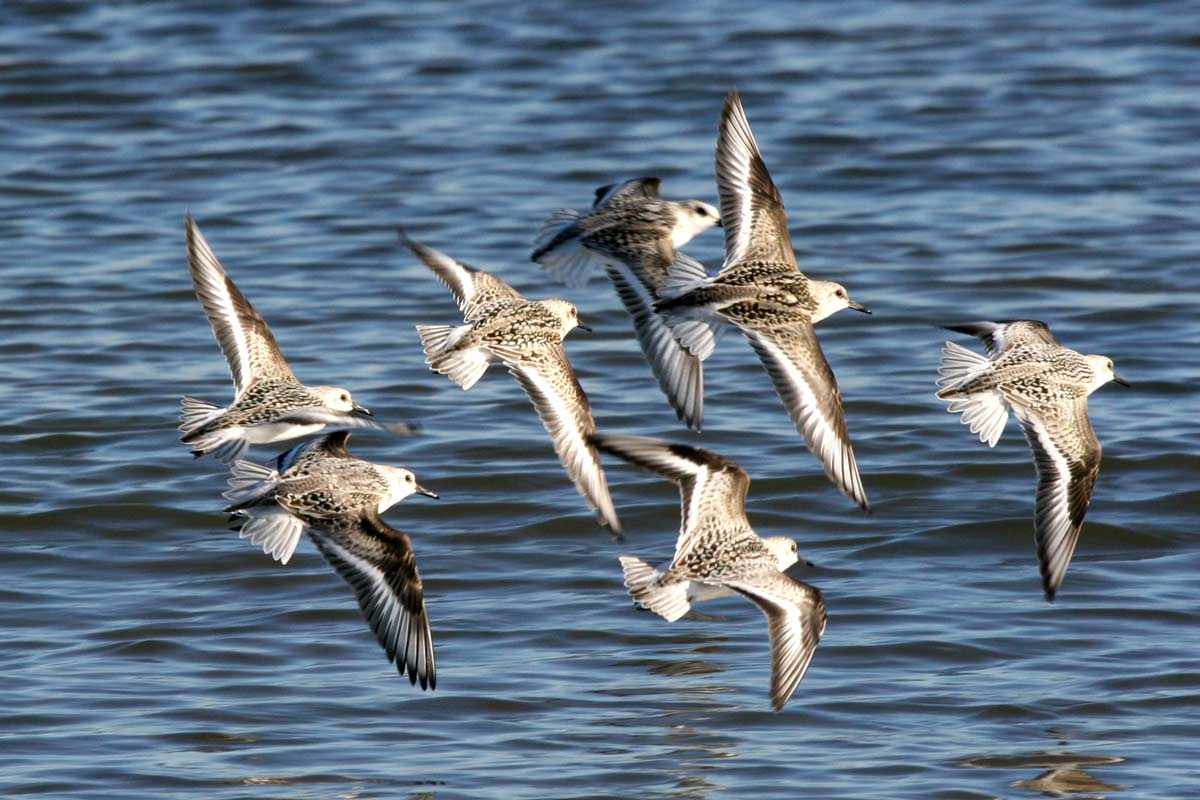
The Sanderling is a long-distance migrant that breeds in the Arctic tundra and winters in coastal areas around the world, with the exception of the Antarctic continent (Billerman et al. 2026). In Portugal, it occurs mainly along the Mainland coast, being less abundant in the Azores and Madeira (Equipa Atlas 2018; Fagundes & Catry 2022). It can be found along the entire Mainland coast, from Caminha to Vila Real de Santo António, being clearly more abundant in the northern region and in the vicinity of the major wetlands in the centre and south, such as the Tagus estuary and the Ria Formosa (Meirinho et al. 2014). It occurs in greater numbers along our coast during its post-breeding migrations, in the summer and early autumn months, and is also relatively abundant during the winter and mid-spring months. The population occurring in Portugal appears to originate mainly from Greenland and the Canadian Arctic (Reneerkens et al. 2009).
Abundance and population trends
The global population of the Sanderling has been estimated at between 900,000 and 1,200,000 mature individuals (BirdLife International 2025). It is the most abundant wader on the beaches of Mainland Portugal, with an estimated 3,000 individuals recorded in the winter of 2021-2022 (Fagundes & Catry 2022). It also occurs in estuarine areas, but in smaller numbers, with around 650 to 700 individuals counted in the winters of 2024 and 2025 (IWC 2026). Annual censuses under the Project Arenaria, carried out since 2009 (Lourenço et al. 2013), indicate a stable trend in the wintering population of the Sanderling on Mainland Portugal (Fagundes & Catry 2022), with the population having achieved Good Environmental Status for the abundance indicator. This trend contrasts with the global decline of the species (BirdLife International 2025). Although not very abundant on the islands (Equipa Atlas 2018; Fagundes & Catry 2022), the population in Madeira has also achieved Good Environmental Status for the abundance indicator, unlike the population in the Azores.
Ecology and habitat
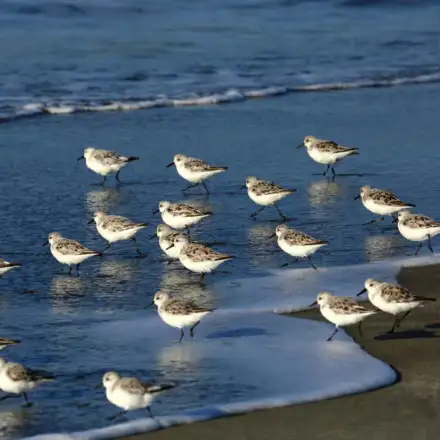
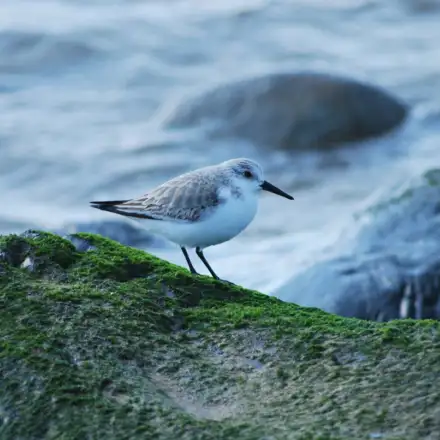
During the winter, Sanderlings inhabit mainly sandy or muddy-sandy beaches, though they are also sometimes found in rocky shelf areas (Lourenço et al. 2013). They feed mainly in areas of exposed sediment at low tide or near the surf zone (Mazzochi et al. 2021). Their diet consists of small invertebrates, which live buried in or on the surface of the sediment, such as polychaetes, bivalves and mosquito larvae, or small fish (Lourenço et al. 2015; Lourenço 2019).
Threats and conservation
Although they occur on beaches near urban centres, which are often located close to estuaries and other highly productive wetlands (Lourenço et al. 2013), Sandpipers are particularly sensitive to direct human disturbance associated with the presence of people and, above all, of off-leash dogs in their foraging areas (Lourenço et al. 2013; Lopes 2024). The species is also affected by plastic pollution; a study conducted in the Tagus estuary revealed the presence of microplastics in 80% of samples from this species, in concentrations surpassed only by those found in Avocets Recurvirostra avosetta (Lourenço et al. 2017).
- Autor
Maria P. Dias
Reneerkens J, Benhoussa A, Boland H, Collier M, Grond K, Guenther K, Hallgrimsson GT, Hansen J, Meissner W, de Meulenaer B, Ntiamoa-Baidu Y, Piersma T, Poot M, van Roomen M, Summers RW, Tomkovich PS & Underhill LG (2009). Sanderlings using African–Eurasian flyways: A review of current knowledge. Wader Study Group Bulletin 116: 2–20. Bibliography:
Meirinho A, Barros N, Oliveira N, Catry P, Lecoq M, Paiva V, Geraldes P, Granadeiro JP, Ramírez I & Andrade J (2014). Atlas das Aves Marinhas de Portugal. Sociedade Portuguesa para o Estudo das Aves. Bibliography:
Mazzochi MS, Nightingale J & Pereira MJR (2021). Trophic interactions of shorebirds in a wintering area of southern Brazil: Foraging strategies and habitat preferences. Waterbirds 44(4): 492–498. Bibliography:
Lourenço PM, Serra-Gonçalves C, Ferreira JL, Catry T & Granadeiro JP (2017). Plastic and other microfibers in sediments, macroinvertebrates and shorebirds from three intertidal wetlands of southern Europe and West Africa. Environmental Pollution 231: 123–133. Bibliography:
Lourenço PM, Catry P, Lecoq M, Ramírez I & Granadeiro JP (2013). Role of disturbance, geology and other environmental factors in determining abundance and diversity in coastal avian communities during winter. Marine Ecology Progress Series 479: 223-234. Bibliography:
Lourenço PM, Alves JA, Catry T & Granadeiro JP (2015). Foraging ecology of sanderlings (Calidris alba) wintering in estuarine and non-estuarine intertidal areas. Journal of Sea Research 104: 33–40. Bibliography:
Lourenço PM (2019). Internet photography forums as sources of avian dietary data: bird diets in Continental Portugal. Airo 26:3-26. Bibliography:
Lopes AF (2024). Influência da pressão antropogénica na distribuição e ecologia alimentar de aves limícolas em contexto urbano. Tese de Mestrado. Faculdade de Ciências da Universidade de Lisboa. Bibliography:
IWC (2026). Censo internacional de aves aquáticas. Downloaded from https://iwc.wetlands.org/index.php/nattotals on 02.04.2026. Bibliography:
Fagundes AI & Catry P (2022). Projeto Arenaria, 2009–2022. In Alonso H, Andrade J, Teodósio J & Lopes A (coords.). O estado das aves em Portugal, 2022 (2nd ed.). Sociedade Portuguesa para o Estudo das Aves. Bibliography:
Equipa Atlas (2018). Atlas das Aves Invernantes e Migradoras de Portugal 2011-2013. Sociedade Portuguesa para o Estudo das Aves, LabOr- Laboratório de Ornitologia – ICAAM - Universidade de Évora, Instituto da Conservação da Natureza e das Florestas, Instituto das Florestas e Conservação da Natureza (Madeira), Secretaria Regional da Energia, Ambiente e Turismo (Açores) e Associação Portuguesa de Anilhadores de Aves. Lisboa. Bibliography:
BirdLife International (2025). IUCN Red List for birds. Downloaded from https://datazone.birdlife.org on 30.11.2025. Bibliography:
Billerman SM, Keeney BL, Kirwan GM, Medrano F, Sly ND & Smith MG (eds.) (2026). Birds of the World. Cornell Laboratory of Ornithology, Ithaca, NY, USA. Glossary:
Individuals capable of breeding, used as a reference in population estimates. Glossary:
Molluscs with two shells, such as clams and cockles, common in intertidal environments. Glossary:
Plastic particles smaller than 5 mm. Glossary:
A species or parameter that reflects the state of an ecosystem or environmental changes. Glossary:
The direction of change in the size of a population over time (increase, decline or stability). Glossary:
A concept defined under the Marine Strategy Framework Directive (MSFD), referring to the condition of the elements of the marine environment, including birds. It aims to assess whether ecosystems are healthy, balanced and capable of supporting ecological functions and human uses in a sustainable manner. The ultimate goal is for the components and ecosystems to achieve Good Environmental Status. Glossary:
A group of birds associated with coastal or inland wetlands, generally found in habitats such as mudflats, saltmarshes, estuaries, lagoon margins, sandy areas and flooded zones. Some of these species also use the sandy and rocky coasts of Portugal. Glossary:
The name given to the extensive plains with low-growing vegetation and no trees, characteristic of Arctic and sub-Arctic regions. The tundra is generally a very cold region with low precipitation. Glossary:
Annelid worms belonging to the class Polychaeta.