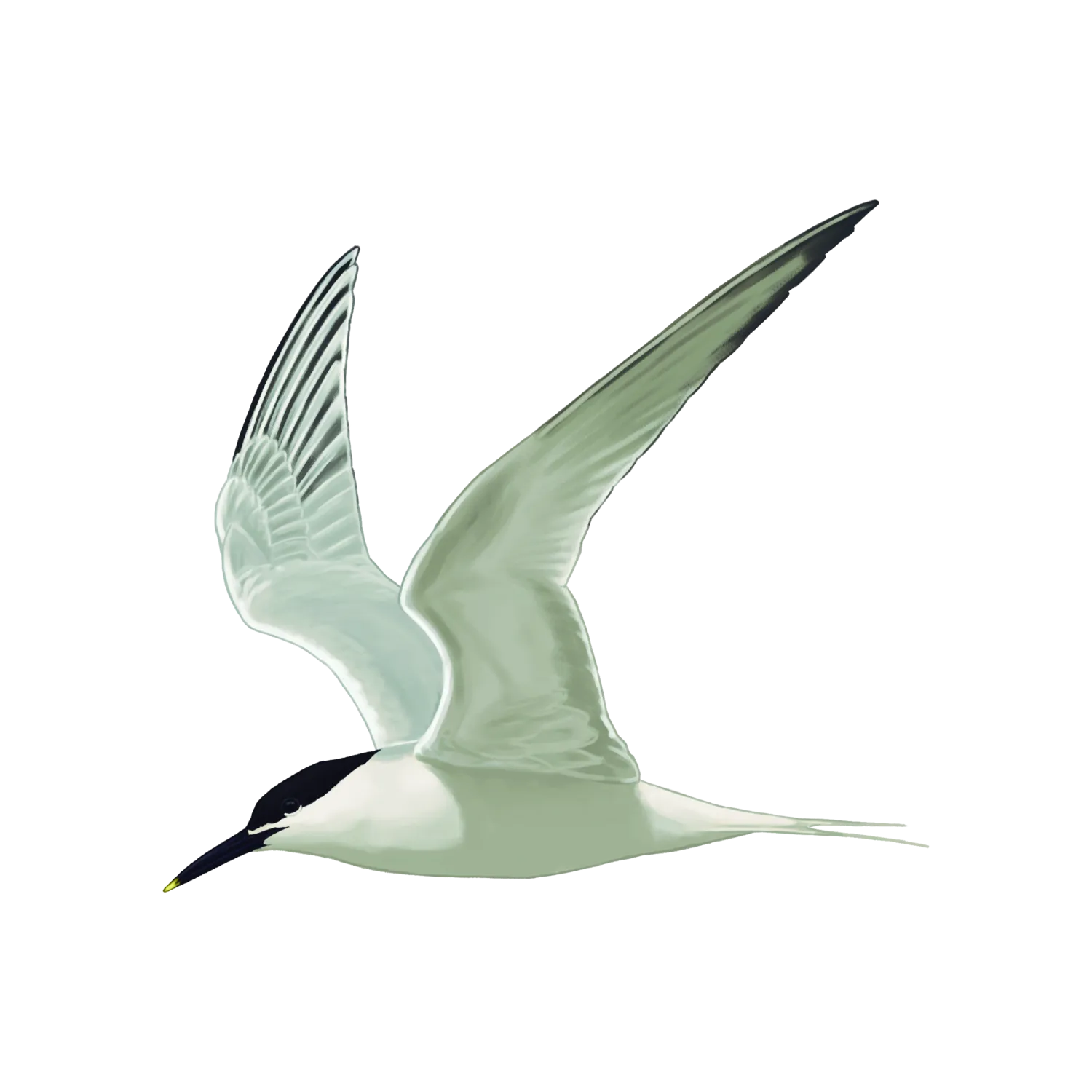
Sandwich Tern
Scientific name: Thalasseus sandvicensis
Family laridae
Phenology
- Mainland
- Wintering and passage migrant
- Madeira
- Passage migrant
- Azores
- Vagrant
Conservation status
Learn more- Mainland
- Madeira
- Azores
- IUCN Global
Data
Maps
Distribution | Breeding
Scale
Minimum value:
Maximum value:
Scale
Minimum value:
Maximum value:
Scale
Minimum value:
Maximum value:
Scale
Minimum value:>
Maximum value:<
Scale
Minimum value:
Maximum value:
Scale
Minimum value:>
Maximum value:>
Distribution based on seabird tracking data (locations/hexagone).
Colony(ies) of origin:
Device:
Data period / number of individuals:
Data period / number of individuals:
Distribution of seabird breeding colonies or sites (number of breeding pairs).
Distribution based on marine censuses (probability of occurrence).
Observed density based on marine censuses (birds/ km2).
Confirmed occurence during marines censuses.
Abundance of waders derived from Project Arenaria coastal surveys (birds/square).
Passage rates derived from RAM coastal surveys (birds/hour).
No data available for the selected period.
Presentation
Distribution, movements and phenology
The Sandwich Tern breeds in Eurasia, Africa and the Americas. The European population breeds between May and August along the coasts of much of the continent, and winters from France to South Africa, mainly along the African coast (Billerman et al. 2026).
In Mainland Portugal, it occurs during migration and wintering. It is found mainly in coastal areas, generally not venturing beyond the limits of the continental shelf (Meirinho et al. 2014), although some birds do venture into deeper waters (Fijn 2024). Most of the birds occurring in this area originate from the British Isles and the North Sea (Catry et al. 2010a). Pre-breeding migration takes place between March and June, whilst post-breeding migration occurs between August and October. In the Azores and Madeira, it is occasionally observed during migration in artificial areas such as harbours and marinas. The tracking of 24 birds fitted with GPS from colonies in the Netherlands confirms the use of the Mainland coast during both phenological periods, with a notable concentration in the Ria de Aveiro area. It is noted that they did not remain during the winter, nor were they recorded in the Azores and Madeira.
Abundance and population trends
The global population is stable and has been estimated at between 490,000 and 640,000 birds, of which 79,900 to 148,000 pairs breed in Europe (BirdLife International 2025).
It is an abundant species along the coast of Mainland Portugal. It occasionally uses coastal wetlands as stopover sites, where it may form large concentrations, reaching up to a thousand individuals (Farinha & Costa 1999). During the post-breeding migration in 2015, 5,661 birds were counted passing southwards from Cape Carvoeiro (Elmberg et al. 2020). A considerably smaller number of individuals winter in Portugal, amounting to a few hundred birds (Equipa Atlas 2018). Based on the data used for the environmental status assessment, an estimate of around 8,500 to 16,600 individuals was obtained for the continental shelf in 2024. Despite fluctuations in the size of this population over recent years, Good Environmental Status has been achieved for the abundance indicator.
Ecology and habitat
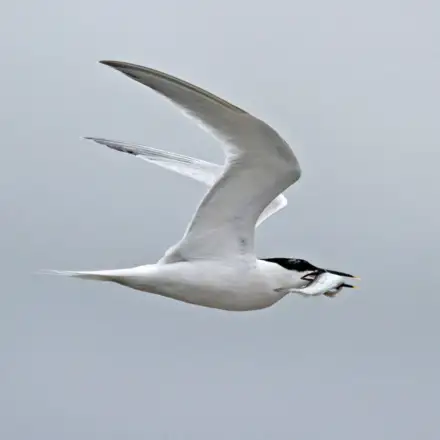
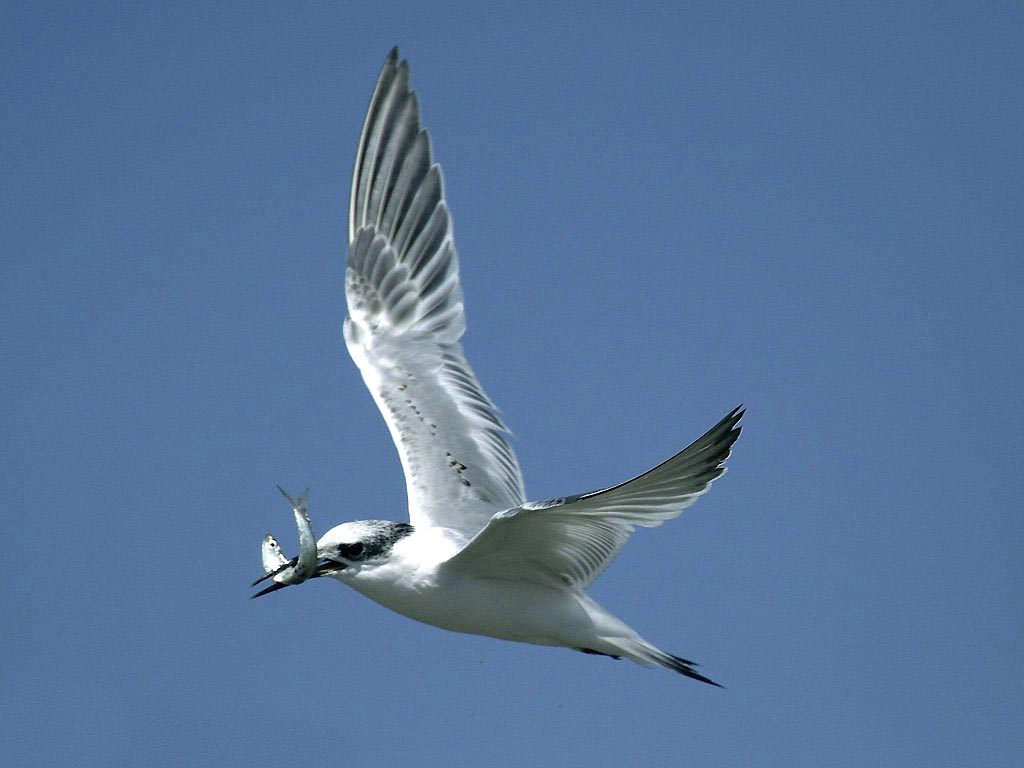
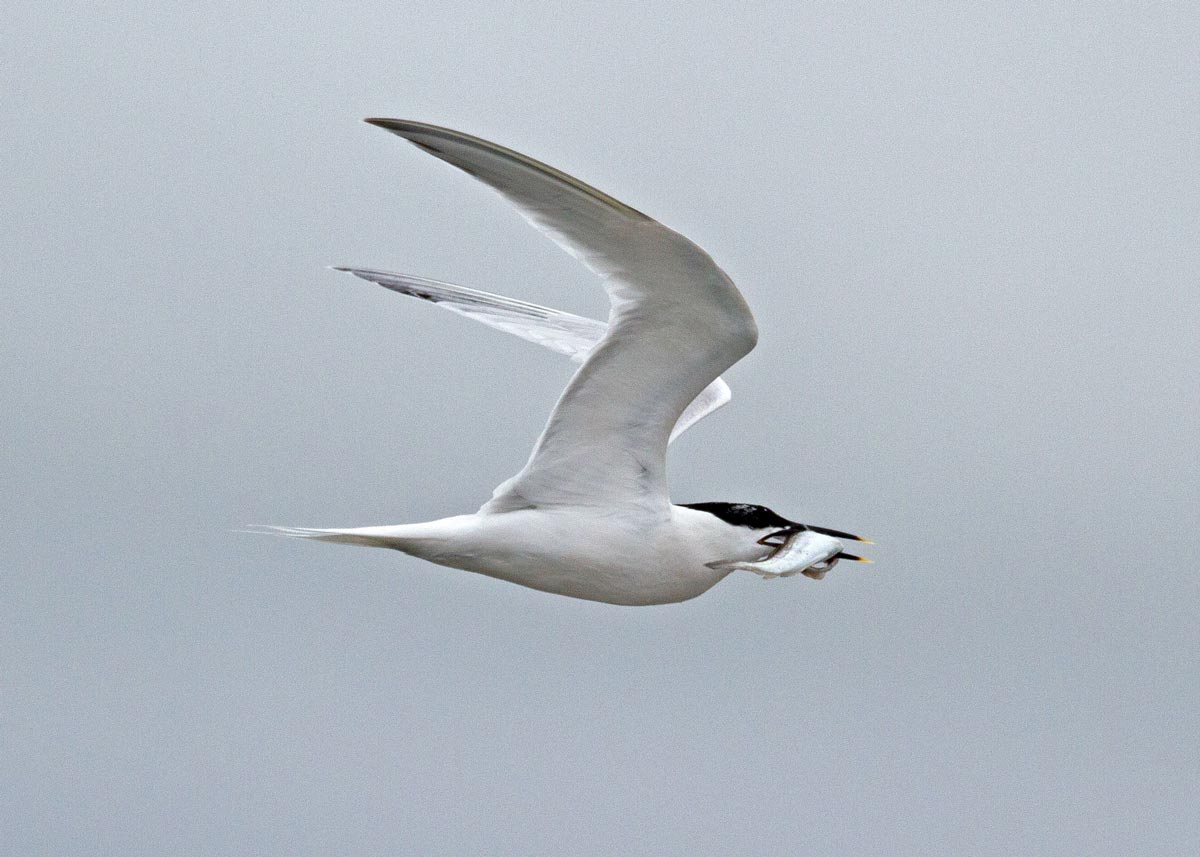
The Sandwich Tern occupies coastal habitats during migratory stopovers, but can be observed far from the coast during migration. It feeds mainly on small fish, but may also capture small marine crustaceans and annelids (Billerman et al. 2026). It prefers open marine environments, but is also frequently observed in wetlands such as estuaries, coastal lagoons, fish farms, salt pans and saltmarshes.
Threats and conservation
It is particularly vulnerable to human disturbance in breeding colonies (Billerman et al. 2026). The European population appears to be stable, although it has suffered significant declines in some countries due to recent outbreaks of avian influenza (Knief et al. 2024; BirdLife International 2025). The species may also be sensitive to the impacts of offshore wind farms through disturbance, collision risk, barrier effects and habitat loss (Fijn 2024; van Bemmelen et al. 2024a).
- Autores
Ruben Fijn, Tânia Nascimento
- Owners/sources of tracking data
Ruben Fijn
van Bemmelen RS, Leemans JJ, Collier MP, Green RM, Middelveld RP, Thaxter CB & Fijn RC (2024a). Avoidance of offshore wind farms by Sandwich Terns increases with turbine density. Ornithological Applications 126(1): duad055. Bibliography:
Meirinho A, Barros N, Oliveira N, Catry P, Lecoq M, Paiva V, Geraldes P, Granadeiro JP, Ramírez I & Andrade J (2014). Atlas das Aves Marinhas de Portugal. Sociedade Portuguesa para o Estudo das Aves. Bibliography:
Knief U, Bregnballe T, Alfarwi I, Ballmann MZ, Brenninkmeijer A, Bzoma S, Chabrolle A, Dimmlich J, Engel E & Fijn R (2024). Highly pathogenic avian influenza causes mass mortality in Sandwich Tern Thalasseus sandvicensis breeding colonies across north-western Europe. Bird Conservation International 34: e6. Bibliography:
Fijn RC (2024). Tracking terns: Year-round movement ecology of sandwich terns in a changing marine environment. PhD thesis, University of Amsterdam, the Netherlands. Bibliography:
Farinha JC & Costa H (1999). Aves aquáticas de Portugal. Instituto de Conservação da Natureza, Lisboa Bibliography:
Equipa Atlas (2018). Atlas das Aves Invernantes e Migradoras de Portugal 2011-2013. Sociedade Portuguesa para o Estudo das Aves, LabOr- Laboratório de Ornitologia – ICAAM - Universidade de Évora, Instituto da Conservação da Natureza e das Florestas, Instituto das Florestas e Conservação da Natureza (Madeira), Secretaria Regional da Energia, Ambiente e Turismo (Açores) e Associação Portuguesa de Anilhadores de Aves. Lisboa. Bibliography:
Elmberg J, Hirschfeld E, Cardoso H & Hessel R (2020). Seabird migration at Cabo Carvoeiro (Peniche, Portugal) in autumn 2015. Marine Ornithology 48: 231-244. Bibliography:
BirdLife International (2025). IUCN Red List for birds. Downloaded from https://datazone.birdlife.org on 30.11.2025. Bibliography:
Billerman SM, Keeney BL, Kirwan GM, Medrano F, Sly ND & Smith MG (eds.) (2026). Birds of the World. Cornell Laboratory of Ornithology, Ithaca, NY, USA. Bibliography:
Catry P, Costa H, Elias G & Matias R (2010a). Aves de Portugal, Ornitologia do Território Continental. Assírio e Alvim, Lisboa Glossary:
A rocky, steep and prominent geographical area that projects into the sea, often forming a cape. Glossary:
A group of marine arthropods that are important in the marine food chain. Glossary:
A sudden increase in the incidence of a disease within a population or region. Glossary:
Wind energy production infrastructures installed at sea. Glossary:
A species or parameter that reflects the state of an ecosystem or environmental changes. Glossary:
A concept defined under the Marine Strategy Framework Directive (MSFD), referring to the condition of the elements of the marine environment, including birds. It aims to assess whether ecosystems are healthy, balanced and capable of supporting ecological functions and human uses in a sustainable manner. The ultimate goal is for the components and ecosystems to achieve Good Environmental Status. Glossary:
A small device attached to birds to study their movements at a finer scale (usually during the breeding season). These devices use the Global Positioning System (GPS) to obtain information on position, latitude, longitude and altitude at any point on Earth, using a network of orbiting satellites. Glossary:
Referring to the period preceding breeding. Glossary:
Referring to the period following breeding. Glossary:
The portion of the seabed that begins at the coastline and slopes gently downwards to the continental slope (where the slope is much steeper). On average, the continental shelf extends to a depth of 200 metres. Glossary:
A period generally corresponding to the winter months, which may include part of autumn.