
South Polar Skua
Scientific name: Catharacta maccormicki
Family stercorariidae
Phenology
- Mainland
- Vagrant
- Madeira
- Passage migrant
- Azores
- Wintering and passage migrant
Conservation status
Learn more- Mainland
- Madeira
- Azores
- IUCN Global
Maps
Distribution | Breeding
Scale
Minimum value:
Maximum value:
Scale
Minimum value:
Maximum value:
Scale
Minimum value:
Maximum value:
Scale
Minimum value:>
Maximum value:<
Scale
Minimum value:
Maximum value:
Scale
Minimum value:>
Maximum value:>
Distribution based on seabird tracking data (locations/hexagone).
Colony(ies) of origin:
Device:
Data period / number of individuals:
Data period / number of individuals:
Distribution of seabird breeding colonies or sites (number of breeding pairs).
Distribution based on marine censuses (probability of occurrence).
Observed density based on marine censuses (birds/ km2).
Confirmed occurence during marines censuses.
Abundance of waders derived from Project Arenaria coastal surveys (birds/square).
Passage rates derived from RAM coastal surveys (birds/hour).
No data available for the selected period.
Presentation
Distribution, movements and phenology
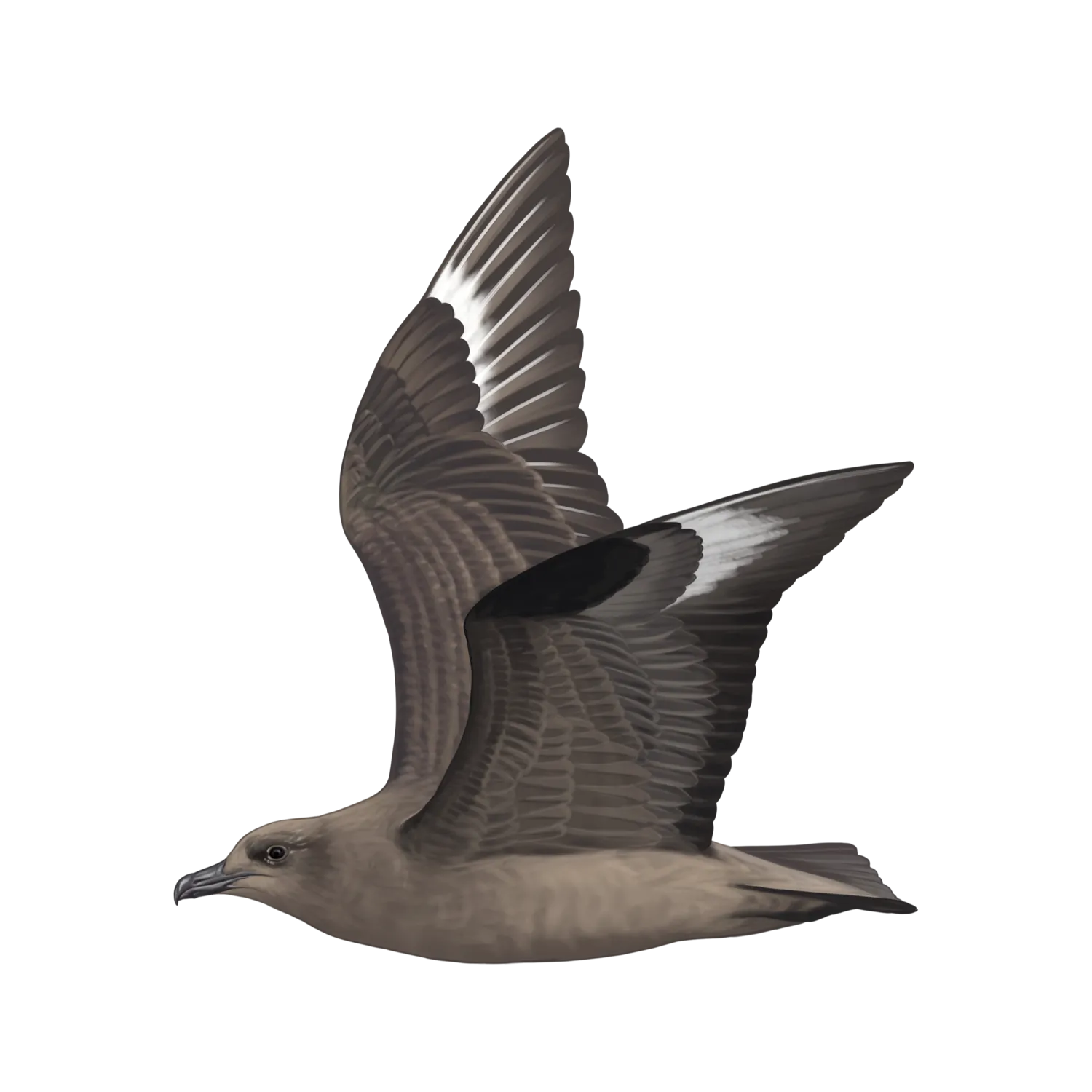
The South Polar Skua breeds between November and May on the Antarctic coast, particularly on the Antarctic Peninsula and in the South Orkney and South Shetland archipelagos and the Ross Sea. It is one of the seabirds with the longest migration, wintering in the North-west Atlantic and the northern Pacific. It is precisely during the pre-breeding migration that this species crosses the North-east Atlantic, passing mainly off the European mainland coast, though some individuals approach the coast of the Iberian Peninsula, particularly between late August and early November (Kopp et al. 2011). The species’ rare occurrence, combined with the difficulty in identifying it, contributes to the scarcity of observations in this region (Flood et al. 2024). Tracking data from 28 birds from the South Shetland Islands fitted with GLS devices show this fragmented use of continental waters. However, this is not observed in the Azores sub-area, where the species appears to make more extensive use of the waters, particularly in the western half and during the wintering period. Corroborating observations have recently been recorded during birdwatching trips on the open sea (e.g. Alfrey & Legrand 2025). In the waters off Madeira, there appears to be a lower but still significant occurrence of the species, particularly near the Selvagens Islands, and it can also be observed in other areas (e.g. Flood et al. 2013).
Abundance and population trends
The global population is estimated to number between 6,000 and 15,000 mature individuals (BirdLife International 2025). The population appears to be stable, with no evidence of decline or significant threats. As the species is rarely observed in Portugal, there are no data available to assess population trends or its environmental status.
Ecology and habitat
The South Polar Skua nests in areas with little snow cover, where it usually lays two eggs between November and December. It feeds mainly on fish, krill, and penguins, supplementing its diet with carrion (Billerman et al. 2026).
Threats and conservation
Population survival may be affected by prey abundance, climate change leading to a decline in sea ice concentrations (Pacoureau et al. 2019), and infectious diseases (León et al. 2025). They also exhibit bioaccumulation and biomagnification of organic pollutants, which may pose a risk of chronic effects on survival and breeding success (Bustnes et al. 2006).
- Autores
Hany Alonso, Tânia Nascimento
- Owners/sources of tracking data
Pacoureau N, Delord K, Jenouvrier S & Barbraud C (2019). Demographic and population responses of an apex predator to climate and its prey: a long‐term study of South Polar Skuas. Ecological Monographs 89(4): e01388. Bibliography:
León F, Ulloa‑Contreras C, Pizarro EJ, Castillo‑Torres PN, Díaz‑Morales KB, Franco AC, Timm FCB, Corrêa ML, Krüger L, Poulin E, Pardo‑Roa C & Vianna JA (2025). Skuas mortalities linked to positives HPAIV A/H5 beyond Polar Antarctic Circle. bioRxiv, preprint. Bibliography:
Kopp M, Peter H-U, Mustafa O, Lisovski S, Ritz MS, Phillips RA & Hahn S (2011). South Polar Skuas from a single breeding population overwinter in different oceans though show similar migration patterns. Marine Ecology Progress Series 435: 263–267. Bibliography:
Flood RL, López-Velasco D, Sutherland K & Newell D (2024). Identification of Great Skua and South Polar Skua in north-eastern Atlantic Ocean in autumn. Dutch Birding 46: 217-244. Bibliography:
Flood B, Romano H & Correia-Fagundes C (2013). The first confirmed South Polar Skua for Madeira. Birding World 26(6): 248–252. Bibliography:
Bustnes JO, Tveraa T, Henden JA, Varpe Ø, Janssen K & Skaare JU (2006). Organochlorines in Antarctic and Arctic avian top predators: a comparison between the south polar skua and two species of northern hemisphere gulls. Environmental science & technology 40(8): 2826-2831. Bibliography:
BirdLife International (2025). IUCN Red List for birds. Downloaded from https://datazone.birdlife.org on 30.11.2025. Bibliography:
Billerman SM, Keeney BL, Kirwan GM, Medrano F, Sly ND & Smith MG (eds.) (2026). Birds of the World. Cornell Laboratory of Ornithology, Ithaca, NY, USA. Bibliography:
Alfrey P & Legrand V (2025). Pelagic birding at Banco da Fortuna, Azores. Dutch Birding 47: 104-113. Data:
Kopp M, Esefeld J, Krietsch J & Peter H‑U (2010). Dataset 1116: South Polar Skua, Catharacta maccormicki, Geolocator (GLS), King George Island, South Shetland Islands, Antarctica, 2007–2010. BirdLife International Seabird Tracking Database. Downloaded from https://data.seabirdtracking.org/dataset/1116/ on 30.11.2025. Glossary:
Individuals capable of breeding, used as a reference in population estimates. Glossary:
Chemical compounds resistant to degradation that accumulate in organisms and the environment. Glossary:
Long-term effects resulting from prolonged exposure to toxic agents. Glossary:
Persistent changes in global or regional climate patterns, influenced by natural and anthropogenic factors. Glossary:
The process by which chemical substances build up in the tissues of an organism over time. Glossary:
The direction of change in the size of a population over time (increase, decline or stability). Glossary:
A concept defined under the Marine Strategy Framework Directive (MSFD), referring to the condition of the elements of the marine environment, including birds. It aims to assess whether ecosystems are healthy, balanced and capable of supporting ecological functions and human uses in a sustainable manner. The ultimate goal is for the components and ecosystems to achieve Good Environmental Status. Glossary:
Referring to the period preceding breeding. Glossary:
Small crustaceans of the order Euphausiacea found in all oceans. Krill are considered an important prey source for many vertebrate species such as birds, seals, whales and fish that inhabit sub-Antarctic waters, forming the base of the food chain. Glossary:
A period generally corresponding to the winter months, which may include part of autumn. Glossary:
A small device attached to birds to study their large-scale movements (usually migration), which works by recording light intensity (from which the duration of night and the local midday time are estimated, and consequently the latitude and longitude on each day).