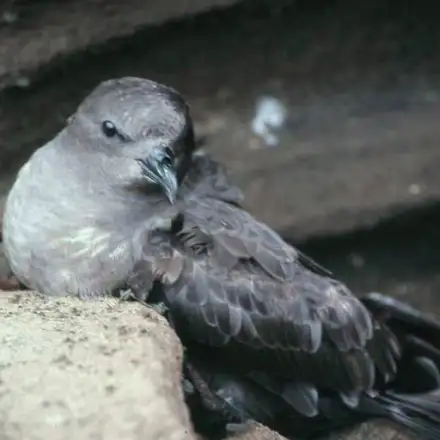
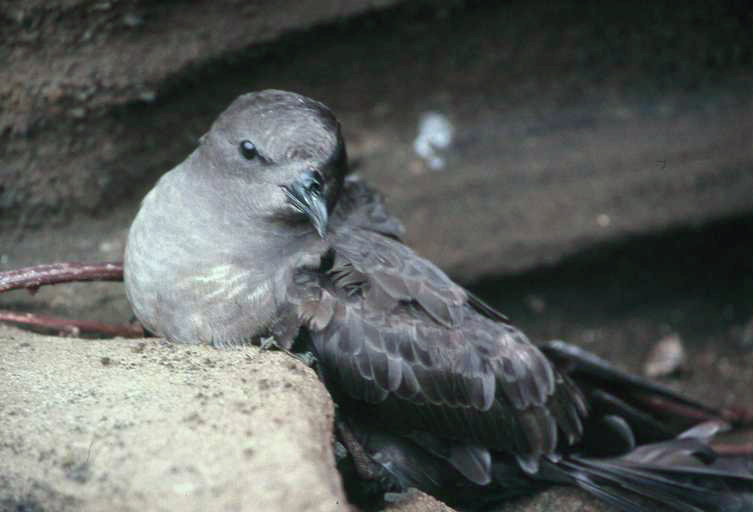
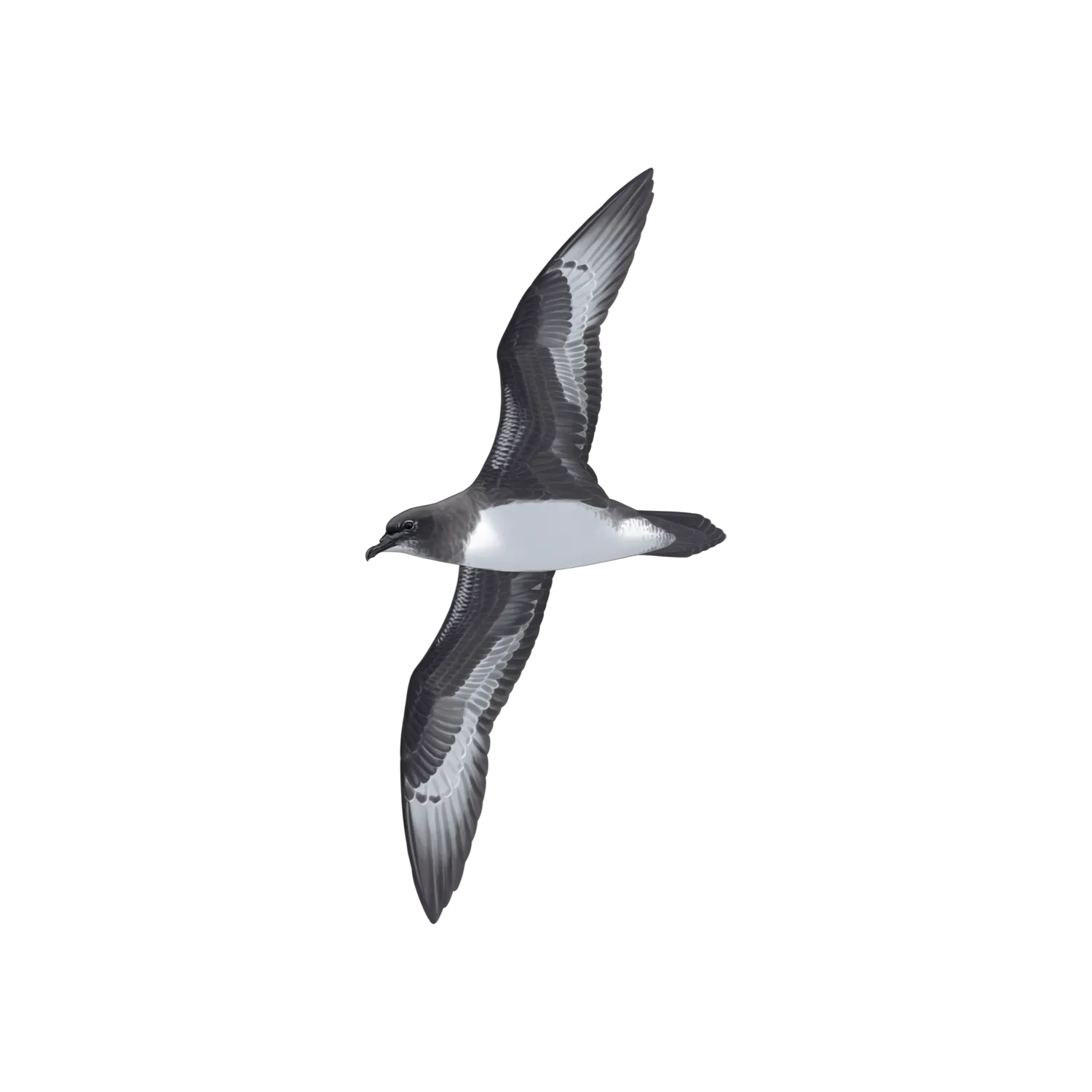
Trindade Petrel
Scientific name: Pterodroma arminjoniana
Family procellariidae
Phenology
- Mainland
- Absent
- Madeira
- Absent
- Azores
- Vagrant
Conservation status
Learn more- Mainland
- Madeira
- Azores
- IUCN Global
Maps
Distribution | Non-breeding
Scale
Minimum value:
Maximum value:
Scale
Minimum value:
Maximum value:
Scale
Minimum value:
Maximum value:
Scale
Minimum value:>
Maximum value:<
Scale
Minimum value:
Maximum value:
Scale
Minimum value:>
Maximum value:>
Distribution based on seabird tracking data (locations/hexagone).
Colony(ies) of origin:
Device:
Data period / number of individuals:
Data period / number of individuals:
Distribution of seabird breeding colonies or sites (number of breeding pairs).
Distribution based on marine censuses (probability of occurrence).
Observed density based on marine censuses (birds/ km2).
Confirmed occurence during marines censuses.
Abundance of waders derived from Project Arenaria coastal surveys (birds/square).
Passage rates derived from RAM coastal surveys (birds/hour).
No data available for the selected period.
Presentation
Distribution, movements and phenology
The Trindade Petrel breeds exclusively on the islands of Trindade and Martim Vaz, off the coast of Espírito Santo in Brazil, and on Ronde Island in Mauritius (Billerman et al. 2026). Breeding birds are found in these areas throughout the year; it is a species with two distinct breeding seasons, one peaking in October and the other in April. However, the birds only breed during one of these periods (BirdLife International 2025). During the breeding season, they feed in the more coastal waters of Brazil (Leal et al. 2017). Movements outside the breeding season are very poorly understood. Recent data suggest that the birds migrate to the central and North-west Atlantic to spend their wintering season there (Krüger et al. 2016). In fact, of the four birds fitted with GLS on Trindade Island in 2014, one utilised the Azores sub-area of the EEZ, specifically the waters of the western half. This very brief incursion occurred at the end of April, corresponding to the bird’s wintering period.
Abundance and population trends
The global population was estimated at 1,228 pairs in 2014 (Krüger 2018). Despite its unfavourable conservation status, the species shows a stable trend (BirdLife International 2025). It is a very rare species in our waters, with only ten records submitted to the Portuguese Rarities Committee, all of them referring to solitary birds observed in the Azores (Robb et al. 2025).
Ecology and habitat
It is believed that the Trindade Petrel has an ecology very similar to that of other petrels, exploiting similar habitats for feeding. It is a distinctly pelagic species that feeds mainly on cephalopods, but also on fish, caught using different strategies (Leal et al. 2017). However, it differs from its congeners in the type of habitat it uses for nesting, being able to use both cliff cavities and low-altitude areas at sea level (Krüger 2018).
Ameaças e conservação
The Trindade Petrel has an unfavourable conservation status due to its small population size and restricted nesting range. It is also subject to predation by invasive mammals (cats and rats) in these areas (Alves et al. 2011; BirdLife International 2025). The species has benefited from the eradication of goats and pigs, as well as the control of feral cats, in its main breeding colony (BirdLife International 2025). The potential increase in disturbance, habitat loss and mortality due to recent infrastructure development plans on the island of Trindade, including wind turbines, could degrade the conservation status of this population. The species also ingests plastic particles in significant quantities, although the effect of this on the birds’ health has not yet been established (Leal et al. 2017).
- Autor
Nuno Oliveira
- Owners/sources of tracking data
Robb M, Alfrey P, Alves P, Cardoso H, Crochet PA, Fagerström V, Fernandes P, Nicolau P, Ramalho P & Valkenburg T (2025). Aves de ocorrência rara ou acidental em Portugal. Relatório do Comité Português de Raridades referente ao ano de 2023. Anuário Ornitológico 17: 3-37. Bibliography:
Leal GR, Furness RW, McGill RAR, Santos RA & Bugoni L (2017). Feeding and foraging ecology of Trindade petrels Pterodroma arminjoniana during the breeding period in the South Atlantic Ocean. Marine Biology 164: 211. Bibliography:
Krüger L, Paiva VH, Colabuono FI, Petry MV, Montone RC, Ramos JA (2016). Year-round spatial movements and trophic ecology of Trindade Petrels (Pterodroma arminjoniana). Journal of Field Ornithology 87: 404–416. Bibliography:
Krüger L (2018). Population estimates of Trindade Petrel (Pterodroma arminjoniana) by ensemble nesting habitat modelling. International Journal of Environmental Sciences & Natural Resources 10(4): 145-157. Bibliography:
BirdLife International (2025). IUCN Red List for birds. Downloaded from https://datazone.birdlife.org on 30.11.2025. Bibliography:
Billerman SM, Keeney BL, Kirwan GM, Medrano F, Sly ND & Smith MG (eds.) (2026). Birds of the World. Cornell Laboratory of Ornithology, Ithaca, NY, USA. Bibliography:
Alves JA, Dias M, Rocha A, Barreto B, Catry T, Costa H, Fernandes P, Ginja B, Glen K, Jara J, Martins R, Moniz F, Pardal S, Pereira T, Rodrigues J & Rolo M (2011). Monitorização das populações de aves aquáticas dos estuários do Tejo, Sado e Guadiana. Anuário Ornitólogico 8: 118-133. Data:
Krüger L (2014). Dataset 1282: Trindade Petrel, Pterodroma arminjoniana, Geolocator (GLS), Praia das Tartarugas, Trindade Island, Brazil, 2013–2014. BirdLife International Seabird Tracking Database. Downloaded from https://data.seabirdtracking.org/dataset/1282/ on 30.11.2025. Glossary:
A group of marine molluscs that includes squids, cuttlefish and octopuses. Glossary:
Population management of invasive species without total elimination. Glossary:
Complete removal of an invasive species from a specific area. Glossary:
The direction of change in the size of a population over time (increase, decline or stability). Glossary:
Under the United Nations Convention on the Law of the Sea, coastal states are entitled to declare an EEZ comprising maritime area beyond their territorial waters. The national EEZ is delimited by an imaginary line situated 200 nautical miles from the coast, separating national waters from international or shared waters. Within its EEZ, each state has rights such as the exploitation of marine resources, the conduct of scientific research and the regulation of fishing by foreign vessels. Glossary:
The area or environment where organisms that do not depend on the seafloor normally live. It is the typical ecological environment of open ocean waters. The pelagic ecosystem does not include only the open sea; it also comprises the waters covering the continental shelf. The pelagic zone begins below the influence of tides and extends into the open ocean, at depths ranging from a few tens of metres to approximately 6,000 metres, and is divided into different layers. Glossary:
A period generally corresponding to the winter months, which may include part of autumn. Glossary:
A small device attached to birds to study their large-scale movements (usually migration), which works by recording light intensity (from which the duration of night and the local midday time are estimated, and consequently the latitude and longitude on each day). Glossary:
Classification of the threat level of a species according to its probability of extinction. The criteria for this classification generally follow internationally recognised rules defined by the International Union for Conservation of Nature (IUCN) (http://www.redlist.org) and are based on population size, range and population trend. This status may be national or international.