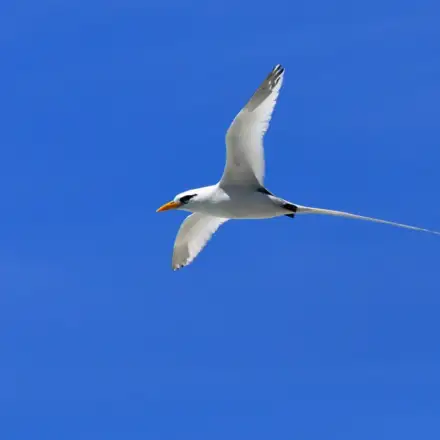
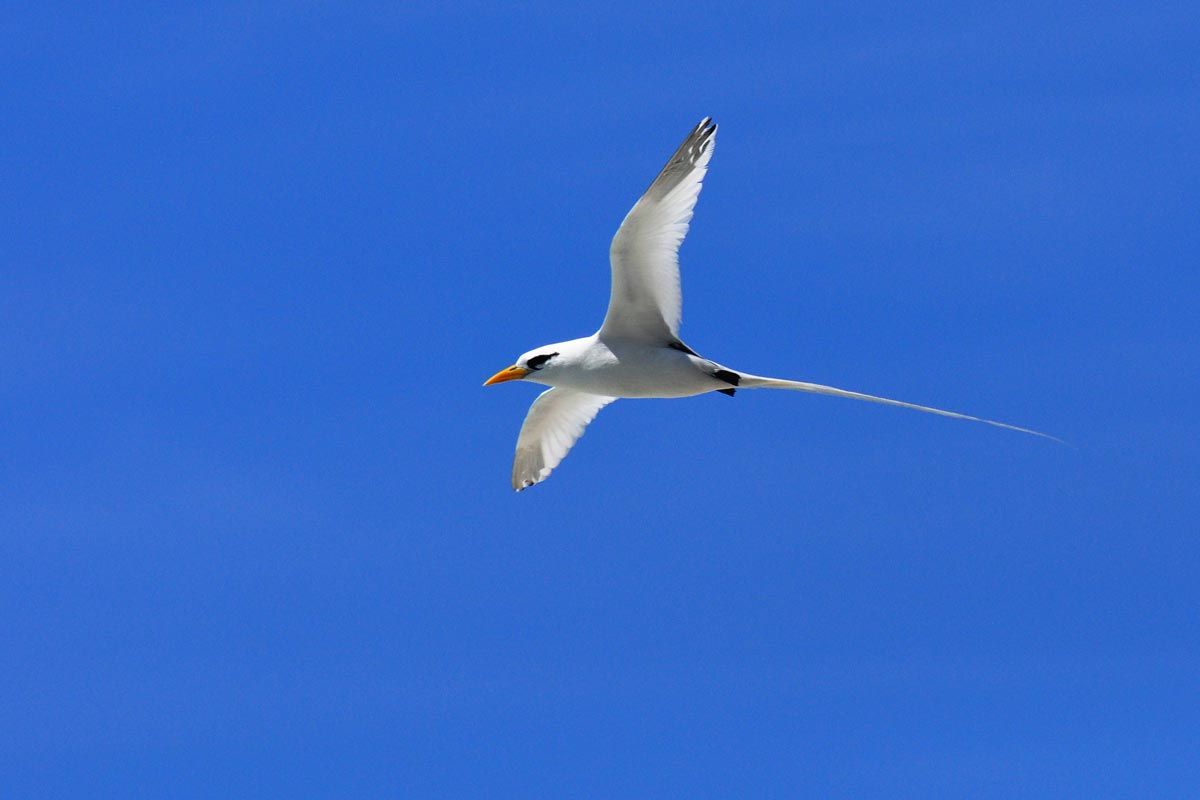
White-tailed Tropicbird
Scientific name: Phaethon lepturus
Family phaethontidae
Phenology
- Mainland
- Absent
- Madeira
- Absent
- Azores
- Vagrant
Conservation status
Learn more- Mainland
- Madeira
- Azores
- IUCN Global

Data
Presentation
The White-tailed Tropicbird breeds in tropical regions of the Atlantic, Pacific and Indian Oceans (del Hoyo et al. 1992). It is a resident and dispersive species, and both adults and juveniles are capable of undertaking long-distance journeys in pelagic environments (del Hoyo et al. 1992). In Portugal, the species occurs as a vagrant to the Azores archipelago, with no records known for the Madeira archipelago or for Mainland waters. In Azorean waters, several individuals have been detected in recent years, the majority being solitary juveniles, between August and October (Birding Azores 2014). In the marine censuses carried out as part of this atlas, only one record of this species was made in Portuguese waters, corresponding to a single individual at the western limit of the Azorean waters of the EEZ, in late October.
- Autor
Meirinho A, Barros N, Oliveira N, Catry P, Lecoq M, Paiva V, Geraldes P, Granadeiro JP, Ramírez I & Andrade J (2014). Atlas das Aves Marinhas de Portugal. Sociedade Portuguesa para o Estudo das Aves. Bibliography:
del Hoyo J, Elliott A & Sargatal J (eds.) (1992). Handbook of the birds of the world. Vol. 1. Lynx Edicions, Barcelona, Spain Glossary:
Under the United Nations Convention on the Law of the Sea, coastal states are entitled to declare an EEZ comprising maritime area beyond their territorial waters. The national EEZ is delimited by an imaginary line situated 200 nautical miles from the coast, separating national waters from international or shared waters. Within its EEZ, each state has rights such as the exploitation of marine resources, the conduct of scientific research and the regulation of fishing by foreign vessels. Glossary:
The area or environment where organisms that do not depend on the seafloor normally live. It is the typical ecological environment of open ocean waters. The pelagic ecosystem does not include only the open sea; it also comprises the waters covering the continental shelf. The pelagic zone begins below the influence of tides and extends into the open ocean, at depths ranging from a few tens of metres to approximately 6,000 metres, and is divided into different layers.