Wilson's Storm-petrel
Scientific name: Oceanites oceanicus
Family oceanitidae
Phenology
- Mainland
- Passage migrant
- Madeira
- Passage migrant
- Azores
- Vagrant
Conservation status
Learn more- Mainland
- Madeira
- Azores
- IUCN Global
Data
Maps
Occurrence | Summer
Scale
Minimum value:
Maximum value:
Scale
Minimum value:
Maximum value:
Scale
Minimum value:
Maximum value:
Scale
Minimum value:>
Maximum value:<
Scale
Minimum value:
Maximum value:
Scale
Minimum value:>
Maximum value:>
Distribution based on seabird tracking data (locations/hexagone).
Colony(ies) of origin:
Device:
Data period / number of individuals:
Data period / number of individuals:
Distribution of seabird breeding colonies or sites (number of breeding pairs).
Distribution based on marine censuses (probability of occurrence).
Observed density based on marine censuses (birds/ km2).
Confirmed occurence during marines censuses.
Abundance of waders derived from Project Arenaria coastal surveys (birds/square).
Passage rates derived from RAM coastal surveys (birds/hour).
No data available for the selected period.
Presentation
Distribution, movements and phenology
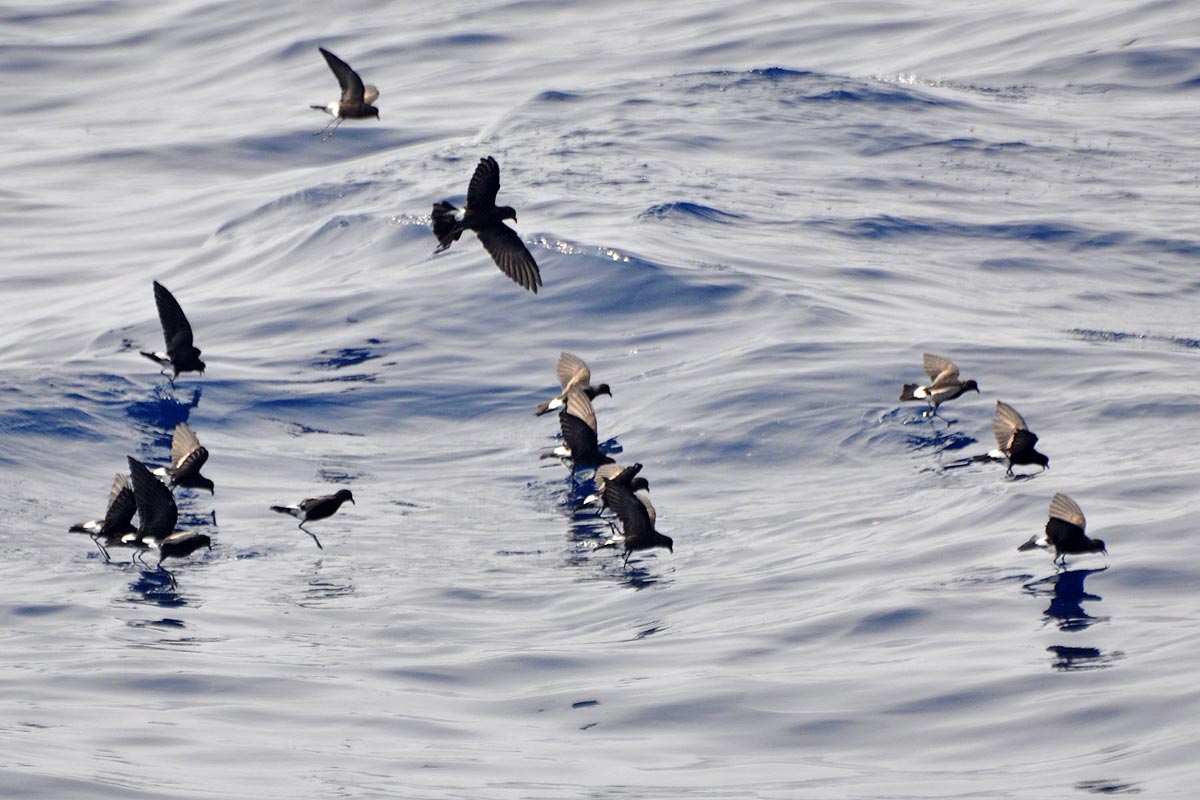
The Wilson's Storm-petrel breeds in the seas of the southern hemisphere, in Antarctica and on sub-Antarctic islands, between November and April (del Hoyo et al. 1992). This species is found throughout the national EEZ, mainly off the Mainland and in the Azores. It is very rarely sighted from land (Catry et al. 2010a). It is mainly in summer and autumn that it visits Portuguese waters, gradually disappearing in the second half of autumn, possibly because most individuals have already begun their return migration to their breeding colonies (del Hoyo et al. 1992). During the winter, this storm-petrel is absent from the national EEZ, and remains relatively rare during the spring.
Abundance and population trends
Although it is a common species in Portuguese waters, there are no estimates of abundance or information to assess population trends. There are several records of more than 50 birds observed on a single day in Mainland waters, particularly in the southern half. The largest concentrations were recorded off the Mainland in August 1999, with around 240 birds observed approximately 15 nautical miles from the coast off Cape Espichel (Catry et al. 2010a); in September 2011, when 170 individuals were observed in an area of four to seven nautical miles off Portimão (Ornithological Reports); and in August 2010, involving around 250 individuals, at the Princesa Alice Bank, some 50 nautical miles south-west of Pico Island in the Azores (Birding Azores 2014). At this latter location, there is also an interesting record of 70 birds, made in September 2009 (Birding Azores 2014).
Ecology and habitat
The Wilson's Storm-petrel prefers pelagic areas particularly rich in plankton (del Hoyo et al. 1992), often situated on the edge of continental shelves or near seamounts. In Mainland Portugal, it occurs from shallower waters to more oceanic areas. Its diet consists of planktonic crustaceans, fish, cephalopods and other small marine organisms. It may also feed on the carcasses of other animals.
Threats and conservation
Globally, the species appears to be stable, with no evidence of population decline or potential threats (BirdLife International 2014).
- Autor
Observations published in Ornithological Reports, see Book Atlas of Seabirds of Portugal – pp. 207. Bibliography:
Meirinho A, Barros N, Oliveira N, Catry P, Lecoq M, Paiva V, Geraldes P, Granadeiro JP, Ramírez I & Andrade J (2014). Atlas das Aves Marinhas de Portugal. Sociedade Portuguesa para o Estudo das Aves. Bibliography:
BirdLife International (2014). http://www.birdlife.org/europe-and-central-asia/european-red-list-birds-0 Bibliography:
Birding Azores (2014). http://www.birdingazores.com/ Bibliography:
Catry P, Costa H, Elias G & Matias R (2010a). Aves de Portugal, Ornitologia do Território Continental. Assírio e Alvim, Lisboa Bibliography:
del Hoyo J, Elliott A & Sargatal J (eds.) (1992). Handbook of the birds of the world. Vol. 1. Lynx Edicions, Barcelona, Spain Glossary:
Under the United Nations Convention on the Law of the Sea, coastal states are entitled to declare an EEZ comprising maritime area beyond their territorial waters. The national EEZ is delimited by an imaginary line situated 200 nautical miles from the coast, separating national waters from international or shared waters. Within its EEZ, each state has rights such as the exploitation of marine resources, the conduct of scientific research and the regulation of fishing by foreign vessels. Glossary:
The portion of the seabed that begins at the coastline and slopes gently downwards to the continental slope (where the slope is much steeper). On average, the continental shelf extends to a depth of 200 metres. Glossary:
Aquatic organisms, generally small, which are suspended in the water and drift with the currents. Plankton may consist of plants (phytoplankton), animals (zooplankton) or other organisms such as bacteria. Glossary:
The area or environment where organisms that do not depend on the seafloor normally live. It is the typical ecological environment of open ocean waters. The pelagic ecosystem does not include only the open sea; it also comprises the waters covering the continental shelf. The pelagic zone begins below the influence of tides and extends into the open ocean, at depths ranging from a few tens of metres to approximately 6,000 metres, and is divided into different layers. Glossary:
An underwater mountain rising from the ocean floor without reaching the surface, usually of volcanic origin, with a conical shape and a circular, elliptical or slightly elongated base. Only elevations exceeding 1,000 metres are considered seamounts.