Zino's Petrel
Scientific name: Pterodroma madeira
Family procellariidae
Phenology
- Mainland
- Vagrant
- Madeira
- Summer breeder
- Azores
- Summering and passage migrant
Conservation status
Learn more- Mainland
- Madeira
- Azores
- IUCN Global
Data
Maps
Distribution | Breeding
Scale
Minimum value:
Maximum value:
Scale
Minimum value:
Maximum value:
Scale
Minimum value:
Maximum value:
Scale
Minimum value:>
Maximum value:<
Scale
Minimum value:
Maximum value:
Scale
Minimum value:>
Maximum value:>
Distribution based on seabird tracking data (locations/hexagone).
Colony(ies) of origin:
Device:
Data period / number of individuals:
Data period / number of individuals:
Distribution of seabird breeding colonies or sites (number of breeding pairs).
Distribution based on marine censuses (probability of occurrence).
Observed density based on marine censuses (birds/ km2).
Confirmed occurence during marines censuses.
Abundance of waders derived from Project Arenaria coastal surveys (birds/square).
Passage rates derived from RAM coastal surveys (birds/hour).
No data available for the selected period.
Presentation
Distribution, movements and phenology
The Zino’s Petrel is found primarily in the North-east Atlantic region and is endemic to Madeira. The first birds arrive at their breeding grounds in late March and the last juveniles leave the nest in the first half of October (Zino et al. 1995b). During the breeding season, the distribution of the Zino’s Petrel is concentrated in the waters around Madeira and the Azores (Zino et al. 2011). Outside the breeding season, the species disperses widely across the Atlantic, migrating to tropical and equatorial regions (Zino et al. 2011; Ramos et al. 2017).
Individual tracking data from 12 birds fitted with GPS in 2018 and 2019 reveal extensive use of the Portuguese EEZ, mainly in the sub-areas of Madeira and the Azores. It occurs mainly in deeper waters or those further from land masses, with the exception of the breeding colony. It is also worth noting the evident concentration in the extreme North-west of Azorean waters. The few forays it made into Mainland waters also appear to be restricted to the deep waters of the North-central region.
Abundance and population trends
The global population has been estimated at around 200 individuals, with fewer than 100 breeding pairs (Equipa Atlas 2022). Currently, it nests only in the central mountain range of the island of Madeira, although subfossil evidence indicates that its past distribution was wider, including other areas of the island and Porto Santo (Zino et al. 2001). Despite the negative effects of forest fires in the main breeding area, the population has remained stable. The environmental assessment indicates that the breeding population has achieved Good Environmental Status for the abundance indicator. Conversely, this population has not achieved Good Environmental Status for the productivity indicator.
Ecology and habitat
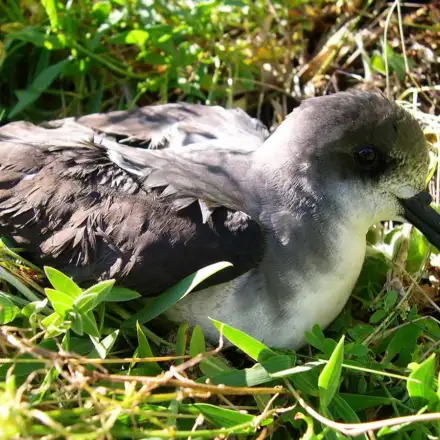
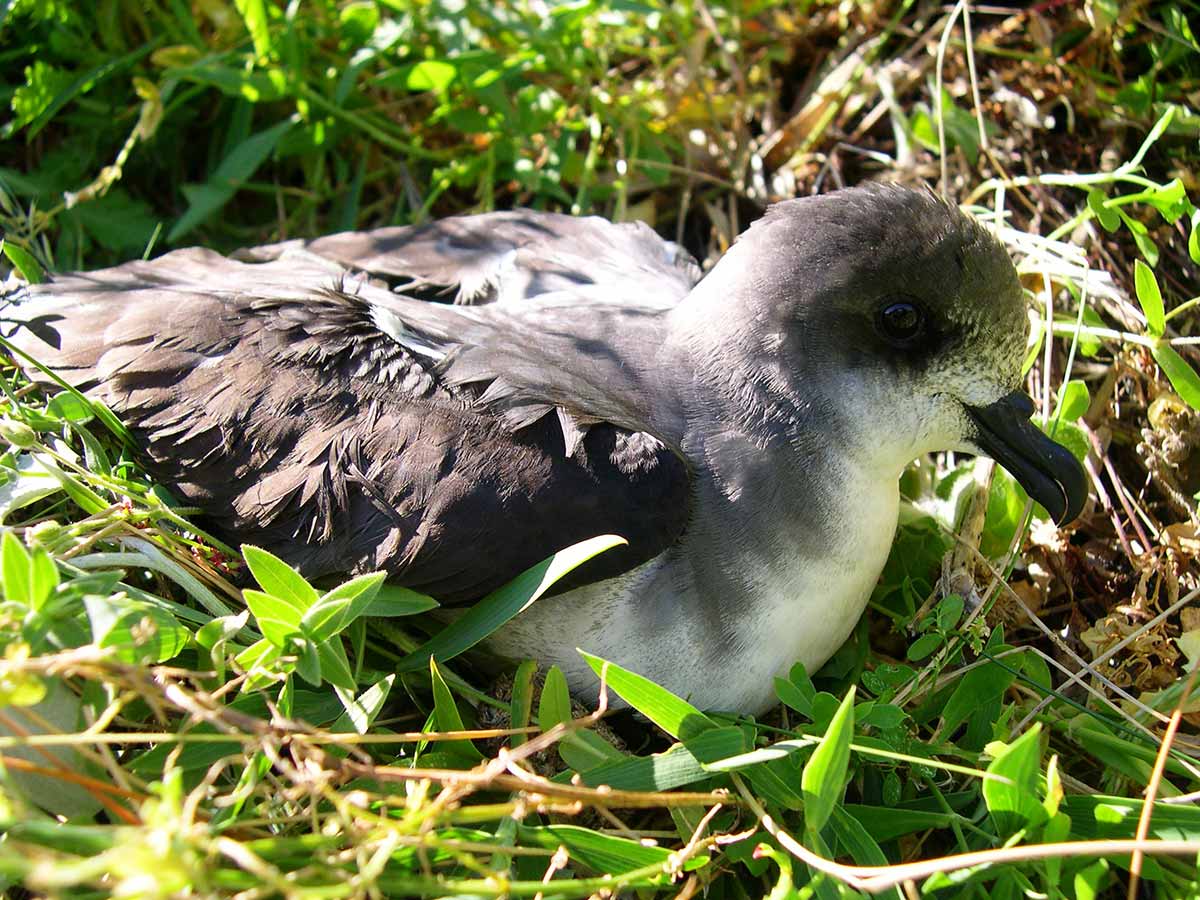
The species nests above 1,600 m in altitude, preferring areas with vegetation characteristic of high altitudes and in a good state of conservation (Zino et al. 2001; Oliveira & Menezes 2004). Nests are excavated in the ground, in a few inaccessible rocky outcrops, and may reach great depths and contain several chambers inside (Menezes et al. 2010a). It is possible that there are still nesting sites yet to be identified.
Threats and conservation
Forest fires in nesting areas pose a critical threat, causing direct mortality of adults and chicks, destruction of nests and habitat degradation, with long-term effects on survival and breeding success (Projeto Freira da Madeira 2010). Direct predation by rats and feral cats also poses a threat to reproduction, and is controlled through trapping programmes and biosecurity measures. Direct human impact on the colonies is limited, despite the high number of visitors, with poorly monitored night-time access restrictions (BirdLife International 2025). The restricted nesting area makes the species even more vulnerable to occasional events such as fires (Menezes et al. 2010b).
- Autores
Francis Zino, Manuel Biscoito, Tânia Nascimento
- Owners/sources of tracking data
Catry et al. 2019b, Zino & Biscoito 2010a, Zino & Biscoito 2010b
Zino F, Phillips R & Biscoito M (2011). Zino’s Petrel movements at sea - a preliminary analysis of datalogger results. Birding World 24: 216–219. Bibliography:
Zino F, Oliveira P, King S, Buckle A, Biscoito M, Neves H & Vasconcelos A (2001). Conservation of Zino’s petrel Pterodroma madeira in the archipelago of Madeira. Oryx 35: 128–136. Bibliography:
Zino F, Heredia B & Biscoito M (1995b). Action plan for Zino’s petrel Pterodroma madeira. In Heredia B, Rose L & Painter M (eds.). Globally threatened birds in Europe: action plans. Council of Europe and BirdLife International, Strasbourg: 25-31. Bibliography:
Ramos R, Carlile N, Madeiros J, Ramírez I, Paiva VH, Dinis HA, Zino F, Biscoito M, Leal GR, Bugoni L, Jodice PGR, Ryan PG & González-Solís J (2017). It is the time for oceanic seabirds: tracking year-round distribution of gadfly petrels across the Atlantic Ocean. Diversity and Distributions 23: 794–805. Bibliography:
Projeto Freira da Madeira (2010). Relatório intercalar do impacto do incêndio na zona de nidificação da Freira da Madeira (secção Oeste do Maciço Montanhoso Central). Bibliography:
Oliveira P & Menezes D (2004). A gestão e conservação das Aves do Arquipélago da Madeira. Parque Natural da Madeira/Arquipélago Verde. Funchal. Bibliography:
Menezes D, Oliveira P & Ramírez I (2010b). Medidas urgentes para a Recuperação da Freira do Bugio Pterodroma feae e do seu Habitat. Segundo Relatório de Progresso. Serviço do Parque Natura da Madeira/ Sociedade Portuguesa para o Estudo das Aves Bibliography:
Menezes D, Oliveira P & Ramírez I (2010a). Pterodromas do arquipélago da Madeira. Duas espécies em recuperação. Serviço do Parque Natural da Madeira, Funchal. Bibliography:
Equipa Atlas (2022). III Atlas das Aves Nidificantes de Portugal (2016-2021). SPEA, ICNF, LabOr/UÉ, IFCN. Portugal. Bibliography:
BirdLife International (2025). IUCN Red List for birds. Downloaded from https://datazone.birdlife.org on 30.11.2025. Data:
Zino F & Biscoito M (2010b). Dataset 827: Zino's Petrel, Pterodroma madeira, Geolocator (GLS), Pico do Areeiro, Madeira, Portugal, 2007–2010. BirdLife International Seabird Tracking Database. Downloaded from https://data.seabirdtracking.org/dataset/827/ on 30.11.2025. Data:
Zino F & Biscoito M (2010a). Dataset 826: Zino's Petrel, Pterodroma madeira, Geolocator (GLS), Pico do Areeiro, Madeira, Portugal, 2007–2010. BirdLife International Seabird Tracking Database. Downloaded from https://data.seabirdtracking.org/dataset/826/ on 30.11.2025. Data:
Catry P, Granadeiro JP & Silva MC (2019b). Dataset 1663: Zino's Petrel, Pterodroma madeira, GPS, Pico do Areeiro, Madeira, Portugal, 2018–2019. BirdLife International Seabird Tracking Database. Downloaded from https://data.seabirdtracking.org/dataset/1663/ on 30.11.2025. Glossary:
A species or parameter that reflects the state of an ecosystem or environmental changes. Glossary:
Monitoring the movements of individuals using tracking devices. Glossary:
A measure of a population’s breeding success, generally expressed as the average number of chicks produced per pair. Glossary:
A concept defined under the Marine Strategy Framework Directive (MSFD), referring to the condition of the elements of the marine environment, including birds. It aims to assess whether ecosystems are healthy, balanced and capable of supporting ecological functions and human uses in a sustainable manner. The ultimate goal is for the components and ecosystems to achieve Good Environmental Status. Glossary:
A small device attached to birds to study their movements at a finer scale (usually during the breeding season). These devices use the Global Positioning System (GPS) to obtain information on position, latitude, longitude and altitude at any point on Earth, using a network of orbiting satellites. Glossary:
Under the United Nations Convention on the Law of the Sea, coastal states are entitled to declare an EEZ comprising maritime area beyond their territorial waters. The national EEZ is delimited by an imaginary line situated 200 nautical miles from the coast, separating national waters from international or shared waters. Within its EEZ, each state has rights such as the exploitation of marine resources, the conduct of scientific research and the regulation of fishing by foreign vessels. Glossary:
A term used in biology (endemism, from the Greek endemos, meaning indigenous) to describe living organisms whose range is confined to a restricted region (e.g. a mountain, an island or a country).